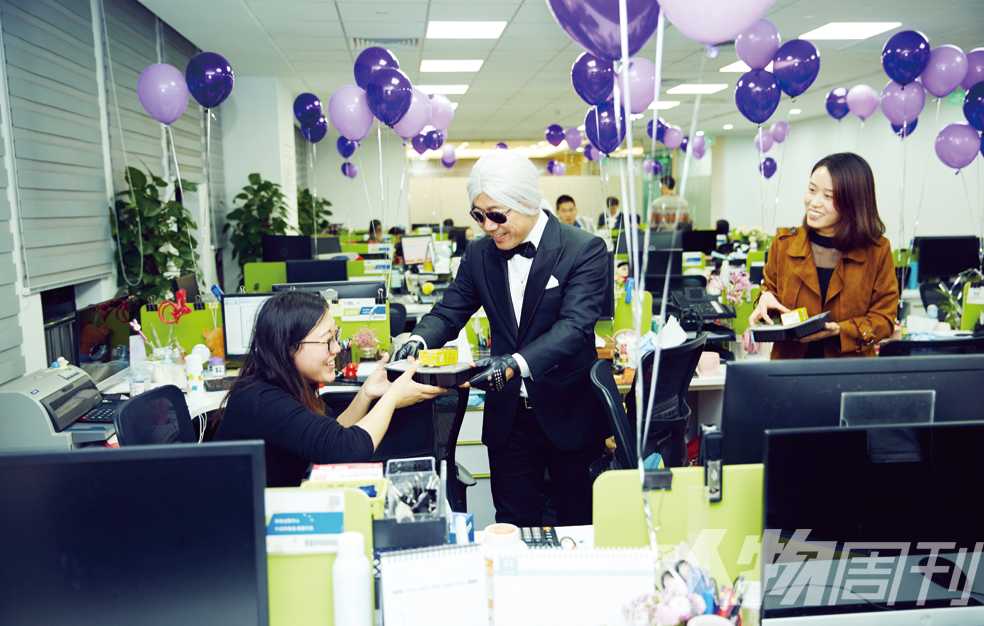
At Baozun, the chief executive has been known to help with the catering. On Singles’ Day in 2013, Vincent Wenbin Qiu put on a chef’s outfit and joined his senior managers in handing out boxed meals to employees working through the shopping festival. The meal service became a recurring tradition. There are grander ways to announce that you understand service. Few are as immediately useful to someone who is hungry.
Qiu’s career has taken him from electronic engineering to enterprise technology, from supply chains to online storefronts, and eventually into the business of running Gap in China. The change in merchandise is conspicuous. The underlying question has remained remarkably practical: how do you get all the parts of a retail operation to work together?
Today he is Baozun’s founder, chairman and chief executive, still leading the business he started in 2007. Its work reaches well beyond the checkout button. A brand may need technology, marketing, customer service, warehousing and fulfillment before an order becomes a satisfied customer. Qiu has spent much of his working life around those connections.
The engineer arrives at the counter
He graduated from Tsinghua University with a bachelor’s degree in electronic engineering in July 1992. Between 1993 and 2000, he worked in technical architecture and management at multinational companies including NCR, Hewlett-Packard China and Sun Microsystems. This was a professional education in systems: the architecture behind a business, rather than the advertisement in front of it.
In 2000, he helped found Erry Network Technology in Shanghai. The company provided supply chain management solutions and services to consumer brands in China. He served as its chief executive from March that year until January 2007. Baozun followed later in 2007, bringing his experience with software and supply chains into brand e-commerce.
The dates matter. Qiu had already spent years dealing with enterprise technology before founding the company for which he is now known. Baozun grew out of a career spent solving operational problems for other businesses. Its founder’s route to retail ran through the machinery that makes retail possible.
By 2010, he was explaining the need to learn from a rather different institution: Walmart. He admired its attention to detail, including the expectation that employees acknowledge nearby customers and respond promptly to requests. An internet company could learn something from a shop assistant. The software alone would not supply the manners.
In the same interview, Qiu described an approach to money that sounded closer to traditional retail than to an internet land grab. He wanted to earn while building the business, rather than spend for years and work out profitability later. He also acknowledged the company’s software origins and the need to absorb the practices of experienced retailers. The technical foundations were useful. Learning to serve customers was another discipline.
A long apprenticeship in other people’s brands
In 2010, Qiu faced a room of 11 Alibaba executives in Hangzhou, including Daniel Zhang. He explained Baozun’s plans for technology investment and the market. The discussions helped lead to Alibaba’s investment. It was a consequential meeting for a founder whose company occupied the space between brands and the platforms on which they wanted to sell.
The less theatrical part of that business was its daily repetition. Store operations, customer questions and the movement of inventory all had to function together. Baozun’s integrated offering connected these tasks, with IT services and digital marketing alongside warehousing and fulfillment. The customer saw a brand’s shop. Baozun worked across the processes that kept it running.
The company listed on Nasdaq in 2015 and in Hong Kong in 2020. Those milestones put Qiu’s business in two public markets. They also extended the audience for his decisions: alongside brand partners and employees stood shareholders expecting an account of what the operation was earning and where it was going.
“Our DNA is all about being steadfast.”
Vincent Qiu, 2023 interview
Growth created some distinctly physical complications. By November 2021, Baozun was holding an earnings call from a new headquarters. Qiu explained that the business had spent years spread across several offices as it expanded. Bringing people together was a milestone in itself. The new home had a suitably hopeful name: Baozun New One.
For a business associated with digital commerce, the detail is pleasingly tangible. Its people still needed somewhere to sit together. Qiu told investors that sharing a location would help collaboration and the company’s culture. The founder was dealing with a familiar consequence of building an organization: eventually, people who work together need to be able to find one another.
Then the shop became his responsibility
In a 2023 interview, Qiu looked back on a beginning that had required two years of exploration. Some experiments failed. Relationships, systems and a team accumulated along the way. He divided the company’s development into stages, with rapid growth beginning in 2009, followed by a period focused on the quality of growth as the market slowed.
He described 2023 as another transition: Baozun was expanding its model into brand management and international business. He also acknowledged how much the job had changed personally. In the early years, he had taken on everything himself. By then, he could point to an experienced team sharing the work. His description of expansion included the need to persevere when tasks were still undefined.
On February 1, 2023, Baozun completed its acquisition of Gap Shanghai and began running Gap’s operations in mainland China, Hong Kong and Macao. Agreements with Gap provided exclusive rights to manufacture, market, distribute and sell its products in Greater China, with local creation capabilities. The arrangements provided an initial ten-year term and two possible five-year renewals.
Qiu now had a different kind of responsibility. Managing a brand meant dealing with product choices and a physical store network as well as digital channels. Sandrine Zerbib led Baozun Brand Management at the acquisition’s completion, while Wing Xiao was appointed chief executive of Gap Greater China. The expansion depended on people with retail and brand experience, alongside Baozun’s technical capabilities.
A broader operating remit, with more decisions meeting in one place.
Nearly 70 systems, one shop
The engineering problem inside the acquisition was considerable. Baozun’s technology team consolidated nearly 70 historical Gap systems into an integrated Retail Operating Platform. Qiu described the work in his 2023 chairman’s letter. The platform connected online and offline inventory and enabled real-time management through a centralized architecture.
There is a dry beauty to that number. A customer choosing an item has little interest in the number of systems consulted on the way to finding it. For the operator, those connections affect whether stock is visible, available and moving efficiently. Qiu’s old professional territory had followed him into the clothing business.
Hunter provided a second route into brand management. Baozun had already worked as its e-commerce partner in China before entering a partnership with Authentic Brands Group in 2023. The arrangement extended into rights to operate the brand and a joint venture concerning its intellectual property in Greater China and Southeast Asia. Again, an existing service relationship became something more involved.
Qiu’s international ambitions also required adapting to different markets. By 2024, Baozun had introduced Hunter in Singapore and Malaysia. His company was building a regional organization while developing its newer brand business. The expansion carried an ordinary but demanding requirement: an operating model needs people and infrastructure wherever it goes.
The letter he wanted to write himself
In April 2026, Qiu opened his shareholder letter with an unusually personal editorial note. He had written it himself, without AI. He used AI every day, he explained, and wanted the company to deploy it widely. For communication with customers, colleagues and investors, he preferred a human approach.
He also acknowledged that the move into brand management had involved limited experience, challenges and mistakes. Gap China reached its first quarterly breakeven in the fourth quarter of 2025, after three years of repositioning and localization. He presented that result as evidence that the new model was working, and set out a further period of expansion from 2026 to 2028.
His ambitions had become more specific: improve margins and efficiency in the established e-commerce business, build scale in brand management, and find opportunities where the two could work together. The next phase would rely mainly on developing existing brands, with new additions considered selectively. Growth had acquired a more detailed job description.
By August 2026, Baozun reported second-quarter net revenue of RMB2.743 billion and operating income of RMB63.4 million, compared with an operating loss a year earlier. Brand Management revenue rose 22%. The company raised its 2028 annual non-GAAP operating income target from RMB550 million to at least RMB700 million. That remained a target, dependent on future performance.
Group net revenue · scale: RMB 0–3bn
Qiu discussed AI and automation experiments as part of that outlook. The practical applications included streamlining work in Gap’s e-commerce operations. In the earnings discussion, management emphasized operational efficiency. For someone trained to think about systems, the attraction was consistent with earlier work: remove friction from a process repeated across a large operation.
In September, Baozun’s board authorized a new share repurchase program of up to US$10 million over 12 months. It was another public-company decision added to a career that began with technical architecture. The responsibilities had multiplied; the operational details were still there.
Qiu’s education in retail continues inside the business he built. It runs through software, stock, people and the brands now entrusted to his company. And there remains something useful about that early Singles’ Day scene: when work stretches late into the night, service can begin with making sure the people doing it have dinner.