Vinayak Sharma learned something about delivery long before he had software to deliver. As a schoolboy in Himachal, he and his brother took fabric to the village tailor during the summer holidays. The uniforms arrived late. School, regrettably, declined to postpone itself. Few customer experiences are quite so memorable as trousers that have become an argument with your ankles.
In his recollection of those school days, the tailor resented reminders. A local barber offered the opposite experience: prompt visits, efficient work and conversation over tea. Years later, Sharma described their differing fortunes and asked what professionals owe the people they serve. The anecdote has a useful lack of grandeur. Nobody invents a new market. Somebody simply keeps an appointment.
Today he leads Byteridge, the software business he founded in Hyderabad in 2008. The scale and subject have changed. That small question about professional responsibility still makes a particularly good place to begin.
Leaving the large-company safety net
His route into entrepreneurship passed through a startup, Oracle and Microsoft. The Army Institute of Technology alumni network lists him in its 2002 computer engineering batch, alongside Byteridge. That is a compact educational entry for a career that would involve both writing software and persuading customers to entrust a business with its development.
Sharma’s attraction to a startup was the breadth of responsibility. Large organizations had given him experience of substantial systems; smaller ones offered direct contact with customers and the consequences of decisions. He founded Byteridge in May 2008, using services work to support the venture. An invoice has a useful advantage over a beautiful business plan: a customer may actually pay it.
By 2011, he was already questioning headcount as a measure of success. His early team’s systems had reached more than 10,000 users. The important thing, he argued, was useful work and its effect on people. The appeal of his early account of the business is its practical scale. He was talking about customers, experimentation and keeping the lights on. Those subjects tend to survive changes in fashion.
The customer calls back
The less theatrical part of a founder’s story is often the revealing part: what happens on the next assignment. One customer account of working with Sharma describes a relationship that predated Byteridge. The customer knew him as an employee and reached out after he became independent. Familiarity had become an opportunity to do business.
The work included website architecture, registration applications and support for a technology accelerator’s engagement with students. Sharma remained the main contact. The customer described him watching the work, preventing escalations and taking responsibility when required. These are modest verbs, and rather demanding ones. A company can announce its values in an afternoon; answering for a project takes longer.
For a founder, that kind of continuity changes the job. Technical judgment must travel through conversations, expectations and other people’s work. The relationship carries the company into a room. Delivery determines whether it receives another invitation.
A visit back to Himachal
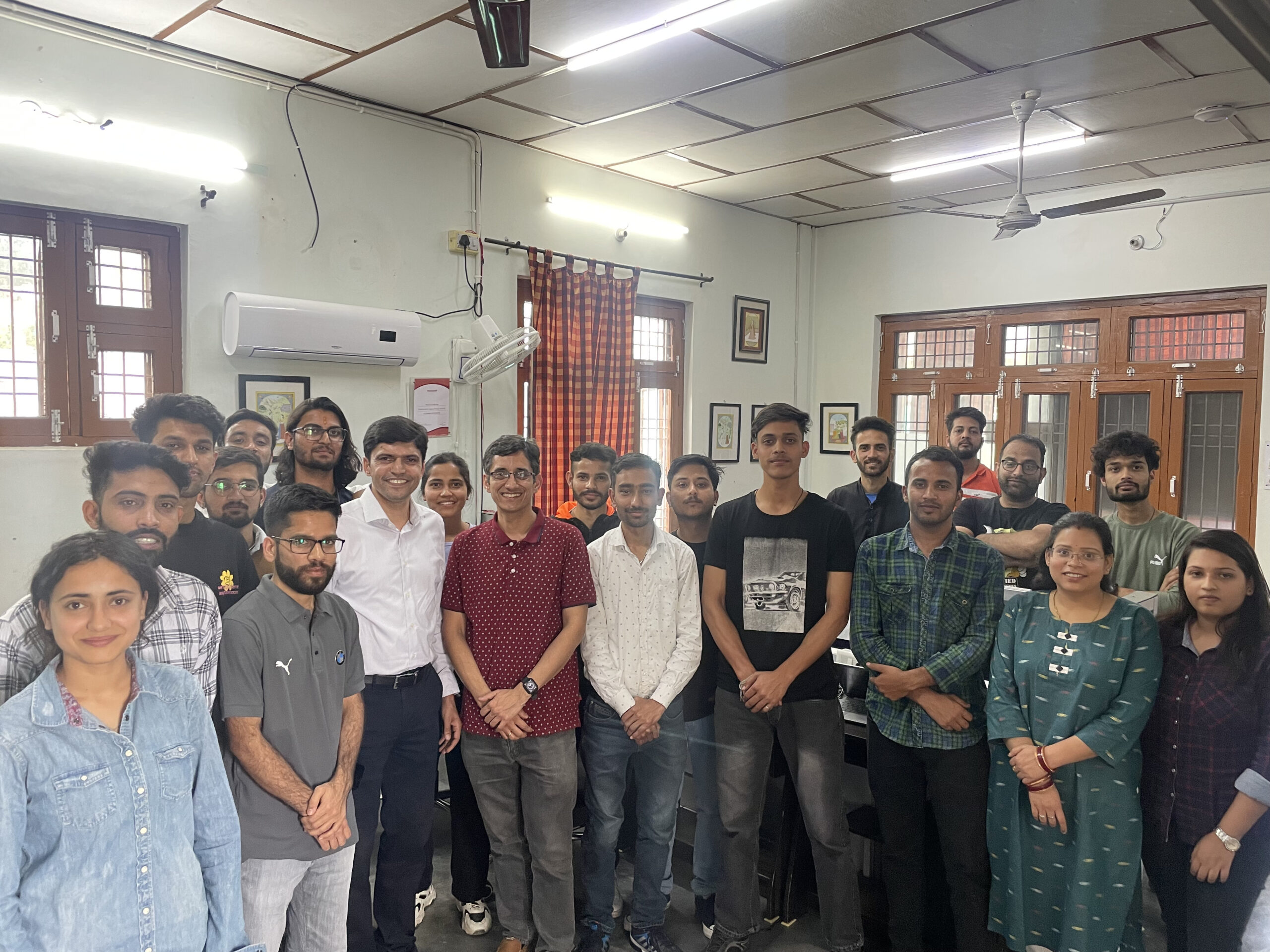
In 2023, Sharma visited Development Logics in Dharamshala. The connection was regional as well as professional: he is a native of Kangra district in Himachal Pradesh. The visit brought his experience at Oracle, Microsoft and Byteridge into conversation with another technology team close to home.
He shared lessons about the technology industry, keeping skills current and encouraging good work. His hosts also singled out his enthusiasm for ultramarathon running. It is an unusually apt extracurricular interest for somebody whose company was already well into its second decade. Running provides a subject for conversation without requiring anyone to open a slide deck.
The photograph from the visit offers a welcome change of scenery from corporate portraiture. Sharma stands with the team in an ordinary working room. There are windows, ceiling fans and a crowd making room for one another. A founder’s biography can be told through institutions; this moment supplies some people.
Two daughters, one useful correction
In a conversation with Byteridge’s leadership team, Sharma introduces himself through marathons and his two daughters. They periodically remind him that Papa does not know everything. Executive authority appears to have a rather shorter jurisdiction at home.
The exchange is funny because it interrupts the usual corporate introduction. Alongside him are CTO Ujwal Parker and sales and marketing leader Rajeev Aurangabadkar, whose interests include scuba diving and wildlife photography respectively. The conversation makes room for lives beyond job titles before turning to the company’s direction.
Sharma describes an ambition to build a digital product team known for the quality of its work. He is animated by colleagues taking on unfamiliar technologies and difficult problems. That is an aspiration rather than a trophy. It requires repeated choices about whom to hire, what to learn and how to work. His daughters’ contribution to the management curriculum is considerably shorter, and presumably harder to dispute.
“Papa you don’t know anything”
Sharma, recounting his daughters’ occasional verdict
The job description gives the game away
Hiring notices can be more informative than slogans. In an appeal for a VP of Engineering, Sharma describes a role spanning engineering, delivery, customer relationships and commercial responsibility. The brief refers to leading and scaling an organization of roughly 150 to 200 people. It is a description of the role’s scope, rather than an audited employee count.
The responsibilities extend to developing other leaders, managing engagement economics and maintaining technical standards. He asks for someone who can build a leadership layer. A founder who once dealt directly with small-team delivery now needs judgment to work through managers and architects.
A separate project-management hiring post emphasizes initiative, anticipation and care for outcomes. Sharma wants people who can handle ambiguity while balancing budgets, scope and time. The recurring idea is ownership. It is easy to admire in a candidate and costly to fake once the project starts. His public briefs make that expectation unusually concrete.
A distributed team needs a meeting place
Byteridge’s annual gathering is called Offline, a pleasingly literal name in the software trade. The 2022 edition reunited colleagues after two and a half years of remote working. Over three days, the team played games, held interactive sessions, recognized contributions and took a Hyderabad city tour.
There is a practical problem beneath the festivities. People who collaborate through screens need opportunities to know the person behind a message. A schedule can arrange a meeting; acquaintance requires a little less efficiency. Games and unhurried conversations supply what another status update is unlikely to deliver.
The gathering has continued. For Offline 2026, Sharma shared reflections on workshops, AI hackathons, achievements and the value of bringing colleagues together. The event took place in July at Pragati Resort in Hyderabad. It makes the company’s people emphasis visible in the calendar. Even a business devoted to digital products occasionally benefits from putting the laptops down.
The AI bill arrives after the applause
Sharma’s recent public writing about AI turns toward architecture and operating costs. He describes a familiar business trap: an AI product wins users, usage rises, and the expense of running it becomes uncomfortable. His concern is what happens after a working prototype has earned its approval.
He calls for planning around token consumption, infrastructure, usage patterns and scale before construction begins. He also asks whether particular features need AI at all. It is a useful question for the person who will eventually receive the bill. Enthusiasm seldom volunteers to manage accounts payable.
That attention to implementation appears in the company’s current work. Byteridge’s services include enterprise AI, product development, mobile applications and application modernization. At Deltek ProjectCon 2025 in Denver, the company promoted Sharma’s participation around AI and modernization. His conversation has moved with the technology, while retaining an interest in what customers must live with once the demonstration is over.
An alumnus, and a route for new builders
There is another connection to his college beyond a line on an alumni list. Byteridge sponsored the Innerve hackathon at Army Institute of Technology, Pune. The event brought aspiring developers together to work on problems and demonstrate their ideas. The company’s participation connects its professional world with people approaching it for the first time.
It would be convenient to give every such event a sweeping outcome. The smaller, visible fact is sufficient: a business associated with an alumnus supported a place where students could build. That is a concrete way for an institutional relationship to continue after graduation.
Sharma’s own career crossed environments with very different expectations. A college event offers participants a setting in which ideas meet deadlines and collaborators. There is room for technical ingenuity, and also for the less celebrated skill of making something work with other people. Both belong in the education of a builder.
Keeping the appointment
Byteridge’s leadership group now includes specialists across technology, sales, people and project delivery. Its public customer list spans names such as Microsoft, Philips, ADP and Tata. For Sharma, leading the company means working through an organization with more kinds of responsibility than any individual could sensibly keep on a personal to-do list.
That makes his childhood anecdote more interesting as the business grows. A customer experiences a company through particular encounters: a promised date, an explanation, a piece of work that does what it should. The organizational chart may be complicated. The experience can remain painfully simple.
Sharma has supplied enough of his own story to make the connection without dressing it up. There is a village in Himachal, a sequence of engineering jobs, a company in Hyderabad, colleagues to develop and customers to answer. His aspirations concern the team he can help them become. Somewhere behind the architecture discussions and hiring briefs sits a schoolboy waiting for his uniform. The deadline was clear. He had school on Monday.