The headphones are ready for an audition. A shopper can lift a pair, listen and decide whether the promise on the box survives contact with their ears. Underneath that apparently simple encounter sits a less glamorous assignment: keep the merchandise secure, make the electronics work, fit the store’s shelving and get the whole thing installed. Multiply that assignment by 1,500 stores and the fixture becomes a substantial manufacturing problem.
Victory Display & Store Fixtures MFG, based in Compton, California, took on that problem for JBL. Its published case study reports completing the rollout in 10 days against a planned 15. The mechanism was practical: coordinated subassemblies, preassembly and a separate crate for each display. Behind the illuminated brand name was a carefully organized journey to the sales floor.
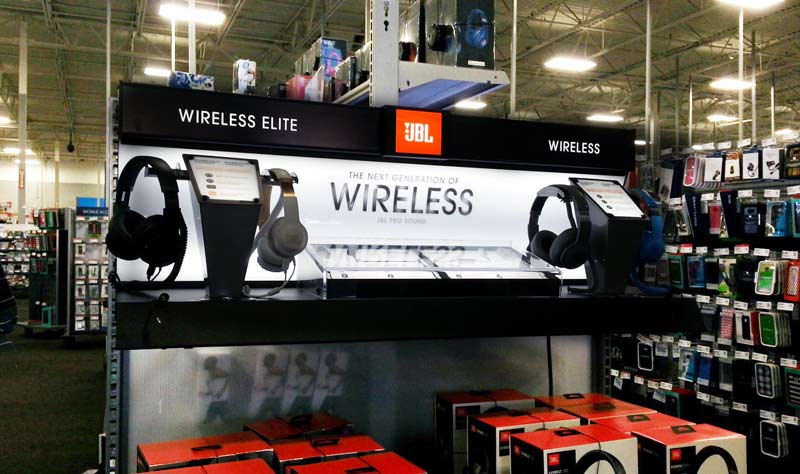
A sales pitch with a power cable
Victory works in point-of-purchase displays: the physical structures that help merchandise explain itself where buying decisions happen. Its portfolio ranges from countertop presentations to floor fixtures, wall displays and whole retail environments. Customers buy places to put products, but also ways to organize attention. A display must show what matters about a product while surviving the ordinary messiness of a shop.
The JBL assignment illustrates that combination. Working demo units had to arrive integrated into a secure, modular fixture compatible with existing gondola shelving. Graphics needed to be updateable. Victory developed a concealed construction for security and a backlit message area for the branding. The shopping interaction remained visible; much of the apparatus supporting it disappeared.
Five days ahead of plan. Figures are Victory’s reported project results; bars compare elapsed rollout time.
The company says early completion saved its client money. That is a useful outcome to consider alongside the fixture’s appearance. For a retail buyer, the relevant bill encompasses transport, setup and time as well as the object itself. A display that needs less work when it reaches the store changes the assignment handed to employees.
The partnership began with a purchase order
Victory’s origin is refreshingly commercial. Fred Berman and David Neutel operated separate Southern California distribution businesses in the early 1990s. They began purchasing together, gaining the combined volume to buy directly from offshore suppliers and pursue larger customers. Each also developed a small manufacturing operation, one in acrylic displays and the other in wood casework.
In 1999, they merged their businesses and bought Victory Distributing. Retailers’ demand for distinctive fixtures helped push the combined company further into fabrication, graphics and engineering. Its history describes an expansion of capabilities around what customers wanted to buy. The purchasing relationship became a business able to design and build more of the finished product.
That background still matters to its positioning. Victory offers domestic manufacturing, importing or a combination. Its metal division dates an overseas office managing factory relationships to 2006. Having a local workshop and knowing how to source elsewhere gives a buyer more than one production route to discuss.
Make the drawing answer to the workshop
Victory’s design process puts a pointed question before the glamorous rendering: can this actually be manufactured at an acceptable cost? Its engineering page describes a sequence from understanding the merchandise and the brief to a rendered concept, then a physical prototype for revisions before production. Electrical load planning sits alongside CAD drawings and color matching.
“What good is it to design something that’s impossible or too expensive to make?”Victory Display · Design & Engineering
That sequence is worth borrowing. A prototype is a place to settle how the display works before multiplying it. For a buyer, reviewing one should involve the people who will stock, clean, install and use the fixture. The attractive angle in a rendering is only one of the angles that will matter in a store.
The production vocabulary is broad. The woodshop lists CNC milling, laminating, contour cutting and assembly, with outputs including counters, guitar racks, platforms and showcases. The metal shop cuts, bends and welds. Its plastics operation cuts and bonds acrylic, finishes edges and uses lasers for cutting and etching. Those are different crafts brought to bear on the same merchandise.
Printing adds another connection. Victory describes flatbed UV equipment that prints directly onto materials including plastics, wood and glass, with routers to cut shapes and roll-fed equipment for vinyl graphics. An image can therefore be planned with the part that carries it. The practical advantage is coordination between the surface, the structure and the message.
Victory occupies the full-service end of a crowded market. Nashville Display, for example, also offers design, prototypes, fabrication and distribution. Buyers should compare the actual production plan, samples and installation responsibilities. Victory’s combination of material shops and interactive display work supplies concrete questions to ask, rather than a reason to assume every project belongs with the same vendor.
The watch display with a repair plan
For Michael Kors Access, the brief called for a display suited to big-box retail with high-end finishes, a video screen, straightforward installation and longevity. Victory placed a digital monitor into the base and illuminated the graphics with LEDs. The display presents watches within a composed branded setting, with moving imagery beside the physical products.
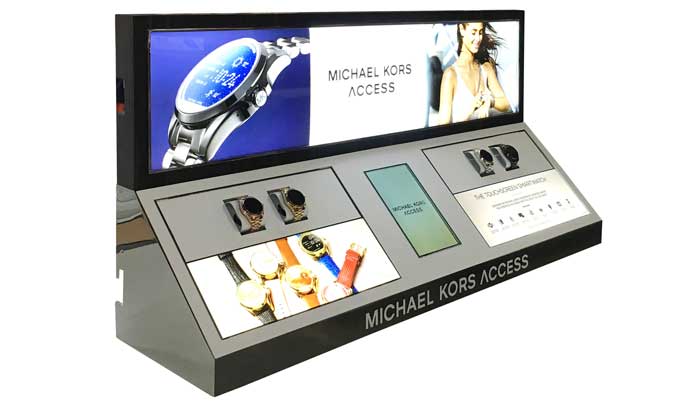
The interesting detail is access to the lighting transformers. Victory engineered them to be swapped out, and designed the fixture so products and messages could change without replacing the entire display. That makes maintenance part of the original design conversation. A buyer can copy the question immediately: which parts of this fixture will need changing, and how will somebody reach them?
This approach is especially relevant when the physical fixture is expected to survive several campaigns. Its value depends on that intention. A short-lived promotion with simple merchandise may justify a much simpler presentation. The decision turns on the job, the anticipated life of the display and the cost of keeping it useful.
The DJ booth is also a stockroom
Victory’s DJ Experience project tackled a different problem: letting shoppers use complex mixers while reducing an inventory-heavy assortment. The brief called for modular components with electrical and sound systems already integrated. Loss-prevention requirements still applied, so alarms and hold-downs had to protect equipment without disabling the experience customers came to try.
Several choices solved ordinary store problems. Hand-swirled aluminum back panels covered traces of earlier displays and wall damage. Cables were concealed. Merchandise for purchase sat beneath the demo counter. The customer could test equipment above and find the boxed product below, with the arrangement intended to work with or without sales assistance.
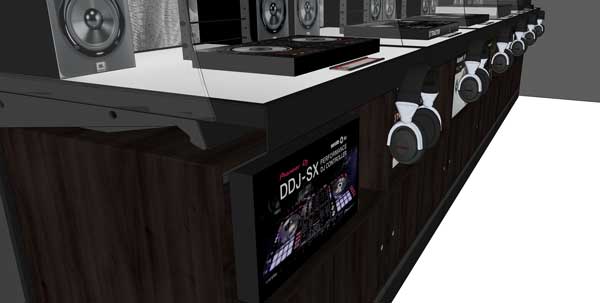
Victory reports a 12% increase in sales in test stores, reduced inventory costs and a subsequent chain-wide rollout. Treat that as the company’s account of a particular project. The transferable idea is the test itself: put the revised assortment and environment into stores, observe the result, then decide whether the design deserves a wider audience.
A display alone cannot make that result repeatable. The assortment, pricing, stock availability and shopper interest also matter. Nor does a usable demonstration happen simply because a screen has been added. Victory’s interactive offering covers wiring harnesses, circuit boards, touch controls, audio and power requirements - the infrastructure needed to make the interaction function.
Who owns the last ten feet?
Victory sells through project inquiries as well as stock offerings. A useful custom brief specifies the product, quantity, deadline, materials and dimensions. Those inputs give a manufacturer something concrete to price and engineer. Buyers should carry the same specificity into delivery: what arrives assembled, what needs power and who is responsible for putting the fixture into service?
The company’s logistics offering includes custom packaging, shaped foam, wood crating and store-level delivery. It advertises installation across the United States and Canada and describes working with installation service companies to reduce travel expenses. It also says it owns Gemtech Construction, extending its offering to retail improvement work.
Reporting is another part of the assignment. Victory describes retail support software for tracking field activity, including photographic evidence, and an installation service that can support simultaneous work across multiple cities. For the buyer managing a rollout remotely, confirmation that a fixture arrived and confirmation that it is working answer different questions.
Recent public posts show the same concern at smaller scales. Victory has highlighted a Guitar Center podium with few parts and clear instructions. It has also announced an acrylic, three-tier stand holding up to 18 LEGO minifigures, with pegs machined into the acrylic. Even a collector’s shelf poses the familiar question: how do you keep the product where it belongs?
The most useful way to approach Victory is with a real product and a specific retail problem. It might be a headphone that needs hearing, a watch campaign that needs updating or a mixer that needs playing without walking away. The fixture succeeds when the shopper can do the intended thing and the store can keep it ready for the next person.
Visit the workshop, virtually
Explore Victory Display’s website, its JBL project, Michael Kors Access display and DJ Experience.
Follow company updates on LinkedIn, Instagram, Facebook and X, or visit its YouTube channel.