The mural stayed. In Akron, Ohio, where Chapel Hill Mall once sent shoppers toward JCPenney, a painting called The Four Seasons now looks down on the work of making retail displays. The customers have gone elsewhere. The business of helping them shop has moved in. For Paul Chapuis, founder and CEO of OnQ, this is a satisfying turn of events: an old place of commerce finding work in the service of new ones.
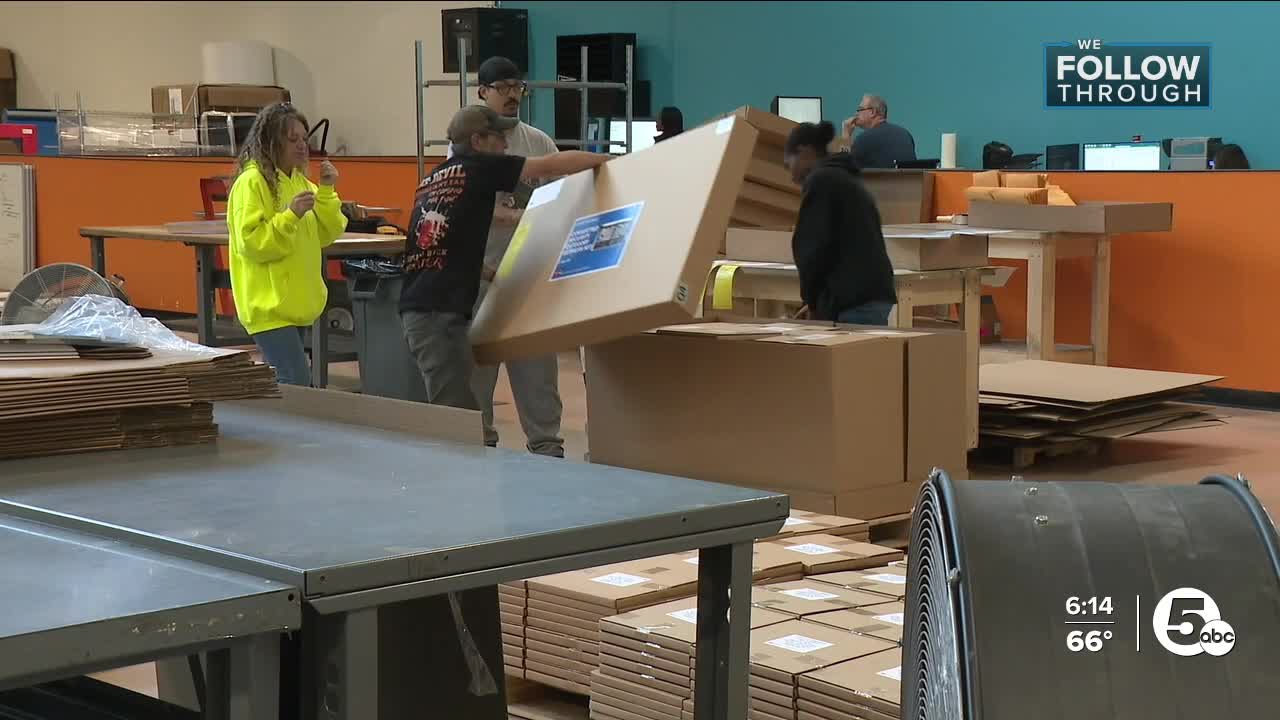
Chapuis wanted to keep the mural. “Everyone that looked up at the mural remembered it,” he said. His company had moved its manufacturing and production operations into the former mall, now Chapel Hill Business Park. Beneath that familiar artwork, employees build and package the structures that introduce products to shoppers. A building associated with retail’s retreat has become part of its supply chain.
There is an appealing symmetry here. Chapuis has spent years working on the space between a product and the person considering it. That space can be a few inches of shelf, a tablet, a security bracket or a piece of explanatory content. In Akron it has acquired the dimensions of a former department store. He seems to enjoy the change of scale.
A guest room with commercial ambitions
OnQ began in 2004 in the guest room of Chapuis’s California house. Fifteen years later, when the company appeared at number 3,808 on the Inc. 5000 list, he marked the distance between those two addresses in a short public post. The celebration was characteristically sociable: he thought the occasion deserved a toast. A guest room is a modest starting point for a company whose output eventually has to survive the bustle of major retail chains.
He came to the business with experience on the brand side, directing retail channel marketing for Kodak, Gillette, Adobe and Logitech. The jobs put him close to a recurring commercial puzzle: products can be complicated, and the moment of choosing one is often hurried. A display must help someone understand enough to make a decision while also satisfying the people paying for it.
Chapuis’s earlier career wandered further. He built rustic patio furniture, marketed a rock radio station and worked as a professional stilt walker in a circus troupe. He has compared that last occupation with being a CEO. The comparison is his; the image rather looks after itself. His education took in philosophy and sociology at the University of Saskatchewan, with further study in Quebec City and Montpellier.
The range makes an amusing biography, but the everyday task at OnQ is precise. An object has to be designed, made, delivered and used. The furniture maker and the marketer both have something to contribute. The performer might reasonably ask whether anyone is paying attention.
The shopper has a question
The work becomes easier to understand at Fred Meyer. In 2019, OnQ tackled an electronics department with a practical constraint: the retailer did not have dedicated consumer-electronics salespeople to answer technical questions. It also wanted to retain its existing display structures. Chapuis’s team had to make useful guidance fit the store that already existed.
The solution used four tablets on rails. A customer slid a screen in front of a product and the relevant information appeared. Specifications and explanatory videos sat beside the merchandise they described. The shopper could send the experience to a personal phone and continue considering the purchase later. The existing fixture remained, while the way people learned from it changed.
This is a revealing example of Chapuis’s field of work. The interesting decision happens before the machinery arrives: what does a person standing here need to know? A touchscreen has little to offer if it merely relocates confusion from a cardboard label to a glowing rectangle. The value comes from making the next step easier.
Chapuis addressed that problem directly in his 2019 writing about retail technology. He argued that retailers should define the engagement they want before choosing a system. A sale may be the objective. For a more involved purchase, education or an eventual consultation may be the useful next step. Agreeing on the purpose can be harder than specifying the equipment. Anyone who has sat through a meeting about adding a screen may recognize the distinction.
“They can touch and try it.”
Paul Chapuis, on what a store display lets shoppers do
Physical shopping offers that elementary privilege. A customer can handle something, judge its scale and see how it works. Chapuis’s business adds the explanation around the object, then deals with the less glamorous business of keeping the explanation running. Design and engineering lead into production, installation and continuing support. The encounter on the shop floor depends on work the shopper will never see.
Giving the screen a memory of the stockroom
In 2014, Chapuis co-founded Converge Retail to connect the informational depth of online shopping with the physical encounter in a store. The problem has continued to develop. A useful display needs current content, functioning devices and a way for the people operating it to understand what customers do. At a 2023 retail presentation, he identified device management, content management and feedback loops as three requirements for deploying technology at scale.
That is a fairly sober list for a business associated with attention-grabbing displays. It is also where an installation becomes an ongoing responsibility. The screen that worked at launch must still work after a promotion changes, a product is replaced or a remote connection becomes unreliable. Across many stores, a small maintenance problem gets plenty of opportunities to repeat itself.
What does it do?
in this store?
and choose
and manage devices
By October 2025, OnQ was integrating Epson receipt printers into its Converge Take-a-Ticket kiosks. Instead of relying entirely on pre-printed fulfillment cards, customers could select an item and print its information for checkout. Availability could be reflected digitally; the system also connected with ecommerce options. A small printer had a place in the plan because a purchase still needed a practical route to the register.
In May 2026, OnQ announced another connection: Converge could integrate with IBM AS/400 inventory systems. The company said the capability had moved beyond a pilot and was deployed across 610 Costco clubs in the United States. Displays could suppress unavailable items and align promotions with actual stock. Chapuis’s stated ambition was to connect inventory and operations with the customer’s experience.
The significance is wonderfully ordinary. A customer may enjoy learning about a product, but availability remains a persuasive feature. Connecting the two saves a store from delivering an elaborate introduction to something it cannot sell. For Chapuis, the display’s job now extends beyond explaining an object to knowing whether the store can fulfill the promise.
A company is also a gathering
Chapuis has another public role: host. OnQ OnAIR brings him into conversation with people who build brands, stores and businesses. The guest list includes WANT Branding founder Jonathan Bell, former Apple retail leaders Steve Cano and Ron Johnson, and entrepreneurs working in technology and entertainment. The series gives a retail display company an unusually conversational window onto the people behind commercial environments.
Names, layouts and product demonstrations all affect how a business becomes legible to the public. Those subjects sit comfortably together in his interview series. Chapuis makes room for accounts of how decisions were made, including the early history of Apple’s stores. The person commissioning a display might find the hardware interesting; the person hosting the conversation wants to hear how the idea came about.

His regard for the people around him appears in a remark about his own success: “It is the sum total of the people around you who make you.” OnQ’s growth gives that thought a practical setting. A design business with production operations needs colleagues who can carry an idea through many different kinds of work. The founder’s enthusiasm has to survive contact with drawings, deadlines, boxes and trucks.
There are public milestones along that route. OnQ reached the San Francisco Business Times Fast 100 again in 2023, its third appearance on the list. In 2024, Chapuis spoke to an international gathering of entrepreneurs at Hotel del Coronado about starting his company after immigrating to the United States. The guest room had become a story he could tell other founders.
What the old mall kept
Back at Chapel Hill, the building carries stories that predate OnQ. Adam Berkley, the company’s senior director of operations, had his first date with his wife at the mall. Other employees remembered visiting as children. Their new workplace occupied a place already furnished with personal associations. Keeping the mural allowed a visible piece of that history to remain in daily use.
At the October 2024 opening, Chapuis gave a buoyant video tour of the new facility. Families and neighbors had joined the celebration. His pleasure in showing people around was plain. After years of helping other businesses arrange encounters between people and products, he had a large new space in which to arrange encounters of his own.
A former stilt walker might be expected to appreciate a room with generous clearance. Chapuis has found something else to appreciate as well: the chance to keep an old retail building busy. Under the mural, the next display is being packed for another shop floor, where someone will stop, look and try to decide.