Company ◆ Climate & Synthetic Biology
The Fuel Startup Betting a Molecule Can Just Float Out of the Tank
Most biofuels get stuck in the same trap: make the alcohol, then spend a fortune pulling it out of the water. A four-person Houston team engineered a yeast whose product simply volatilizes away - and they think that changes the math.
Every biofuel company on earth is fighting the same quiet enemy, and it is not oil companies or regulators or public opinion. It is water. You grow some sugar, you let a microbe eat it, and the microbe hands you back a thin, watery soup with your fuel dissolved inside. Then you spend an enormous amount of energy and capital boiling that soup down to pull the fuel out. That separation step - not the biology, not the chemistry - is where a lot of good ideas go to die on a spreadsheet.
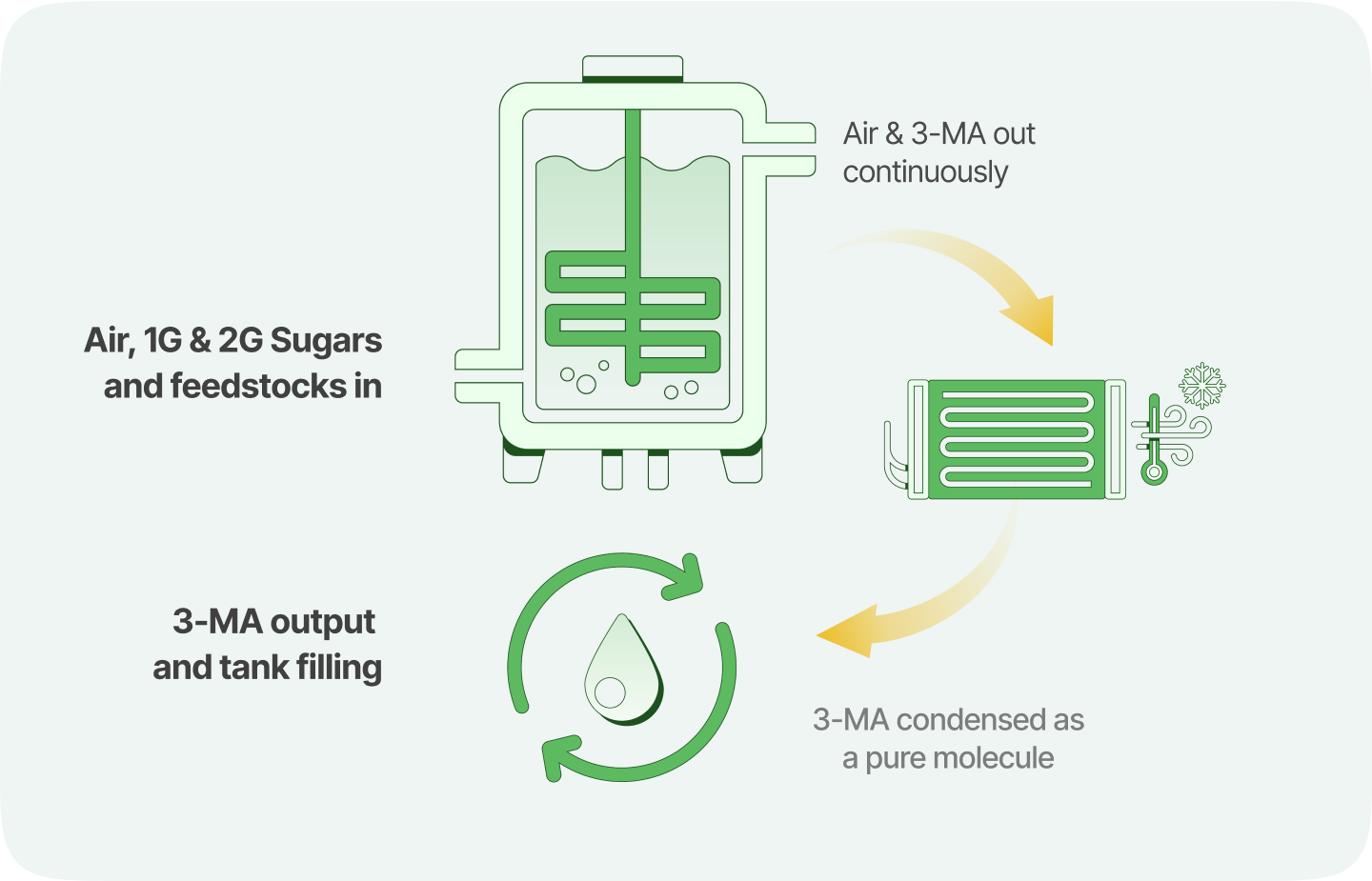
VIA BioFuels, a small company headquartered in the Houston suburb of Nassau Bay, decided to attack that problem from a strange angle. Instead of building a better still, they engineered a molecule that separates itself. Their yeast produces a bio-aromatic called 3-methylanisole - 3-MA for short - and 3-MA has a useful bad habit: it is hydrophobic and volatile, so it evaporates out of the fermentation broth on its own. VIA catches the vapor, cools it, and condenses it back into a high-purity liquid. No distillation column. That is the whole pitch, and it is a better one than it sounds.
“A pure molecule, a cleaner future.”
VIA BioFuels company tagline01What VIA actually does
VIA BioFuels was founded in 2023 and describes itself plainly: it produces and sells premium drop-in fuels and chemical feedstocks to the transportation, aviation, and chemical industries. “Drop-in” is the operative word - the whole point of the molecules VIA makes is that they slot into existing engines, aircraft, and chemical plants without anyone having to swap hardware or rebuild a pipeline.
The engine of the business is a proprietary, genetically engineered strain of Saccharomyces cerevisiae - the same species that ferments beer and bread. VIA reprogrammed it to eat ordinary ethanol-plant feedstocks (starch, sugar, and cellulosic sugars) and excrete 3-MA. Because the molecule volatilizes as it forms, the reaction can run as a continuous process rather than the stop-start batch cycle most fermentation relies on. The company says its process is less expensive than ethanol fermentation and yields a higher-value product.
02Why the evaporation trick matters
To appreciate why this is clever, you have to understand what ethanol producers put up with. Ethanol dissolves happily in water, so getting a marketable product means distilling it - heating the whole batch to separate alcohol from water. That is energy-hungry, and it caps how concentrated the fuel can get. Ethanol is also toxic to the very yeast making it, so batches poison themselves and have to be stopped, drained, and restarted.
3-MA sidesteps all of that. It does not stay dissolved and it does not build up to toxic levels in the broth, because it keeps leaving as vapor. That means the yeast keeps working, the tank keeps running, and the captured product comes out clean. VIA reports 3-MA carries more than 150% of ethanol's energy density and exceeds gasoline - so each gallon is worth more, before you even count the savings on separation.
3-MA is produced through continuous fermentation and a simple capture process made possible by its unique volatilization feature and stability as it naturally exits the broth.
VIA BioFuels, on its process03One molecule, five markets
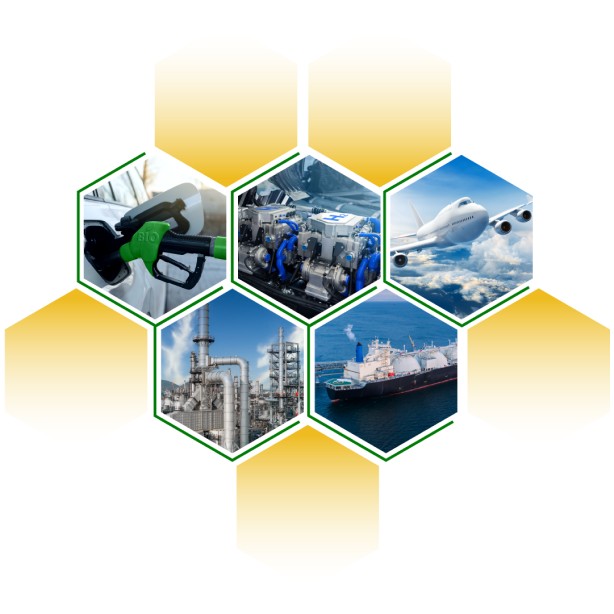
Here is the part that turns a chemistry demo into a business. 3-MA is not a dead end - it is a hub. Through single-step catalytic conversions, it becomes methylcyclohexane (MCH), a hydrogen carrier and fuel component, or toluene, a gateway into the BTX aromatics that feed both fuels and plastics. So the same fermenter output can be pointed at very different customers.
Line up the end markets and the addressable surface is wide: gasoline replacement, sustainable aviation fuel, hydrogen transport, chemical feedstocks for BTX, and para-xylene for PET plastics. VIA cites a US market opportunity north of 100 billion gallons. The bar chart below is a rough sketch of how far each of those doors is from a fuel-grade aromatic - not a forecast, just the shape of the opportunity.
Illustrative routes from 3-MA to end markets. Bar length reflects directness of the pathway, not volume or revenue.
04How it's different from the alternatives
The obvious comparison is ethanol, and VIA's whole design reads like a list of ethanol's weaknesses turned inside out. But the more interesting contrast is with other advanced-biofuel and synbio players - companies like Gevo, LanzaTech, or the Amyris school of engineered fermentation. Most of them still finish with an energy-intensive separation and often need purpose-built capital to reach scale. VIA's argument is that self-separation plus existing infrastructure gets to the same place with less of both.
| Conventional ethanol | VIA BioFuels 3-MA | |
|---|---|---|
| Separation | Energy-intensive distillation | Self-volatilizes, then condenses |
| Run mode | Batch (self-poisoning) | Continuous fermentation |
| Energy density | Baseline | 150%+ of ethanol (reported) |
| Feedstock | Needs concentrated sugars | 1G, 2G, and dilute waste streams |
| End products | Fuel-grade ethanol | Fuel, SAF, H2 carrier, plastics |
There is also a quieter edge in the feedstock. VIA's continuous process can run on dilute agricultural waste streams that are too weak to bother making ethanol from - the kind of runoff a facility would normally pay to treat. Valorizing that waste turns a cost line into a supply line, which is about as good as a moat gets in a commodity business.
The cheapest input in the world is the one your neighbor is currently paying to get rid of.
The waste-valorization logic behind VIA's feedstock strategy05The team and the model
VIA is small on purpose - a four-person leadership team doing a lot with a little. CEO and co-founder Lewis J. Dutel is a mechanical engineer by training (University of Louisiana at Lafayette), which is a telling choice to run a biotech: the hard problem here is as much process and capture as it is biology. The science bench is deep, though. CSO Philip J. Barr, PhD earned his doctorate in organic chemistry at UCSF; EVP of Chemistry Charles K. Marlowe, PhD did his at UC Berkeley. CFO Brent J. Konstanzer brings a civil engineering degree from LSU and an MBA from Rice.
The business model is straightforward B2B: sell 3-MA and its derivatives as drop-in fuels and feedstocks, with initial production at VIA's Houston facility and partner sites generating early revenue. The scaling thesis is the elegant part - rather than build greenfield refineries, VIA aims to deploy its process inside existing ethanol infrastructure, borrowing the capital-heavy plant that already dots the American Midwest.
06Where it fits, and where it might not
VIA has moved through the right rooms for a company this young. It was incubated by IndieBio (the SOSV biotech accelerator) and is a Greentown Labs alumni member in the transportation sector, with ties to BioWell and Capital Factory. In 2024 it raised a convertible note while targeting a roughly $2.0M seed round, with investors including IndieBio/SOSV, Vectors Angel, and First Bight Ventures. In 2025 it was named to the inaugural cohort of the Agventure Downunder program, extending its feedstock hunt toward Australia.
The honest caveats are the ones any early deep-tech reader should hold. The energy-density and cost claims are the company's own and worth watching as third-party data arrives. Self-separation is elegant at bench and pilot scale; the real test is whether the economics hold when the fermenter is the size of a building and the catalyst has to run for years, not weeks. And “drop-in inside existing ethanol plants” is a lovely thesis that still has to survive its first commercial retrofit. VIA's bet is that the chemistry does the hardest part for free. The next few years are about proving that the factory agrees with the flask.