The first obstacle was language. Vertex Network wanted to put demanding digital experiences within reach of ordinary devices. Yet its early website, according to the agency that rebuilt it, was in Chinese. For someone who could not read Chinese, the promised removal of hardware barriers came with a rather immediate barrier of its own. Before the company could explain a different kind of computer network, it had to make itself understood.
- Developers bring applications. Suppliers bring GPU capacity.
- Users reach the experience through a browser.
- The difficult part is making those three interests work together.
That small mismatch is a useful entrance into Vertex. The company’s 2023 proposition concerned access: who gets to use sophisticated software, who supplies the machinery, and how the two find each other. Born out of Vertex Labs, it positioned itself around decentralized edge rendering and AI computing. Its most interesting question was pleasantly concrete. Does using an expensive computer require owning one?
01 / The arrangementA computer on the other side of the glass
Vertex described three constituencies. Developers would contribute applications; GPU providers would contribute processing capacity; users would open experiences in their browsers. The proposed benefit was a change in where the heavy work happened. Instead of asking every participant to arrive with capable hardware and installed software, the platform would organize remote resources around the application.
Its announced services spread that arrangement across several jobs. Edge Desktops addressed remote work and creative tasks. Edge XR concerned immersive environments. Edge Hosting covered computational resources, while Edge Distribution addressed delivery. The App Store supplied the front door. Together, these were an attempt to connect the machine room to the moment someone clicked an application.
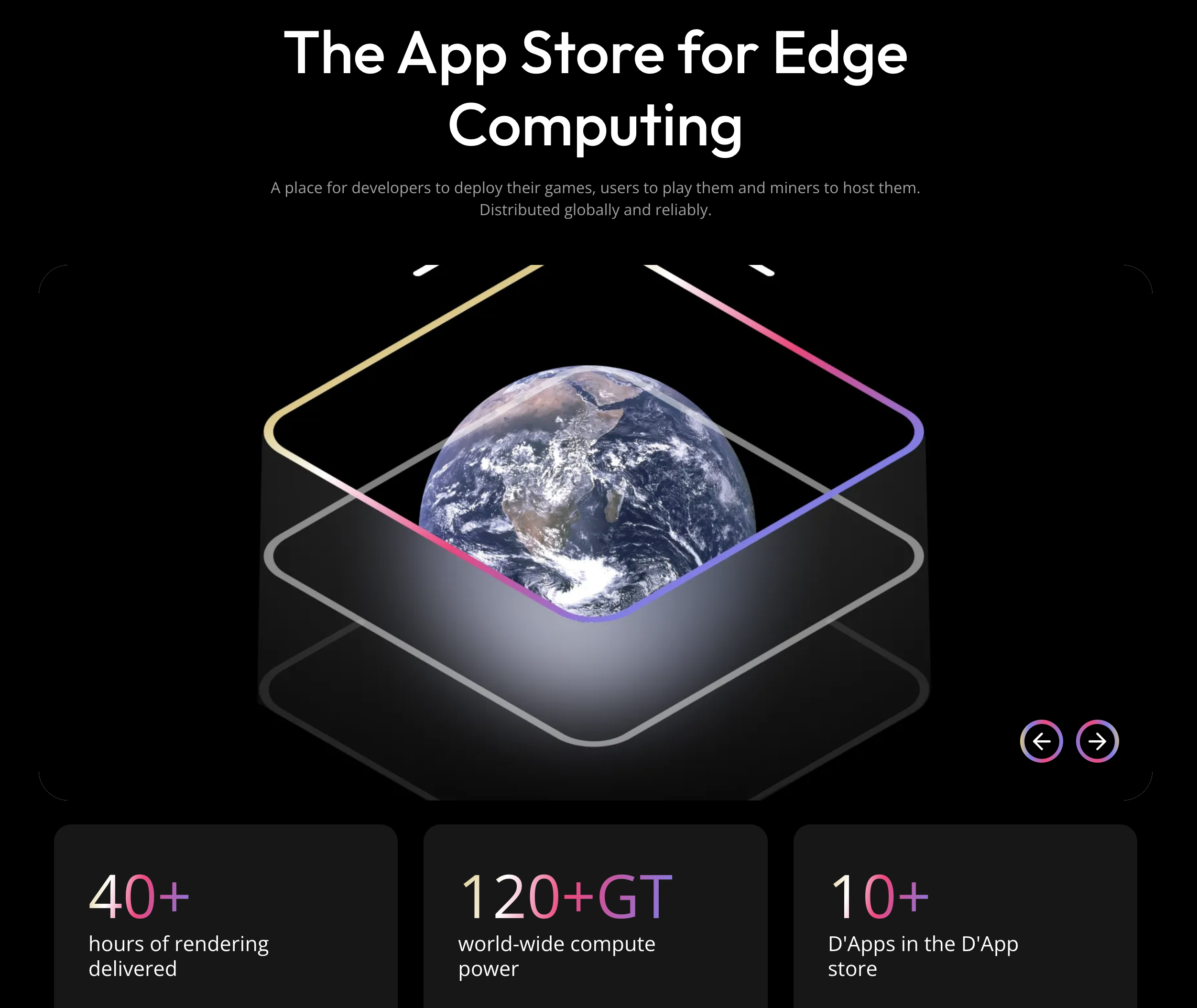
Consider the developer’s problem. A beautifully built virtual environment is commercially awkward if reaching it requires a purchase, a large download and a patient afternoon. Moving work away from the visitor’s device could reduce that friction. It also transfers responsibility to the service operating between the developer and the visitor. Someone still has to keep the experience running.
The creator supplies the application. Distribution becomes part of the product experience.
Conceptual flow based on the 2023 platform description.02 / A public testThen Robbie Williams entered the picture
In September 2023, Vertex took its proposition to EDGE Summit in Hong Kong. Vertex Labs’ account of the event describes the network showing its AI computing and rendering work. More memorably, the summit organizer’s subsequent account credited Vertex with real-time rendering for Robbie Williams’s digital image and stage during a virtual performance of “Rock DJ.”
A pop performance makes an infrastructure pitch unusually legible. The audience can see the result without reading a specification. There is a performer, a world around him, and an experience delivered to a screen. For a company talking about virtual environments, this was a more immediate illustration than a diagram of machines.
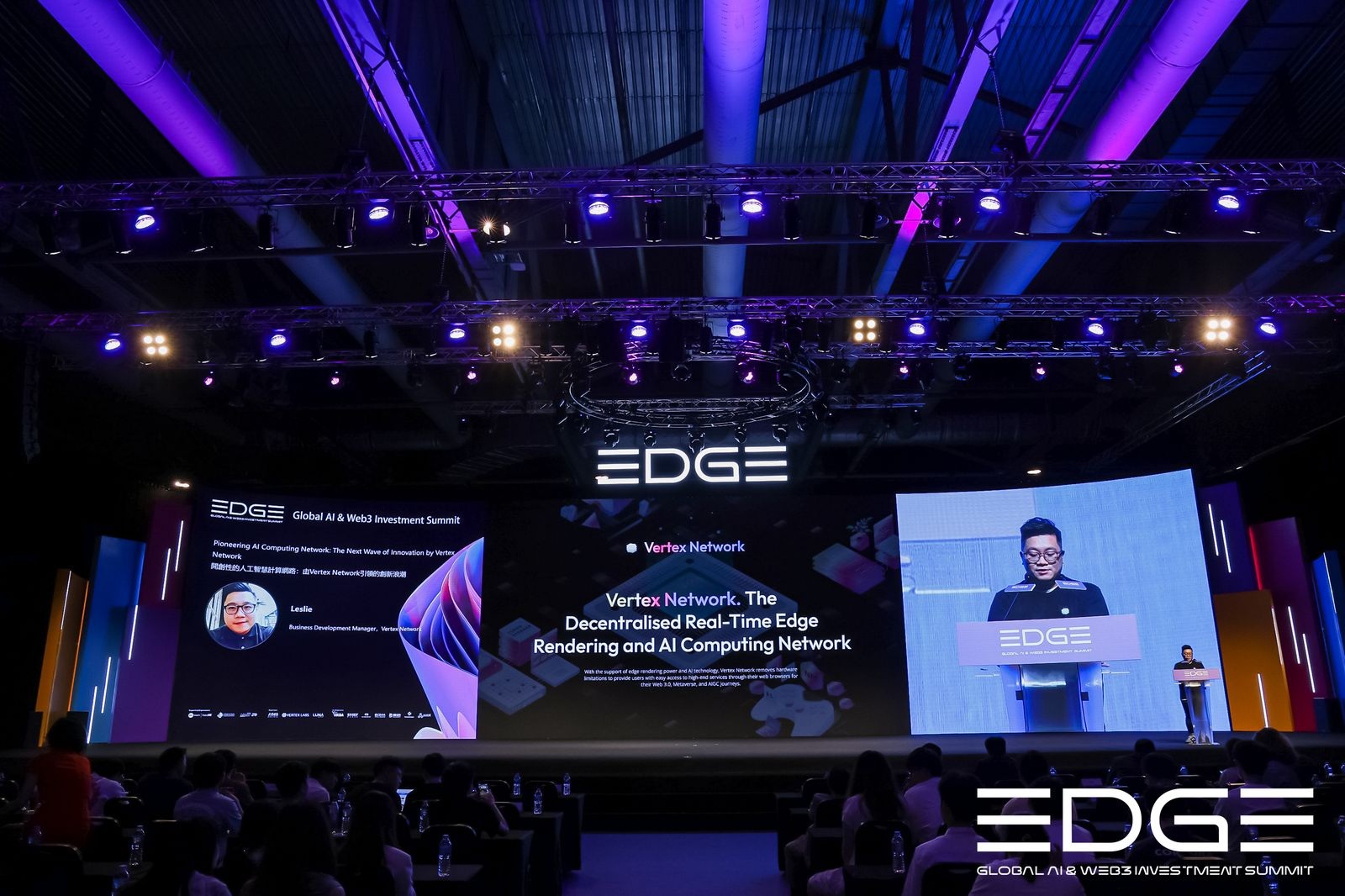
The sensible interpretation is specific: the organizers described an identifiable rendering use case. A staged demonstration and an everyday service answer different questions. One shows what an arrangement can produce under its event conditions. The other must repeat the result for people arriving at unpredictable times, from unpredictable places, with unpredictable connections.
The development sequence also matters. An October 2023 interview dated operations to early 2022 and described hardware allocation, testing and a scheduling system called RAAS. A second version was then approaching release. Read as a sequence, the work points toward coordination: getting available machinery to serve the right application at the right moment.
03 / The hard economicsSomebody pays for the pixels
The operating instructions describe hourly resource charges, supplier deposits and configurable income allocation. They also describe administrator review before resources are deployed. This gives the marketplace a more physical character than the phrase “idle computing” suggests. Equipment has to qualify, connect and be managed before it becomes useful supply.
For a supplier, the useful calculation is income after electricity, connectivity, maintenance and time without a paying workload. For an application owner, it is the cost of a completed, usable session. These are ways to evaluate the proposition, rather than reported Vertex results. Cheap capacity has limited value when getting it to the customer consumes the saving.
“developers share innovative applications and hardware owners monetise computational resources”
VertexNetworkUK · August 2023
The market contains overlapping alternatives. Render Network organizes distributed rendering; Akash offers a decentralized compute marketplace; Amazon GameLift Streams addresses interactive applications delivered to browsers. Vertex’s chosen intersection combined distributed supply with application access. The comparison turns on the job: finishing a render, renting infrastructure and sustaining a live interaction impose different demands.
04 / The useful lessonBuild the front door, too
Voltaire Labs’ project account describes separating Vertex’s public website work from its logged-in product experience. The agency handled design, descriptions and multilingual support while Vertex’s developers concentrated on the platform. That is a practical division other technical teams can copy: assign someone explicit responsibility for explaining the product to the person who has never used it.
Openfabric AI later listed Vertex among its November 2023 partnerships. It placed the project in a wider ecosystem of AI and Web3 services. Such relationships help explain its intended market: developers and creators who needed computing and distribution, alongside suppliers looking for work for their hardware.
The proposition depends on its conditions. An interactive experience needs suitable connectivity and available capacity close enough to respond well. A hardware provider needs sufficient demand to justify operating costs. A buyer with strict control requirements may prefer infrastructure it manages directly. Those constraints should shape any trial before a team commits an important workload.
The experiment worth copying is modest. Pick one application, one intended audience and one complete session. Measure the handoffs, the experience and the total cost. Vertex’s story makes that exercise interesting because it puts three groups around the same machine. Success requires each of them to have a reason to come back.