At LBank Labs’ Singapore gathering during TOKEN2049 in October 2026, guests could play poker and roulette between drinks and conversations. The company’s account described champagne, private hospitality and gifts. For a business associated with financing blockchain startups, the scene offers an unexpectedly useful opening question. What, exactly, is being built here: a portfolio, a community, or a room in which the right people finally meet?
- Two routes: invest in startups and in other venture funds.
- The scale: a publicly advertised $100 million fund.
- The pitch: capital, mentorship and connections that help builders reach a market.
LBank Labs makes the most sense when you follow the connections. Affiliated with cryptocurrency exchange LBank, it describes an investment operation that can fund a young company directly or commit money to another venture investor. The second route is the interesting one. A fund can hire more people to find opportunities. It can also build relationships with people who are already looking.
Buy a seat at more tables
In June 2023, Labs announced an investment in Collab+Currency, a crypto venture fund focused on early consumer and cultural technology. The following month, it announced an investment in Symbolic Capital, whose work included Web3 infrastructure and emerging-market founders. These were investments in fellow investors, adding another layer between Labs’ capital and the entrepreneurs ultimately building products.
That arrangement is called a fund of funds. For Labs, the stated ambition extends beyond financial exposure: participating funds can contribute specialist judgment, introductions and support for portfolio companies. It is a way to reach different corners of a sprawling market without pretending that one internal team understands every corner equally well.
There is a useful wrinkle in the paperwork. Labs’ current FoF page explicitly identifies investments made personally by investment committee members, independently of the firm’s collective decisions. A familiar logo on a network page therefore deserves a second look. The investor behind it may be the institution, or an individual who works with it. For founders mapping potential backers, that distinction matters.
A hundred million is a starting point
The website advertises a $100 million fund. That number describes investment capacity; it says nothing by itself about profits or realized returns. A January 2023 announcement placed the launch of the 100 million USDT vehicle in late 2022. An earlier company release described an investment institution founded in 2019. The recognizable story is an existing operation taking on a larger, more public mandate.
Capital to invest. Not annual revenue.
There have been narrower initiatives, too. In July 2023, LBank announced a $10 million MEME Special Fund, designed to make donations to qualifying early projects. Its criteria included project quality and influence, and applicants were asked to help promote the program. The announcement shows community development sitting beside conventional venture activity. An announced allocation, of course, should be read as an announced allocation.
Three words to get past the token
Labs calls its investment framework “Platform, Standard, Ecosystem.” The categories ask different questions. Can a project become a place people use repeatedly? Can it establish infrastructure others adopt? Can it attract outside developers and complementary applications? The emphasis moves attention from an isolated token toward the activity that might give a project staying power.
The public portfolio gives that language something concrete to stand on. Bubblemaps works with blockchain data visualization; LunarCrush with social intelligence; NAVI and Scallop with decentralized finance. Exabits and Hivello bring computing infrastructure into the picture. Labs occupies the financing and support layer around these businesses. Its offering to founders is investment, incubation and access, rather than a software subscription they buy.
Founders have alternatives: OKX Ventures and KuCoin Labs also offer investment and ecosystem support. Labs’ fund network gives its pitch a particular emphasis, but it is no exclusive claim on helpful relationships. The comparison should turn on which investor understands a founder’s problem and can actually help solve it.
The world is not on GitHub
Czhang Lin joined Labs’ investment committee in 2022 and was identified as its head in 2025 interviews. His earlier experience included PreAngel and JRR Crypto. In an interview published by LBank, he described a recurring founder mistake: assuming technically impressive work would somehow sell itself.
“They’re so deep in their code, they forget the world’s not on GitHub.”Czhang, interview published by LBank, August 2025
His proposed remedy was practical: marketing, community development, public relations and ecosystem introductions. He also described looking for sustainable revenue beyond token issuance, cohesive teams and regulatory adaptability. For a founder, the copyable lesson is to put distribution into the pitch. Identify who needs the product, how they discover it and which relationship would remove the next obstacle.
Labs describes itself as protocol- and exchange-agnostic. That positioning matters in a market where exchange affiliation can suggest a narrow orbit. Its promise is to consider projects across that orbit’s boundaries. Founders can approach through a public submission form; the stated process proceeds through expert analysis and a team meeting before funding. The useful preparation is a clear account of the business and its dependencies.
The network leaves the conference floor

By October 2026, the public story had widened. Labs’ Singapore announcement emphasized experiences for LBank’s VIP community and named Cloudflare and OneCloud as sponsors. It connected the gathering with earlier hospitality in Seoul and at the FIFA World Cup. This adds a relationship-building role alongside the investment mandate: keeping an exchange’s engaged users connected away from a trading screen.
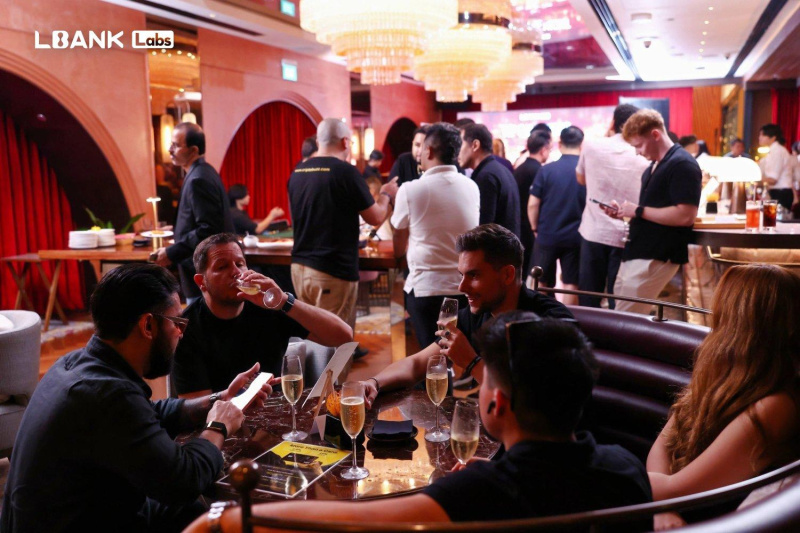
The distinction is worth keeping in view. A founder needs capital and useful introductions. A VIP guest may want recognition and access. Both depend on relationships, but they are different audiences with different measures of success. Reading Labs through both activities explains more than treating every event as evidence of investment performance.
An introduction still has to go somewhere
The model has a straightforward limit. More relationships help only when they lead to customers, developers, expertise or financing that a business can use. Investing through several crypto funds can broaden access while leaving exposure to the same market cycle. And an ecosystem thesis needs people willing to build within it. The test for Labs is whether the connections produce activity after everybody leaves the room.