In September 2026, a cottage-cheese entrepreneur stood beside an oversized check in a historic Minnesota barn. Kate Colehour’s Disco Cow had won $20,000 through the Midwest Dairy Accelerator. The money had a decidedly practical destination: helping the company move from founder-led production to scaled manufacturing. Innovation, in this instance, needed someone else to make the next batch.
VentureFuel, which designed the program with Midwest Dairy, occupies that awkward space between an interesting idea and a functioning business arrangement. Its work ranges from dairy products to enterprise artificial intelligence. The common problem is access: to a buyer, a business unit, a manufacturer, or somebody who knows how the machinery works.
- Corporate problems determine which startups get invited.
- The offerings include research, pilots, product co-development and custom accelerators.
- The useful outcome is a commercial relationship; the pitch is an intermediate step.
The man selling gym advertisements
Fred Schonenberg’s origin story begins somewhere less glamorous than a venture-capital conference. He was selling advertisements in gyms. Big clients kept asking what was coming next. Meanwhile, a friend from high school worked at a startup that struggled to get meetings with precisely those clients.
Here were two groups with complementary needs and a remarkably inconvenient distance between them. Schonenberg founded VentureFuel in 2014. In a 2019 interview, he described the firm’s role with unusual economy: “VentureFuel is in the business of translation.” Knowing the words was only part of it. Each side also needed realistic expectations about the other.

Today its named clients include Comcast NBCUniversal, Biogen, Hershey, DICK’S Sporting Goods and AARP Foundation. Public-sector and industry organizations also feature. That breadth matters: the firm sells a way of arranging collaboration, with the technical or product specialty supplied by the startup and the commercial context supplied by the client.
First, find the person who can say yes
The Comcast example makes the method tangible. In 2023, LIFT Labs restructured its accelerator around enterprise-ready startups. It matched participants with relevant business units and decision-makers, moved toward proofs of concept, and streamlined approvals for pilots. Startups participated without exchanging equity.
Comcast reported that all 18 companies in its 2023 AI accelerators secured pilot or commercial deals with Comcast, NBCUniversal or Sky. Those are distinct outcomes: a pilot tests a relationship; a commercial agreement takes it further. The figure does not mean every experiment became a permanent deployment.
Startups in Comcast’s 2023 AI accelerators secured pilots or commercial deals, according to Comcast.
A COHORT RESULT, NOT A SCALE-UP GUARANTEEWhat changed their minds? In a 2025 conversation, LIFT Labs leader Laura Plunkett described a mismatch in value creation for both startups and Comcast under the previous approach. Listening to those stakeholders helped prompt the redesign. VentureFuel worked alongside the team as it changed the format.
“We noticed that there was a mismatch in value creation”Laura Plunkett, on rethinking LIFT Labs
In that same discussion, Schonenberg explained that business-unit pain points come before the startup search. The sequence is the interesting part. An internal team already wants something solved. The newcomer arrives with a reason to be there, rather than hoping that a sufficiently charming demonstration will manufacture one.
Four verbs, with work attached
VentureFuel’s services make that sequence available in several forms. Research and strategy identify gaps and produce a roadmap. Commercial pilots involve sourcing and vetting companies, facilitating introductions and agreements, and testing solutions against specific problems. Product co-development pairs clients with startup capabilities; the stated offering includes an eight-week sprint toward a minimum viable product.
Custom corporate accelerators can be public or operate quietly under a client’s brand. Their intended outcomes include commercial agreements or investments. This places VentureFuel between internal innovation teams, consulting engagements and investment-led startup programs. Its distinction is the work of finding a partner and organizing an actual test of the relationship.
The business is an advisory and program operator serving organizations. An equity-free startup program can make sense because the sponsoring organization wants access to useful products, technologies or new demand. The publicly stated California program charges participants nothing. For founders, however, time and strategic commitments still belong in the calculation.
Cottage cheese has a supply chain
Midwest Dairy’s first VentureFuel-supported cohort in 2025 extended earlier pitch events into an eight-week accelerator. By 2026, its finale followed a ten-week program covering manufacturing, distribution, retail strategy and other practical subjects. These are the chores that make a promising food product available for purchase.
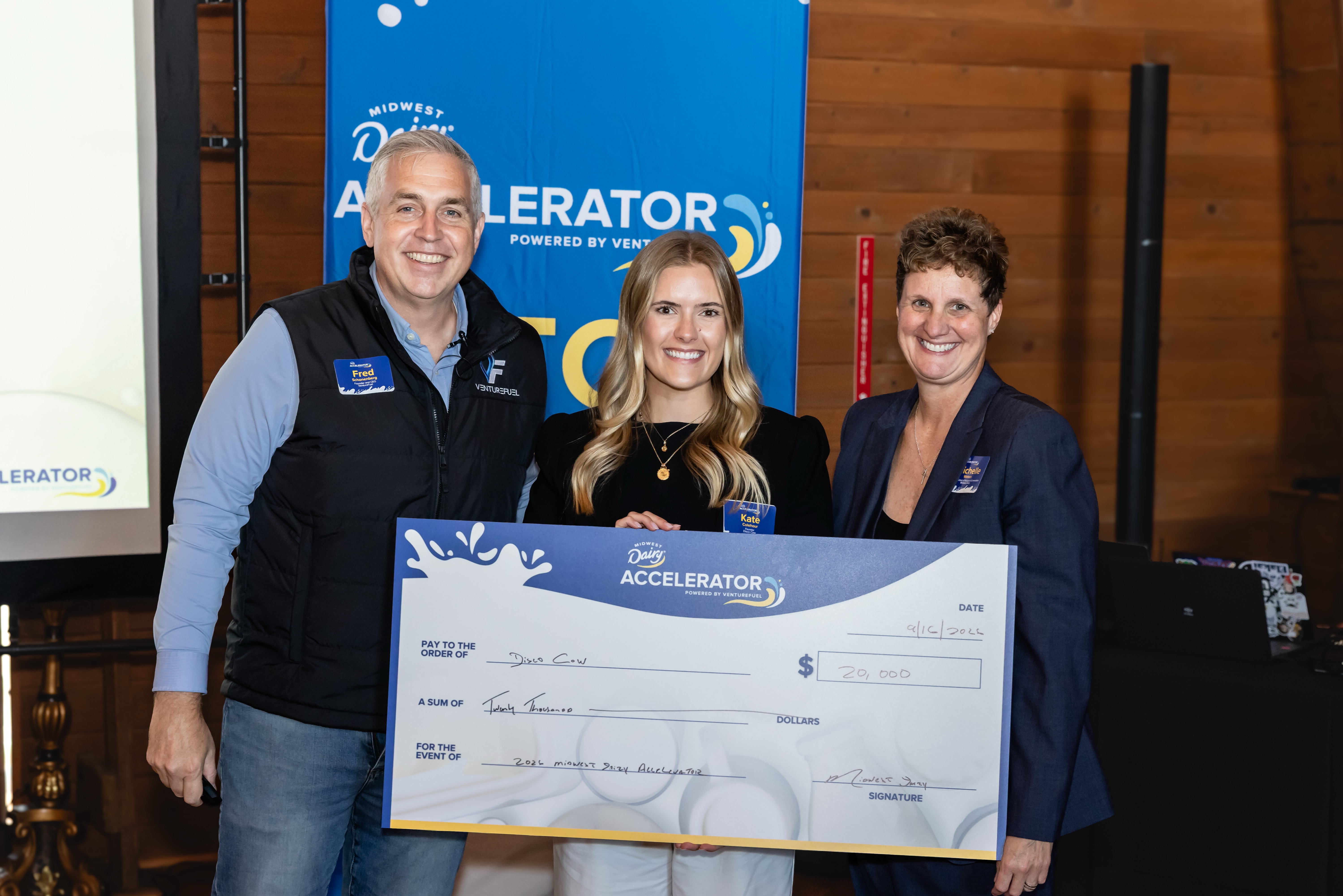
The California Milk Advisory Board collaboration has a similarly concrete bargain. Its Real California Milk Excelerator offers mentorship, commercialization support and prize opportunities, with free participation and no equity taken. International companies can apply if willing to produce using California milk and use the program’s seal. Award rules include a 24-month commitment to qualifying California dairy ingredients.
That requirement gives the sponsor a commercial reason to care. It also tells a founder when the opportunity is a poor fit: if the ingredient commitment contradicts the business plan, the benefits will not magically reconcile the two. The same logic applies to enterprise pilots. A startup that cannot deploy, or a corporation without an engaged internal buyer, has a different problem to solve first.
The part worth borrowing
VentureFuel describes a distributed US team and lists simplicity, action, collaboration and curiosity among its hiring priorities. Those values suit work that crosses organizational borders. A good introduction can be wasted if nobody explains the next decision.
The reader can borrow the sequence without borrowing the entire program. Name the problem. Involve its owner. Select a startup ready for the job. Agree on what the experiment must demonstrate and who will act afterward. The oversized check makes a fine photograph. The smaller, less photogenic commitments determine whether anybody gets to buy the product.