The desk is a mess. Papers overlap. A neat person sees a problem; David H. Freedman sees a question. What, exactly, would improve if someone tidied it? That question helped produce A Perfect Mess, his book with management scholar Eric Abrahamson. Its proposition is pleasantly inconvenient: the effort spent imposing order can exceed the benefit. Before buying another organizer, perhaps count the hours spent organizing.
- Five nonfiction books, spanning artificial intelligence, hacking, management, disorder and expert advice.
- Magazine reporting connects research and technology to decisions people actually face.
- The useful habit: examine the evidence, including evidence that complicates a favorite argument.
Various publications & books is the company label attached to this profile. Follow its website and you arrive at Freedman’s author portfolio: articles, books and a biography introducing a science journalist. The business becomes intelligible through the work. Readers buy books; publications carry his reporting; the archive brings those scattered pieces together.
Five books, one loose thread
Start with Brainmakers, published in 1994. It examined researchers trying to create machines more like brains. Its historical setting matters. Intelligent machines were already objects of ambition and disappointment long before a chatbot could draft an email. Reading it today offers perspective on how old some apparently new questions are.
Then change shelves. At Large, written with Charles C. Mann, follows a computer intruder and the effort to catch him. Banks, universities and government systems enter the story. The subject shifts from building intelligence to defending institutions, but both books concern the uncomfortable distance between what people expect complicated systems to do and what happens.
Corps Business, published in 2000, moves into management through thirty principles drawn from the U.S. Marines. The attraction is adaptability under pressure. Pair it with a book defending moderate disorder and the portfolio starts to look less random. Both ask how organizations function when circumstances refuse to cooperate with the plan.
Put neatness on the expense account
A Perfect Mess supplies the portfolio’s most immediately usable provocation. Abrahamson and Freedman draw examples from business and everyday life to argue that some disorder can improve flexibility and resource use. The operative word is some. Their publisher describes assessing the appropriate amount of disorder for a particular system.
A reader can copy that question without adopting a philosophy of permanent clutter. Before standardizing a workflow, compare the maintenance effort with the delays, mistakes or confusion it prevents. That is an application of the book’s argument, rather than a guaranteed result. A filing habit and a safety procedure deserve different calculations; consequences determine how much looseness is tolerable.
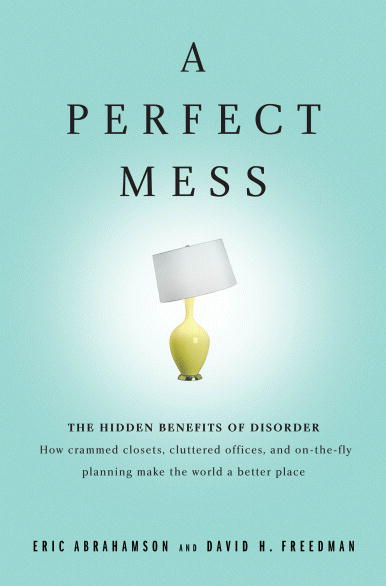
There is a literal price, too. At the time of checking, the publisher listed the trade paperback at $21.99 and the hardcover of Wrong at $37. Those are prices for particular editions. For the reader, the larger investment is time spent following an argument carefully enough to challenge it.
The skeptic gets a second look
Wrong, published in 2010, examines why expert advice goes astray. Its scope includes researchers, consultants and financial authorities. Its appeal lies in treating error as something with causes: incentives, organizational habits and the preference for persuasive answers. A person considering advice has more to inspect than the speaker’s résumé.
“Is This Book Wrong?”An appendix title in Wrong
That year, Freedman also profiled John Ioannidis for The Atlantic, explaining the scientist’s scrutiny of medical research. A decade later, in WIRED, he examined criticism of Ioannidis’s coronavirus research, including concerns about recruitment, testing and analysis. The familiar subject received fresh scrutiny. This episode suggests a demanding reader’s rule: apply the questions again when the person making the claim is someone you already admire.

Read the small print, too
The market for this work includes general readers curious about science and business, and editors seeking explanations of complicated subjects. The author’s Inc. profile lists contributions across publications including The Atlantic, Wired and MIT Technology Review. Its range gives readers several doors into the same portfolio. An interest in management can lead toward research quality; an interest in technology can lead toward healthcare.
Recent work makes those connections explicit. Two March 2025 articles cover healthspan and healthcare AI. Both belong to a Scientific American Custom Media series created for Google, the Buck Institute, Optispan and Phenome Health. The publication states that this division is separate from the magazine’s board of editors. That disclosure belongs in any fair reading of the work.
In January 2026, Freedman wrote about working as a standardized patient, role-playing illness for medical education. Here the observer became part of the encounter. A May 2026 Inc. feature on Databricks returned to business and technology. The archive keeps moving between institutions that promise better outcomes.
His Discover article on the streetlight effect offers a compact explanation of another trap. Researchers can concentrate on what they can readily measure, while the answer they need lies somewhere harder to investigate. For a business reader, the analogy is useful: an easily counted activity may be a poor substitute for the outcome that matters. A rising number on a dashboard deserves a second question about what it represents. That is an editorial interpretation of the reporting, and a practical reason to read beyond one’s own industry.
Take a better question home
Readers have plenty of alternatives: specialist newsletters, other science reporters, management books and original research. This portfolio’s particular appeal is its movement between those worlds. Its books offer extended arguments; its articles let readers try the approach on a narrower subject. Choose the format that matches the decision and the time available.
The practical benefit depends on resisting an easy shortcut. A story about faulty expertise cannot settle a medical decision, and an argument for disorder cannot decide every workplace procedure. Read closely, check the setting, and ask what would change the conclusion. Even that unruly desk deserves evidence before its owner claims victory.