Josh Goldberg’s mother had a reasonable question. Her son had gone to law school, become a corporate lawyer, and then announced a move into residential solar. As he remembers it, she wanted to know whether all that education had been preparation for becoming a door-to-door salesperson. He concedes that her description came rather close. His parents became Astrum Solar’s first customers. Their system was free. He remembers the sale as difficult anyway.
There is something useful about beginning a financing executive’s story with a customer who needed persuading even at a price of zero. The obstacle between a new technology and a household can be larger than the technology’s price tag. Someone has to understand the proposition, trust the people making it, and agree to live with the consequences. A legal qualification offers limited protection against questions from one’s mother.
Goldberg has since co-founded businesses that install solar, finance it, and help commercial property owners pay for it. At Sunstone Credit, where he is co-founder and chief executive, the customer has usually become a business. The recurring challenge remains recognisable: an available roof does surprisingly little until someone can arrange the transaction underneath it.
A lawyer with a new sales route
Before the rooftops, there were deals of another kind. Goldberg studied finance and history at the University of Maryland, College Park, earned his law degree at Maryland’s law school, and began his career doing mergers and acquisitions work at Ballard Spahr. The education placed money, institutions and agreements close together. His next move would require putting a physical product in front of a customer.
The invitation came through Vadim Polikov, a friend from growing up. Their connection stretched back through school and wrestling. Polikov saw an opportunity in residential solar, and Goldberg was interested in trying entrepreneurship. They joined Ben Davis to start Astrum Solar on the East Coast in 2008. Goldberg entered the industry without a background in solar. His account of the early days is cheerfully unromantic about how much he had to learn.
The first venture eventually acquired a price that was easier to announce than those early household negotiations. In July 2014, Direct Energy bought Astrum for $54 million. At the time, the business was reported to have generated $40 million in revenue in 2013 and installed roughly 10 megawatts that year. Those are company figures, rather than a measure of Goldberg’s personal proceeds. They describe the distance travelled from the first family installation.
Direct Energy’s purchase price for Astrum Solar, which Goldberg co-founded in 2008.
The customer wanted the roof back
Goldberg’s education in solar finance also took place in a Prius. He drove to prospective customers and sold systems at their kitchen tables. That put him in a useful position to notice the difference between a product someone accepts and one someone wants. A lease could remove a large upfront payment. Ownership still mattered to the household considering what would sit on its roof.
That observation helped send him looking for a loan alternative. A conversation with Wilson Chang, then at Hudson Clean Energy, led toward financing customers who wanted to buy their systems. After Astrum’s sale, the idea could serve other installers too. Sunlight Financial, which Goldberg and Chang helped co-found in 2014, grew from that opportunity.
The progression is worth slowing down for. Installing equipment and arranging credit require different kinds of expertise. Yet the salesperson sees both arrive in a single conversation. If the customer must leave that conversation and independently find a lender, a promising project acquires another appointment, another application and another opportunity to stall. For a contractor trying to close a sale, that extra step has consequences.
“I’m an entrepreneur, I’m not a big company guy.”
Josh Goldberg
His stated preference for entrepreneurship helps explain why an acquisition did not end the sequence. He moved on to another part of the transaction. He also co-founded Legends of Learning, an educational games company. The résumé has a detour through classrooms as well as rooftops; solar finance has never been its only entry.
The commercial roof next door
Sunstone, founded in 2021, took the financing question into commercial property. A smaller business might have a suitable building and an interest in generating power, while lacking an easy route to borrowing for the installation. Sunstone’s model brings together contractors who find the customer and financial institutions that provide capital, with the platform organising the loan process.
Goldberg’s own operating background is relevant here. He has been on the installer’s side, where financing is part of getting a project built. Sunstone’s leadership includes people with experience in solar development, commercial lending, technology and capital markets. The mix reflects the practical demands of assessing a borrower and a project while giving the contractor something usable during a sale.
In January 2023, Sunstone announced a $20 million Series A led by an affiliated fund of Greenbacker Capital Management. Corporate funding supports the company building the platform; the customer loans are another layer of the business. Keeping those two pools of money separate makes the story easier to follow. One finances the organisation. The other helps finance the work on a customer’s property.
A simplified view of the platform’s contractor and lending relationships.
An old company comes round again
Some founder stories proceed tidily from one exit to the next. Goldberg’s includes a return under difficult circumstances. Sunlight Financial went through Chapter 11 restructuring in 2023. When it emerged that December, Sunstone was among the investors in the acquiring consortium, alongside an affiliate of Greenbacker, IGS Ventures and others. Cross River Bank also became an owner.
The announcement placed Goldberg back in the orbit of a company he had helped create almost a decade earlier. He welcomed the opportunity to participate in its next chapter. The transaction also connected his commercial financing business to his earlier residential one. It was a return to familiar people and work through a new ownership arrangement.
That episode puts some weight behind the otherwise comfortable phrase “repeat founder.” Repetition can mean meeting an earlier venture again when its circumstances have changed. A company’s history carries on after the founder’s original role ends. In Goldberg’s case, another business he had built became part of that continuing history.
Baltimore, with a national address book
Goldberg is based in Baltimore, and his local ties appear in the business. In March 2024, Sunstone opened a co-headquarters at Clipper Mill, adding a Maryland base to its primary New York headquarters. The announced space measured 2,650 square feet and was intended to house 15 employees. He described himself as a Baltimore native in welcoming the opening.
By then, Sunstone had also acquired commercial solar lender ORKA Finance. A month after that January acquisition, it announced Express Loan for solar borrowing below $250,000. These were different ways of broadening the business: bringing in another lender, simplifying smaller transactions, and establishing room for a team. Growth took several forms before it became a larger application total.
The public personality is less solemn than a commercial loan document. Goldberg posts television recommendations and has publicly expressed his love of tennis and bagels. His business updates can come with a food opinion attached. It gives the reader a useful sense of the person doing the asking: someone willing to make a professional appeal sound like a conversation.
The roof is only the beginning
In September 2025, Sunstone announced that commercial solar loan applications had reached $1 billion. The milestone had arrived the previous month through a California business seeking $1 million for solar and battery storage. An application records a request for financing. It should be read that way, rather than as a total of money lent.
Storage soon received its own product. Sunstone introduced SOL in October 2025 to finance standalone commercial batteries. In April 2026, the company widened another boundary, launching a Large Loan Program for solar and energy storage projects from $6 million to $30 million. Goldberg said demand above the earlier ceiling had previously meant turning customers away.
That expansion changes the size of the project his company can consider. Standalone storage changes what can be financed. Together, the products show a business adjusting its scope around different transactions. A contractor with a smaller solar customer and a developer with a much larger project bring different demands to a financing process. They do not necessarily need the same route through it.
Flex extends Sunstone’s financing platform to HVAC, roofing, energy performance, EV charging and other energy-related commercial projects.
Then came Flex, announced on October 7, 2026. It covers energy-related commercial improvements including HVAC, roofing and EV charging, with financing from $25,000 to $6 million. The company described decisions typically taking less than a week and terms extending up to 15 years. Those are the product’s announced features, rather than a promise about every application.
The same announcement reported more than 1,000 solar contractor partners and more than $2 billion in applications since inception. For Goldberg, it meant taking a platform established around commercial solar into other purchases that businesses need to make. The contractor still needs a way to help a willing customer get the work paid for.
An introduction, payable in crab cakes
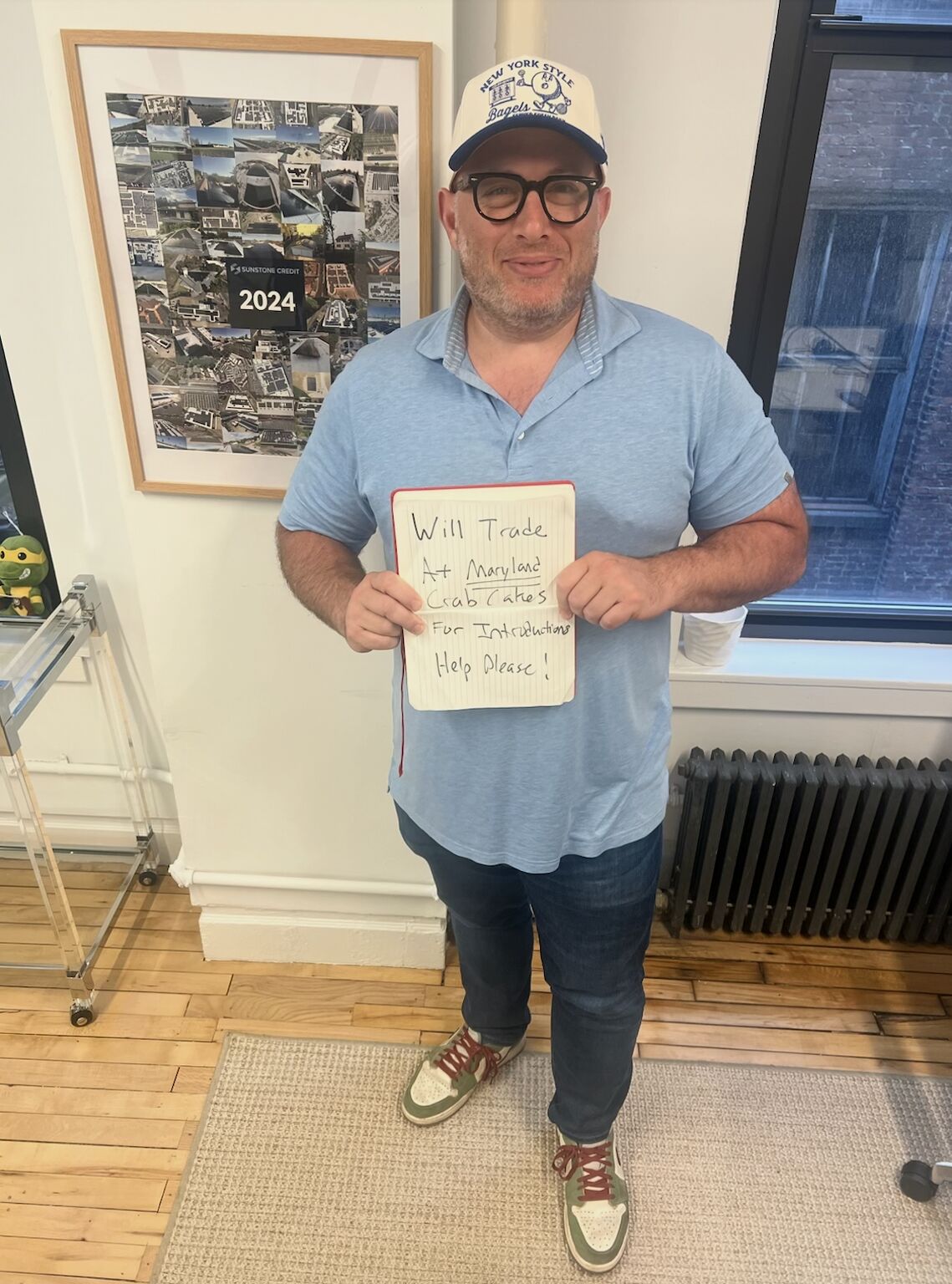
Goldberg’s own pitch for that broader market included a handwritten sign. Wearing a cap that combined his affection for tennis and bagels, he asked his network for introductions to businesses selling the equipment and improvements Flex could finance. He offered crab cakes to the person bringing the most referrals. A commercial expansion had acquired a distinctly Maryland incentive.
It is an appropriate place to leave him: asking for the next conversation. The former lawyer has spent years moving between the people who sell a project, the people who buy it, and the people who can fund it. Even with a national platform and a longer list of products, another introduction still has value. This time, at least, his prospective customer need not be his mother.