A promise can lose its value without changing a single word. A bank balance still contains numbers. A document still bears a signature. The unsettling part arrives when the world around them changes and those familiar marks stop doing their job. For Valery Vavilov, growing up in Latvia as the Soviet Union came apart, that was an early lesson in the distance between possessing something and being able to keep it.
Years later, he recalled his family losing what it had, and money becoming paper. The memory gives his subsequent career a more particular shape than the familiar tale of an entrepreneur discovering Bitcoin early. He became interested in the machinery that makes a claim believable: who records it, who can change it, and what happens when the institution behind it fails. A child could hardly redesign a monetary system. A technically minded adult might at least attempt a better record.
A telephone call about something bigger than the internet
Vavilov trained in computer science, earning a master’s degree from Riga’s Transport and Telecommunication Institute. He later completed the Stanford Executive Program. Before Bitfury, he had spent more than 15 years in technical and leadership roles. His career therefore began well before the cryptocurrency industry had conferences, institutional investors or much occasion to order matching company T-shirts.
The decisive conversation came in 2010. His future co-founder, Valery Nebesny, called with a discovery: Bitcoin’s protocol resembled ideas he had spent years considering. They began experimenting in 2011, first with ordinary computer processors, then graphics cards. In 2012, Bitfury became their full-time priority. They were learning microelectronics as they went. Vavilov’s account of that period is refreshingly specific about the gap between understanding a network and knowing how to manufacture the silicon that would serve it.
He also supplied a compact explanation of the company name. A bit was the simple unit, zero or one; fury suggested speed. The working method was to break difficult tasks into smaller ones. It is a pleasantly unromantic recipe for a business associated with monetary revolution. When a problem looks impossible, make it small enough to put on somebody’s desk.
The awkward business of selling tomorrow to pay for today
The early financing required choices that look uncomfortable through hindsight’s very expensive spectacles. Vavilov sold mined Bitcoin to support the company, including at prices as low as $30. Outside investors were difficult to persuade. “Very few investors believed in this technology,” he said. Holding every coin would have made a splendid hypothetical portfolio. It would also have been a peculiar way to pay for an operating business.
This tension matters more than a retrospective calculation of forgone gains. A company needs cash at the moment a bill falls due. Its founder cannot settle the invoice with a chart of what an asset might eventually be worth. Vavilov’s choice was to convert some of the network’s rewards into the means to keep building around the network. The wager was on an enterprise that could continue producing, rather than a collection that could only appreciate.
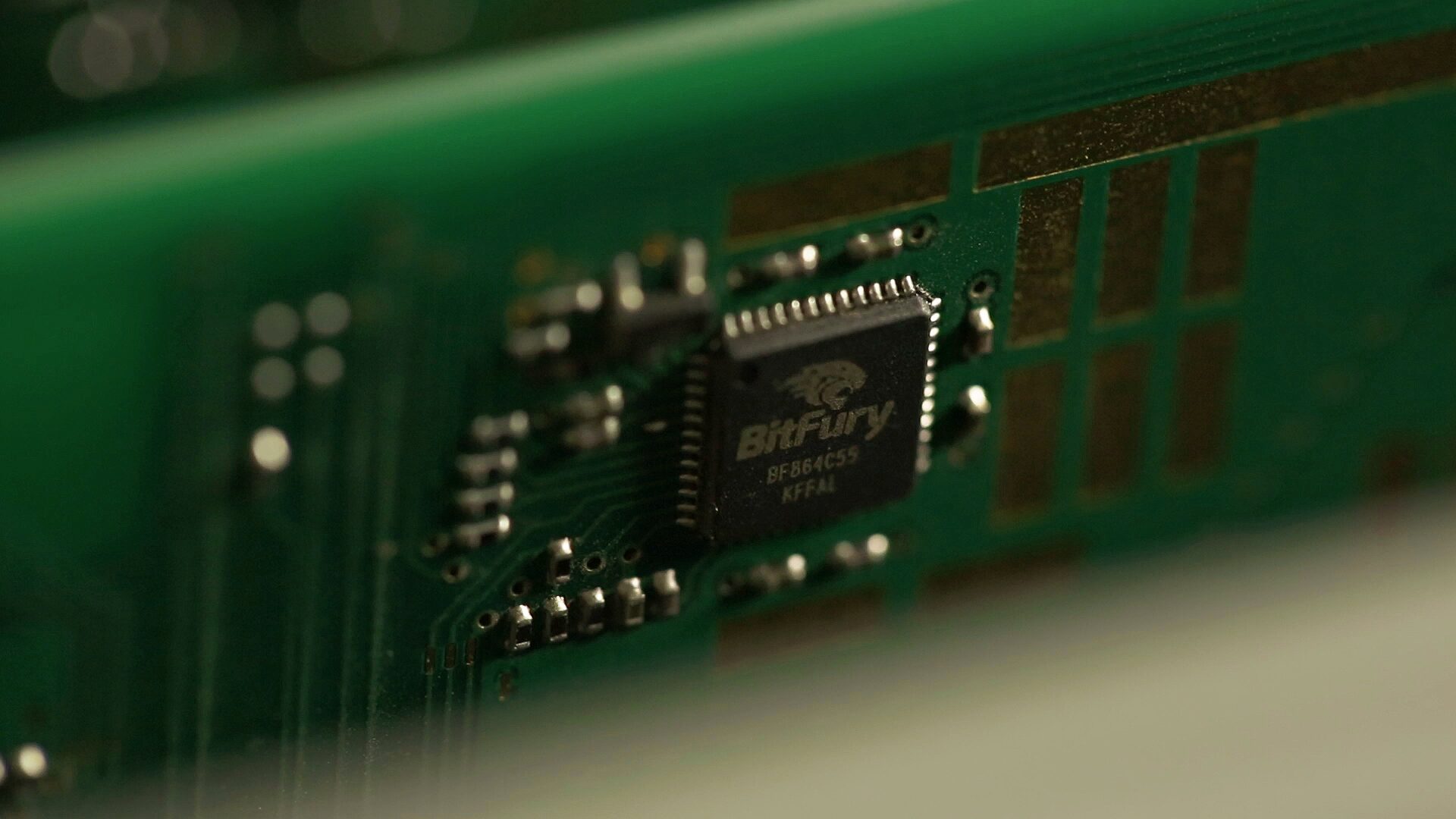
Bitfury developed specialized mining chips and data-center designs. Its official biography credits eight generations of chips. The work put Vavilov in a business where conviction had to survive contact with physical constraints. Electricity, heat and equipment costs have an admirable indifference to a founder’s vocabulary. Whatever the long-term promise of digital assets, the computers doing the work still needed to run.
A property registry makes an unlikely island souvenir
The next part of the story leads to Richard Branson’s Necker Island, where Vavilov helped convene blockchain gatherings. In his account, the Georgia land-registry project grew out of discussions there with economist Hernando de Soto. De Soto’s work on property rights supplied an unusually concrete subject for a technology gathering: how people demonstrate ownership, and what insecure records prevent them from doing.
It is an appealingly odd setting for administrative reform. A private island is where one might expect ambitious talk about escaping bureaucracy. Here the conversation returned to the registry. The attraction was the ordinary document, the sort of thing that becomes interesting only when somebody disputes it. Property rights gave Vavilov’s early preoccupation with fragile ownership a practical assignment.
Bitfury and Georgia’s National Agency of Public Registry signed an initial agreement in April 2016. In February 2017, Vavilov and agency chairman Papuna Ugrekhelidze signed another memorandum to expand the work. The pilot marked Bitfury’s move from mining and hardware into blockchain software. It also required a different kind of collaboration: engineers working with a public institution responsible for actual records, rather than merely demonstrating an elegant prototype.
The distinction between a reliable record and a just outcome remains essential. Preserving a record does not establish that the original claim was fair. A registry still needs sound procedures and people who can correct mistakes. The useful ambition is narrower and more concrete: make later interference easier to detect. For someone concerned about ownership disappearing when systems change, that is a meaningful piece of the problem to tackle.
- 01 / RecordAn institution records a claim.
- 02 / CommitA cryptographic fingerprint is anchored to a public ledger.
- 03 / CheckLater records can be checked against that commitment.
Building trust meant keeping some company
Vavilov’s career also complicates the picture of the cryptocurrency founder as a permanent outsider. In March 2016, Bitfury backed the MIT Media Lab’s Bitcoin Developer Fund, which supported work on the protocol. The arrangement explicitly kept donors from influencing the developers. A commercial participant was helping sustain common infrastructure without purchasing control over the people maintaining it. The separation was part of the design.
The company’s circle extended into policy and business education. Bitfury helped launch the Global Blockchain Business Council in 2017, bringing blockchain advocacy into the rooms where businesses and governments discuss adoption. These connections suited a founder whose ambition reached beyond selling equipment. A technology intended for public records has to become intelligible to public officials. That usually involves more meetings than a revolutionary brochure cares to admit.
By December 2019, the company had launched Exonum Enterprise. The software allowed organizations to operate permissioned networks while periodically anchoring records to Bitcoin. The architectural choice expressed a compromise: an organization could retain control of its own system while making a verifiable commitment outside it. The practical question was how much independence a customer could preserve while gaining a record other parties could check.
That leaves room for skepticism as well as interest. A public audit trail cannot prevent every fraud. It can help establish what was recorded and when. Vavilov’s work is most understandable at that level of detail. Large claims about trust become something a buyer can examine: a system, a procedure, an independently checkable trace. The idea has to earn its usefulness in each application.
The chips were pointing toward AI already
Bitfury’s expansion into artificial intelligence was public by August 2019, when it announced a dedicated division led by Fabrizio Del Maffeo. The plan combined hardware and software for applications at the edge and between cloud systems and local devices. The appointment gave the effort an experienced operator rather than leaving AI as a promising phrase attached to the company description.
There was a recognizable industrial connection. Both mining and AI depend on computing infrastructure. Neither escapes the cost of running machines or removing heat. Expertise does not transfer automatically between markets, but the recurring problems help explain why the company’s portfolio came to include AI-chip developer Axelera AI and cooling business LiquidStack. Behind an apparently weightless digital service is a substantial quantity of equipment.
Vavilov’s own title changed along the way. When Brian Brooks became chief executive in late 2021, Vavilov moved to chairman and chief vision officer. Bitfury’s current executive biography again lists him as CEO, co-founder and chairman. The movement of responsibilities is a useful reminder that a founder’s working life can be less tidy than the single uninterrupted title on a conference badge.
A billion-dollar proposal, with the difficult part still ahead
On November 18, 2025, Bitfury announced a $1 billion funding initiative and a shift toward operating as an investment firm. Its stated purpose was to support founders putting ethics, transparency and human values into emerging technologies. The amount described an initiative, rather than a completed sequence of investments. The aspiration was plain: apply the experience and capital accumulated through building technology businesses to other people’s ventures.
“Bitfury has always believed that technology must serve human progress.”
Val Vavilov · November 2025
Two subsequent portfolio events gave that change a tangible backdrop. In February 2026, Axelera AI announced more than $250 million in funding, with Bitfury among the participating existing investors. On March 3, Trane Technologies completed its acquisition of LiquidStack. The developments concern different businesses and different transactions. Together, they show how far the infrastructure built around an early Bitcoin company had traveled.
November 2025
February 2026
by Trane Technologies
Different measures: an announced investment initiative, a portfolio company’s funding round, and a completed acquisition.
Ethics is an agreeable word in an investment announcement; the harder questions arrive with decisions. Which founders receive money? What does transparency require when disclosure becomes inconvenient? How does an investor measure the independence a product gives its users? Those are the standards suggested by Bitfury’s own stated mission. They will be tested through the businesses it chooses to back and the behavior those businesses reward.
Vavilov’s story keeps returning to the same vulnerable object: a person’s claim on something valuable. First came the family experience of a system coming apart. Then came processors, property records and software intended to make changes visible. Now comes the attempt to fund other builders. The scale has altered considerably. The question remains close to the one a Latvian childhood placed in front of him: when the world changes around a promise, what will make it hold?