Cathie Wood's father had an idea for his young daughter's education: send her to UCLA to learn Fortran. He was a radar systems engineer, excited by the electronic age, and wanted her to understand the world taking shape around them. Wood remembers being about ten or twelve. She learned the programming language. She was rather less enchanted than he was.
“I didn't find that too interesting, to be honest,” she recalled. The future had arrived, and the future apparently needed a better sales pitch. Years later, Wood would make explaining technological change her business. She would also discover that explaining it, investing in it, and persuading other people to wait for it are three demanding occupations.
Today, Catherine Duddy Wood is the founder, chief executive and chief investment officer of ARK Investment Management. To her public following, she is usually just Cathie. That familiarity is part of the story. Here is a portfolio manager who discusses economic theory on YouTube, publishes investment arguments for anyone to inspect, and gives people ample opportunity to disagree.
Her career invites a deceptively simple question. What happens when an investor's view of where the world is going runs ahead of the market's willingness to pay for the journey? Wood has built a company around that gap. The gap has sometimes been wonderfully profitable. It has also proved quite capable of swallowing years of patience.
A long apprenticeship before the leap
Wood grew up in Los Angeles, the eldest child of Irish immigrant parents. Education mattered in the household. After Notre Dame Academy, she attended the University of Southern California, graduating summa cum laude in 1981 with a degree in finance and economics. The choice of economics gave her a way to connect individual decisions with the larger machinery of the world.
Arthur Laffer became a mentor. As an undergraduate, she was admitted to his graduate economics class. She remembers discussions that continued over dinner and a teacher who enjoyed challenging the ideas she had picked up elsewhere. The attraction was argument, explanation, the pleasure of getting a mechanism to make sense. Economics supplied the excitement that Fortran had failed to provide.
Her professional route was lengthy and thoroughly institutional. She began as an assistant economist at Capital Group, then spent eighteen years at Jennison Associates, working across economics, equity research and portfolio management. She co-founded Tupelo Capital Management before moving to AllianceBernstein, where she spent twelve years as chief investment officer of global thematic strategies and managed more than $5 billion.
These were decades spent learning how investment organizations sort information and assign responsibility. A thematic investor follows a change across businesses; a conventional sector structure divides those businesses among specialists. Those two arrangements can produce different questions about the same company. Wood eventually made that organizational disagreement the premise of an independent firm.
The founder had to find her customers
She registered ARK as an investment adviser in January 2014. The appealing shorthand is a veteran backing her own judgment. The operational reality was less cinematic: she had to pay for a business while persuading people to put money into unfamiliar funds. Experience in managing investments did not automatically supply expertise in selling exchange-traded funds.
Wood has described financing ARK herself during its early years and discovering that the institutional investment world she knew communicated poorly with the ETF world she was entering. Her network did not deliver the immediate audience she expected. Assets remained around $30 million to $40 million through much of the early period, by her account. A good thesis still needed distribution.
That is an unusually useful detail in a story often told through spectacular stock predictions. The founder's first difficulty was a mundane business problem: reaching customers. She sought partners rather than treating distribution as something the research team could simply improvise. Resolute Investment Managers took a minority ownership interest in 2016.
ARK's name has two explanations. Its public acronym is Active Research Knowledge. Wood has also spoken about the Ark of the Covenant and the religious conviction behind her decision to start the firm. In her account, faith and the practical work of building an investment business occupy the same story. The balance sheet still required attention.
“I had fallen into the trap that many entrepreneurs fall into, not understanding the market completely.”
Cathie Wood, on ARK's early years
An electric car escapes its filing cabinet
The method becomes easier to understand through Tesla. A car company belongs naturally on an automobile analyst's desk. Wood's argument reaches into batteries, software, artificial intelligence and autonomous transport. The company is a meeting place for technologies whose costs and capabilities change together. Put it into one industry category and, in ARK's view, you may miss the interaction.
That view does not establish what a share should cost. It establishes the questions the research team wants to ask. How quickly might costs fall? How large could demand become? Which companies could capture the revenue? What assumptions have to hold for a distant valuation to make sense? There are many places for an attractive answer to become an expensive mistake.
ARK describes a process that moves from broad technological change to individual companies, then to valuation and portfolio decisions. Analysts work across innovation themes. External specialists and public responses feed into the research. Wood retains ultimate responsibility for investment decisions. A lively discussion can widen the evidence; somebody still has to choose the holdings.
The public dimension is deliberate. ARK shares research and models, inviting outsiders to examine the reasoning. Wood also brings her economic arguments to regular video commentary. For an interested viewer, the appeal is access to a manager's working explanation. For a critic, the same openness supplies a conveniently extensive reading list.
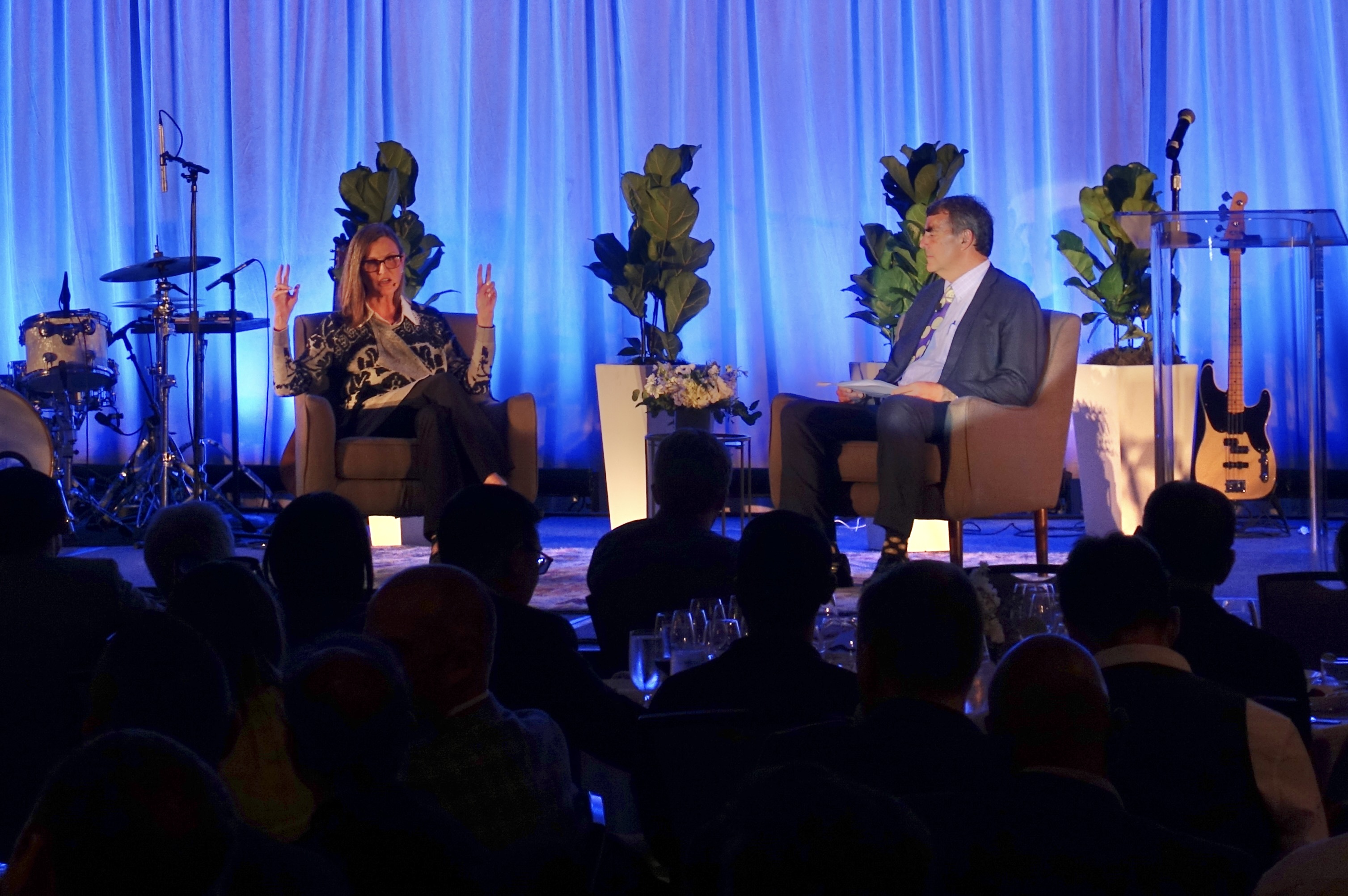
Photo: Steve Jurvetson / CC BY 2.0. Original photograph, uncropped.
The numbers refuse a tidy ending
In 2020, the flagship ARK Innovation ETF returned about 153% at market price. That figure helps explain the fascination better than any personality sketch. A strategy organized around rapid technological change had delivered a calendar year that made conventional expectations look rather small. Followers could see a striking number beside an intelligible story about the future.
Then the experience reversed. ARKK lost about 23% in 2021 and 67% in 2022. The sequence matters. A large gain followed by large losses produces a different result for someone who bought early than for someone who arrived after the applause. The calendar makes each percentage look self-contained. An investor's account carries the previous year into the next.
The reversal had a market setting. Rising interest rates reduced the appeal of many high-growth shares, particularly businesses whose valuations leaned heavily on hoped-for future earnings. Money expected years from now is worth less today when the rate used to discount it rises. That arithmetic can be merciless to an eloquent account of technological progress.
ARKK's 2023 NAV return was about 68%, another sharp move. A rebound can be substantial while leaving an earlier buyer below their starting point. Wood's record asks readers to hold several observations together: some technology bets paid off, the fund experienced deep losses, and the timing of entry shaped what investors actually lived through.
Wood's stated horizon has generally been five years. That helps explain her willingness to tolerate volatility, but it cannot cancel volatility's consequences. A long horizon gives an investment thesis time to develop; it also gives its assumptions time to encounter competition, financing costs, slower adoption or a business model that captures less value than expected.
A future with a very uneven present
Back to the classroom, by another route
The educational strand of Wood's life extends beyond market commentary. In 2018, she launched the Duddy Innovation Institute at Notre Dame Academy, her former school in Los Angeles. The program was intended to let young women work beyond traditional subject boundaries. It brought an argument about learning back to the place where she had once been a student.
In 2021 she founded the nonprofit now known as ARK Educate. Its work includes curriculum development, teacher training and school partnerships, using technological change as a way to encourage students to ask questions and connect ideas. The resemblance to ARK's research organization is plain: both ask people to look across the boundaries between familiar subjects.
Wood has linked that ambition to her parents' sacrifices for education and to the excitement she felt studying economics. “There's nothing like being an inspired student,” she said in a 2022 interview. In 2023, USC selected her to address Marshall's graduating undergraduates. The former student returned with a career that offered plenty to discuss about opportunity and uncertainty.
Her geographic center changed as well. ARK announced its move from New York to St. Petersburg, Florida, in 2021, alongside plans to collaborate on an innovation incubator. Her public profiles now place her in St. Petersburg. The investment business had acquired a local setting, with an interest in the people building companies as well as the securities representing them.
Follow the idea across the boundaries.
Economics → investing → educationStill arguing about the next five years
By September 2026, Wood was taking her case to Australia, discussing a new investment partnership and the economic effects she expects from artificial intelligence. Her argument was characteristically expansive: faster productivity growth could lower production costs while stronger economic activity eventually pushed short-term interest rates higher. She was describing a forecast, with all the uncertainty that the word carries.
A September 22 investor letter developed the same theme, considering how stronger growth, falling inflation and higher interest rates might coexist. Her October 16 quarterly commentary continued to emphasize technology's potential to reduce costs. The economist who began at Capital Group remains readily visible beneath the portfolio manager who became a public personality.
The continuity is striking. A father wanted his daughter to understand a new electronic age. A professor showed her how economic explanations could provoke and delight. Decades in investment firms taught her where existing research structures might struggle. She put those experiences into a company, then exposed its reasoning and its results to public scrutiny.
There is something human about the mismatch between an expansive future and an account balance inspected today. Wood keeps working on the expansive part. Her investors have to live with both. The next five years may offer a fresh argument, a vindication, another revision. In the meantime, tomorrow continues to send a bill.
Keep following the argument
- ARK Invest: research and commentary
- Wood's September 2026 investor letter
- October 2026: quarterly commentary
- Watch: the 2026 Upfront Summit conversation
- Watch: Wood's 2023 USC commencement address
- ARK Educate: learning through innovation
- Read: Wood's September 2026 interview with ABC
- Explore the ARKK performance record