Vahe Andonians remembers being a successful young trader. He also remembers that success came with a qualification: “I was very successful, but everybody was.” It was 1998. In a profession fond of giving talent the credit for a rising market, the qualification is worth keeping. So is the habit behind it: look again at what a result actually means.
Today he is the founder and CEO of Cognaize, a company concerned with information that financial institutions possess but cannot easily use. Annual reports, filings and other documents contain numbers that somebody needs to understand. Getting those numbers into a useful form has occupied several chapters of his working life. The glamorous end of finance makes decisions. An enormous amount of the work happens before anyone gets that far.
A trader with a useful caveat
His route into that work crossed several borders. Born in Iran, Andonians moved with his family to the United States while still an infant, then grew up in Austria. He studied information and high-frequency technology in Mödling. Banking followed; at Erste Bank, his work included co-managing a statistical equity arbitrage hedge fund. His education later included an MBA from the University of Liverpool.
The engineering background gives his career a different starting point from the conventional finance biography. High-frequency technology is some distance from an earnings statement. Yet both invite the same practical attention to how information travels, what distorts it and what a usable result requires. His later work would repeatedly bring engineering into the financial office, where a document could be perfectly legible to a person and thoroughly inconvenient for a machine.
He began building startups in 2001. The first converted PowerPoint presentations into web-based training. A customer liked it enough to buy the business after six months, wanting to keep it away from competitors. Andonians recalls directing the proceeds toward fast cars. The textbook version of entrepreneurship would probably have preferred reinvestment. The actual young founder had a shopping list.
The business inside the documents
With SCDM, founded in 2003, he moved into the less photogenic territory of structured credit data. The business expanded into reporting, business intelligence and cash-flow simulations. Its customers included financial institutions for which the quality of an input could matter far beyond the spreadsheet receiving it. Understanding the documents became part of understanding the business.
The work also carried him through difficult conditions. He describes 2009 to 2012 as a hard period for the market he served. Later, in the valuation business, he and a small core team used AI to change the production process, including gathering data and calibrating curves. Winning the German central bank as a client brought scale and the demands that accompany serving an institution much larger than your own.
In 2017, SCDM’s structured credit business went to Moody’s Analytics. Its remaining valuation business went to Deloitte later that year. These transactions help explain the particular experience Andonians brought to his next venture: financial information was already his daily material, and automation already something he had to make work inside an operating business.
A PDF is also a picture
The next problem arrived through Moody’s: could financial information be extracted automatically from PDFs? Andonians dates that early work to 2018. Cognaize’s official biographies place the company’s founding in 2020. The question that connected the two was wonderfully specific. A page full of financial information communicates through its arrangement as well as through its words.
A heading changes how a number should be read. A table puts values in relation to one another. The engineering task therefore involved the page’s visual organization. Andonians describes moving toward a platform where models marked up documents and people verified the results. The correction became part of the process.
“We switched from a model-centric view to a data-centric view.”
Vahe Andonians · 2023
The economics helped drive the change. His early setup involved training data prepared by a separate team in India. More data meant more spending, while the additional benefit from each batch could diminish. That was a problem for the business as well as the science. Building verification into a platform offered a way to connect the work of preparing data with the work of using the model. An accurate result had to be affordable enough to repeat.
That choice gives the human expert an actual place in the machinery. A person reviewing an extraction is doing a different job from a person copying every entry. The system has to make that review useful. Otherwise the tedious work merely acquires a new interface, and the analyst earns the dubious privilege of supervising a faster source of mistakes.
He has called Cognaize a continuation of the work that preceded it: “In my mind, Cognaize is a natural evolution of what I have done before.” Its focus on finance gives the company a defined set of documents and professional requirements to work with. The domain supplies both the opportunity and the complications. Privacy, context and specialist knowledge arrive with the paperwork.
Cognaize announced an $18 million Series A in July 2023, led by Argonautic Ventures with participation from Metaplanet and other investors. The stated uses included research, product development, marketing and sales. For Andonians, then publicly identified as founder, CTO and CPO, the financing marked another stage in turning a technical approach into a business serving financial institutions.
A business decision becomes a belonging
Armenia is part of this story through the teams he has built there, including operations for earlier companies. His account of the connection resists an easy origin myth. He initially came for business reasons. Working there changed how he understood the connection itself. “Now I feel much different. I feel like an Armenian.” His wife, he has said, is from Armenia.
In an earlier account of his Armenian operations, he traced the beginning to 2003: a small team of two and a rented room in Yerevan. His cousin André Andonian had suggested looking at outsourcing locations, including Armenia. The detail brings the scale back down to a recognizable beginning. Long before a company has an international presence, somebody has to find a room and start working.
He speaks about the country’s education, creativity and work ethic in practical terms. Granatus Ventures, an investor in Cognaize, describes Armenia as the company’s largest operation in its founder profile. The relationship therefore has a daily substance: colleagues, engineering work and the experience of building something together. A location on a company slide becomes more personal when it is where the work gets done.
That connection also acquired an institutional form in May 2026, when Cognaize announced it had joined FinTech Armenia as a founding member. Andonians described the aim as building links to the wider ecosystem, exchanging expertise and developing partnerships. The ambition extends beyond recruiting a team. It includes making the surrounding business community more connected.
Leave a chair for the human
Andonians also teaches. As a senior lecturer at the Frankfurt School of Finance & Management, he works across the territory occupied by data science and financial practice. The school’s research pages describe his interest in financial PDFs, graphical classification and financial word embeddings. Those are suitably particular interests for someone whose company began with the difficulties of reading a page.
His public conversations show an interest in the costs and limits of AI alongside its capabilities. In a 2024 Tech Talks Daily appearance, he discussed smaller, specialized models, confidentiality and the risk of inaccurate output. He also argued for educating employees, including executives, about the technology. Buying a system leaves an organization with the work of understanding how to use it.
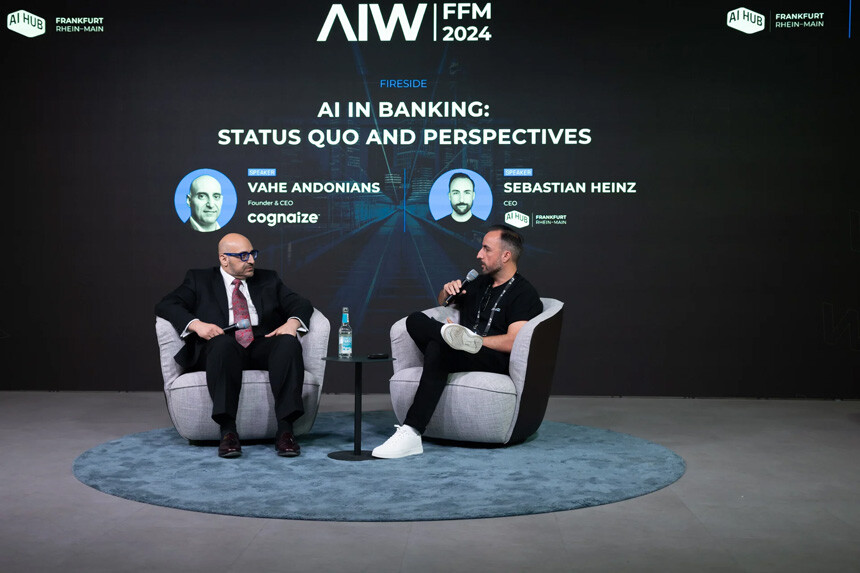
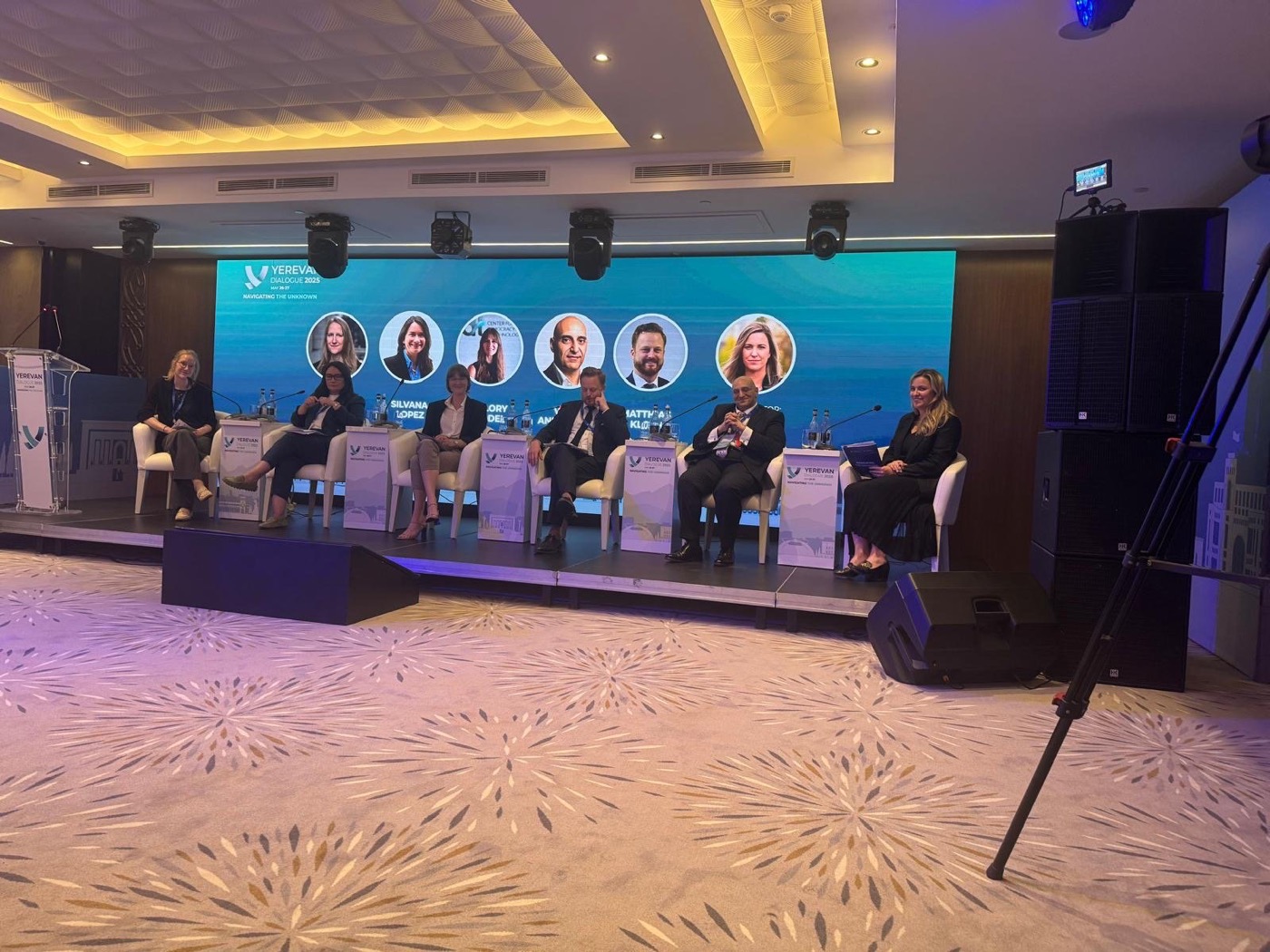
At AI Week Frankfurt in 2024, his discussion with organizer Sebastian Heinz included concentration of power in big technology companies, transparency and human oversight. In May 2025, he took related concerns to the Yerevan Dialogue, joining a panel about AI’s political and social implications. The financial workflow opens onto questions of responsibility: who can explain a system’s output, and who remains answerable for acting on it?
Through Hybrid Minds, he takes the interviewer’s seat as well. A January 2026 episode features Chris D’Agostino, chief data and AI officer at FIS, discussing enterprise AI, older software systems and back-office operations. The format puts Andonians in conversation with people facing the organizational consequences of the technology, beyond the moment when a model first produces an impressive answer.
His writing ranges further. A conversation with Skype co-founder Jaan Tallinn explored AI control, computational resources and centralization. His Medium profile collects technical essays alongside those interviews. The Tallinn discussion also considered whether taking inspiration from the brain could reduce the computing power AI requires. It asked what happens when computing resources are concentrated under one company’s control. These questions connect the technical architecture to the distribution of power around it, a subject that reaches well beyond the financial document. The builder and the lecturer appear comfortable sharing a desk: one asks how the system works; the other keeps asking what follows from using it.
In recent public posts, Andonians has returned to the responsibilities people retain when work is automated. He asks organizations to explain what employees will do next, where experience will matter and which decisions they will continue to own. His announced November 2026 DigiTec appearance in Yerevan is framed around the economics of AI and trust. Bigger models, in his argument, still have to earn their place in a business.
There is a recognizable line from that young trader’s qualification to the questions he asks now. A result deserves inspection. A system deserves understanding. Behind the neatly extracted figures sits somebody who has to decide what they mean. After years spent making information easier for machines to handle, Andonians keeps coming back to the person at the desk.