The advertisement that nobody has bought is an unpromising place to begin a career story. It is an empty rectangle, a missed sale, the bit of the internet left over after the people with purchase orders have gone home. Vadim Telyatnikov saw enough of these rectangles to make a business out of them.
At myYearbook, the social network where he worked in advertising operations, there were billions of impressions outside the direct sales team's deals. He built a system to manage hundreds of possible demand sources. The problem was immediate and practical. A page was loading. An advertiser might pay for the space. Someone had to work out which advertiser, at which price, before the opportunity disappeared.
There is a useful way to read the career that followed: as a succession of attempts to make overlooked transactions work better. Advertising, digital currencies, vendor bills and artificial intelligence have very different dinner-party reputations. In his working life, they keep presenting related questions about information, coordination and the distance between a promising number and an actual result.
A company hiding in the unsold inventory
Telyatnikov attended Penn State from 2000 to 2004. At myYearbook he was among the first dozen employees, close enough to a growing business to encounter its unfinished machinery. His eventual co-founder at LiftDNA was Kingchih Fan. The company launched in September 2009, taking a problem familiar from one publisher and offering a way to address it for others.
The design mattered. LiftDNA worked inside a publisher's existing ad server, bringing different sources of advertising demand into competition there. Publishers could retain their systems and commercial relationships. Anyone who has persuaded a company to replace an essential piece of software can appreciate the charm of an offer that lets it keep the furniture.
By June 2011, the company had more than 20 people and offices in New York, Pennsylvania and China. It had started with the founding team's own resources before accepting outside funding. Telyatnikov described that early choice as an exercise in concentrating on revenue, sales and capital efficiency. These are prosaic concerns, which is precisely why they make a useful foundation.
“We sell all the raw material at the mine.”
Vadim Telyatnikov, explaining LiftDNA in 2012
His mining analogy made the software easier to picture. In the conventional journey, material left the mine on a train, shedding some of its load along the way and reaching different buyers at different prices. LiftDNA proposed doing the selling where the material already was. The metaphor gave a physical shape to a digital inconvenience: value could disappear while everyone was busy moving it around.
The winning bid can still lose
In October 2012, writing as a senior vice president of OpenX Lift, Telyatnikov offered publishers an arithmetic lesson. A network promising a higher price might deliver less money once lost impressions were counted. His example compared a $10 cost per thousand impressions with a $9 offer. Apply different discrepancy rates, and the apparently inferior offer won.
Sometimes $9 beats $10.
Illustrative receipts for 10,000 impressions, before other factors. A worked example, not LiftDNA customer results.
It is a small example with a substantial implication. Revenue depends on what survives the process, including whether a buyer actually fills the opportunity. The publisher also needs to understand which impressions a particular network wants. Sending everything to the highest advertised price can be an expensive way to avoid thinking.
OpenX had acquired LiftDNA that February. The companies had already worked together at the product level since 2010. Their combination put yield optimization alongside an ad server and exchange. It also preserved LiftDNA's ability to operate with other ad servers, a practical extension of the original proposition: improve the publisher's economics without making every relationship start over.
The acquisition price was undisclosed. Around the deal, LiftDNA had roughly 30 employees, including 19 in King of Prussia. The useful scale here is human: a young company, a regional office and a product sufficiently complementary to become part of a larger platform. The transaction gave Telyatnikov a senior vice president's title. It did not hold him indefinitely.
Another market, another missing connection
By April 2013, he was leaving OpenX as LiftDNA's integration approached completion. His next announced projects were Admire Capital, a hedge fund, and Cvetlo, an incubator and seed investor. The move placed him on the other side of the startup conversation, considering where to put capital after building and selling a company himself.
AlphaPoint, founded in 2013, became another operating chapter. Telyatnikov was its CEO by 2014. A $1.35 million funding round brought together investors including Ben Franklin Technology Partners, DuckDuckGo founder Gabriel Weinberg, Robin Hood Ventures and Invite Media co-founder Scott Becker. Ben Franklin had also backed LiftDNA. A new market arrived with some familiar people around the table.

In a filmed conversation at Inside Bitcoins in Las Vegas, he explained the proposition in terms an exchange operator would recognize. AlphaPoint supplied the backend so customers could concentrate on their own markets, marketing and regulatory responsibilities. Building the exchange software was a demanding project in its own right. An entrepreneur starting an exchange already had quite enough other jobs.
He also described an awkward opening-day problem. A customer might arrive ready to buy bitcoin at a newly launched exchange and discover that nobody there wanted to sell. Connecting exchanges could help them share liquidity. A marketplace with a handsome entrance and no counterparty is, after all, mostly a waiting room.
Inside somebody else's exchange
At its 2015 Finovate appearance, AlphaPoint showed a revised trading interface with configurable displays, new order types and tools for administrators. The platform could support different currency pairs and connect through protocols familiar to financial institutions. The work involved making a developing market usable by organizations with existing systems, habits and expectations.
The founding team included Joe Ventura, whose experience included software architecture for financial institutions. Telyatnikov's commercial explanation and the team's trading technology met in a product sold under customers' own brands. That arrangement gives infrastructure businesses an unusual relationship with recognition: the customer can become better known while the supplier remains behind the screen.
In April 2015, Bitfinex and AlphaPoint announced completion of an integration's first stage, with live rollout underway. The work included real-time market data through a WebSocket API and an architecture intended to accommodate additional currency pairs and trading features. Testing and staged deployment were part of the announcement. The glamour of a market still required a careful software migration.
Brazil offered another example. FlowBTC announced an exchange powered by AlphaPoint, with connections to 20 digital currency exchanges planned from its first day. The local operator brought market experience; AlphaPoint brought the underlying platform and links to liquidity. Geography remained local even when the software and potential counterparties crossed borders.
The bill, the wallet and the person using it
There was a less fashionable variation on the same commercial puzzle at SIB Fixed Cost Reduction. Telyatnikov served as president and then continued as chief strategy officer when Kevin Flounders took over the presidency in March 2019. His expanded focus was the company's proprietary software platform, using pricing information to identify and implement savings.
SIB worked on recurring expenses such as utilities, telecom and waste removal. Its model tied its own fees to savings realized by clients. Here the interesting number appeared on an invoice rather than an exchange screen. Better information about prices could change what a business paid for services it was already buying.
By early 2022, AlphaPoint's work extended to improving El Salvador's Chivo wallet after its original launch. The existing application had faced complaints about reliability and access. The assignment involved the unromantic essentials of an application people expected to use: responsiveness, stability, transaction handling and better administrative tools for customer support.
Vadim and his brother Igor, also an AlphaPoint co-founder, discussed the project together that February. They emphasized a simple interface and access to financial services. That focus makes the scale of the task easier to understand. A national payment initiative eventually has to work for an individual making an ordinary purchase, without requiring that person to take an interest in the architecture.
A walk around Gramercy, with AI on the agenda
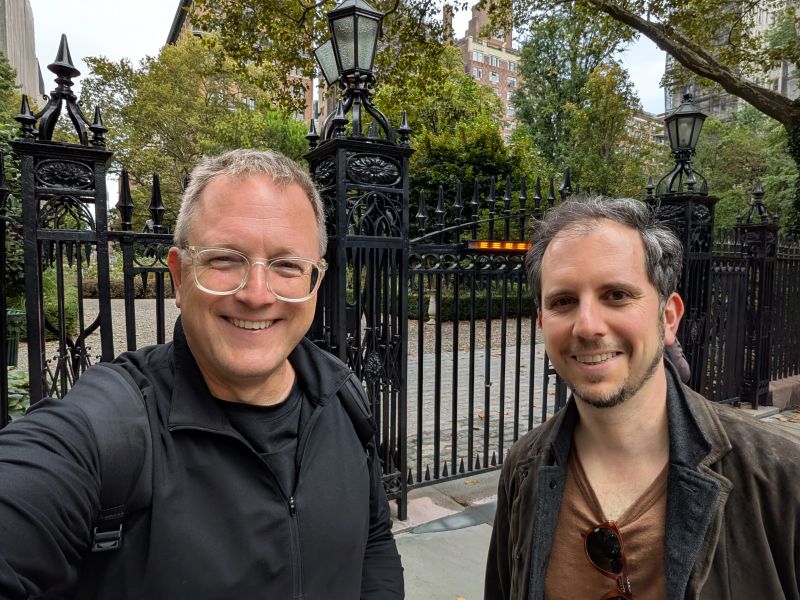
In October 2025, a conversation with Ted Merz around Gramercy Park supplied a more recent view of Telyatnikov's interests. He had been experimenting with AI for summarizing order books, identifying liquidity imbalances and executing trades through text commands. Other applications involved analyzing sales conversations to surface objections and competitive information.
“If AI can read your company's data, it can run parts of your business.”
Vadim Telyatnikov, in conversation with Ted Merz, 2025
Those experiments suggest continuity with his earlier work. The information already exists inside an organization; the commercial question is how to make it useful at the moment a decision is required. An unsold impression, an unmatched order, a vendor's price and a customer's objection all become more interesting when someone builds a system that can act on them.
Colleagues' public recommendations add a quieter detail. An advertising technology partner described his technical command, creative problem solving and calm response to difficult situations. These are observations from someone who spent hours troubleshooting with him. Much of the career takes place in just such hours, when software has to cooperate and the meeting has long since lost its novelty.
Telyatnikov's story began with space that had gone unsold. It has kept returning to the work that happens between an available opportunity and a completed transaction. The empty rectangle proved to contain quite a lot.