Moving house comes with an odd little revelation: your address belongs to more people than you thought. The internet company has it. The insurer has it. So do the magazine, the utility, and whichever business you last remembered just as you were falling asleep. The boxes are visible. The administrative mess is scattered across a dozen other people’s systems.
- For movers: one place to organize tasks and buy essential services.
- For property teams: checklists, reminders, and a view of who is ready to move in.
- For businesses: the machinery to sell complex services inside their own customer experience.
Updater grew out of that mess. Its interesting discovery was that the moving customer could be reached through someone who already knew about the move. Today, the company is applying that logic to a broader question: how do you put a purchase inside the place where a person is already making a decision?
The person holding the keys
David Greenberg, previously a mergers-and-acquisitions lawyer, got the idea during a move within Manhattan. He dates the company’s start to 2010. “The process was just incredibly inefficient,” he told TIME in 2014.
The first attempt to attract individual movers struggled. In 2013, Greenberg switched toward selling through real estate brokerages. An agent could offer the service when a client needed it. That change made the timing part of the product.
Consider the difference. A household moves occasionally; a brokerage encounters moving households continually. The partner has an existing relationship and a reason to make the handover pleasant. In this arrangement, software can travel with the transaction rather than wait for a stranger to discover it.
“Powering commerce anywhere decisions are made.”Updater’s current mission
That mission reads differently when you know the early story. Updater’s present ambition extends well beyond relocation, but the underlying idea remains familiar: find the place where the need becomes immediate.
A checklist with several interested parties
For the person moving, Updater offers help with internet and TV, moving assistance, renters insurance, mail forwarding, utilities, packing supplies, and other services. The moving app is invitation-based, with access through participating property managers. Its appeal is coordination: a household can work through tasks without assembling its own directory of separate businesses.
The app is free to movers. Updater says purchased services come at the provider’s price, without an additional Updater fee. Free access makes sense within a business that also serves the organizations around the household. The mover brings a need; the property partner brings a relationship; service providers bring something to sell.
A relationship diagram, not a chronological sequence.
Multifamily Resident Onboarding gives the property team its own side of the arrangement. Operators configure requirements, approvals, and branding around a community. Residents receive a tailored checklist; staff can monitor progress and open tasks. Automated follow-up takes over some of the calls and emails that otherwise become someone’s afternoon.
This is a useful distinction in the market. A moving quote solves the truck question. A provider website solves one service purchase. Updater places those individual tasks inside a larger transition. Moving and resident-service alternatives include Moved, Monadd, and Porch, although their scopes differ. The other competitor is the familiar collection of tabs, phone calls, and handwritten reminders.
Insurance without the extra expedition
The Assurant integration makes the coordination concrete. A property can specify its insurance requirements inside Updater and remind residents to complete them. Information about the household and community is populated automatically, reducing repeated entry.
With Assurant’s HO4 product, the resident can purchase insurance within the app. Cover360 can bundle renters insurance with rent. The property team gets a clearer route to checking a requirement before move-in, while the resident avoids another detour through another checkout.
There is commercial logic here as well as convenience. A transaction can happen while someone is completing a required task. For an operator evaluating the service, the sensible questions concern completion, staff workload, and the suitability of the offers residents see. An attractive checklist earns its keep only when the work behind it gets done.
Buying the connections
Updater expanded through acquisitions. In 2017 it bought IGC Software and Asset Controls, which supplied business-management software to moving companies. Bridgevine followed in 2019, bringing home-services customer acquisition. In 2021 it bought Dolly, a marketplace for local moving and delivery, for an undisclosed price.
Dolly addressed the smaller job: the move that did not require a full-service operation. At the time of the deal, it operated in 45 cities. The acquisitions suggest a company building more ways to handle the work a move generates, from industry software to service distribution and physical help.
Expansion required capital. In November 2021, Updater announced approximately $60 million in growth funding, with Second Century Ventures among the returning investors. In May 2022, it announced a $215 million investment from Vista Credit Partners. The latter came from Vista’s credit business; it should be understood as financing, rather than casually folded into a venture-equity tally.
The company said that capital would support new moving segments, marketplace and software products, and hiring. Those announcements describe what it intended to fund. They do not reveal the cost of acquiring each customer or maintaining each provider connection.
The checkout is the small part
The current product range turns Updater’s operational work into something other companies can use. Commerce-as-a-Service lets an audience owner embed purchases in an existing experience. Distribution-as-a-Service gives providers a route into multiple channels while Updater handles partner enablement and operational work.
A partner can choose a branded embedded flow, a native SDK, or APIs. Call Transfer sends a customer to Updater’s agents; Order Desk supports call-center ordering. The practical choice is how much of the interface the partner wants to build and how much of the purchase it wants someone else to operate.
Commerce APIs split two important jobs. Serviceability checks which providers and offers are available at an address. Ordering submits the purchase for provider-specific processing. That distinction matters: showing someone an appealing broadband price is of little use if the service cannot be installed in their apartment.
Value of products sold through Updater’s commerce rails. This measures transactions, not Updater’s revenue.
Updater’s current about page reports more than 250 businesses using its commerce infrastructure. The market position is that of an intermediary handling awkward purchases: products with local availability, eligibility rules, changing offers, installation, or regulated requirements. Its expertise sits in connecting those conditions to an actual order.
In a March 2026 account of its telecom operations, Updater reported a median of roughly four minutes between displaying plans and submitting an order. It also described 22 integration bridges and approximately 75 human agents outside peak seasons, with the agent count doubling at peak. A short customer journey can sit on a substantial operating business.
An AI agent still needs somewhere to place the order
In May 2026, Updater announced its Internet Store live inside ChatGPT. A person can enter an address, compare internet and TV plans, choose an offer, and proceed toward purchase. The company says the app connects through its API to more than 25 major US internet providers.
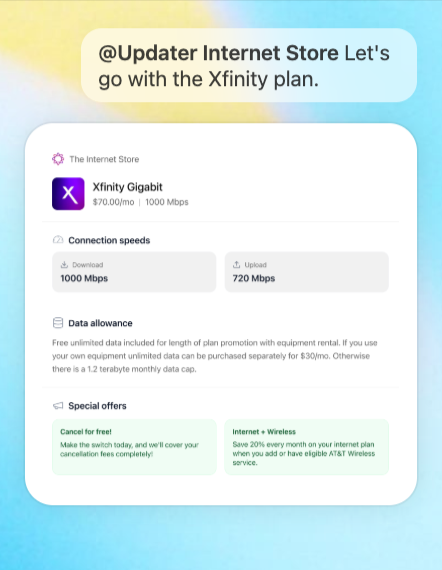
The AI Sales Agent product carries the same ambition into other channels: understand a customer’s needs, surface available options, explain them, and complete a purchase through connected infrastructure. An agent needs current offers and a working route into provider systems. Fluent conversation alone does not reserve an installation.
Other recent changes are less theatrical and just as relevant. Updater added Verizon 5G Home Internet to its offering in May 2026. In April, it announced completion of a SOC 2 Type 2 security examination by Schellman, covering a six-month period. For a business integrating an outside service into its customer journey, the security review belongs in the buying decision.
What to borrow, and what to check
The copyable lesson is distribution through an existing moment of need. Find the organization that already knows the customer is about to act. Give that organization a useful reason to introduce your product. Then make the introduction worth the customer’s time.
That approach depends on a partner having timely information, a relationship people trust, and a problem your product can actually solve. If an invitation arrives too late, or the customer’s provider is unsupported, the neat sequence breaks. A consumer without a participating property partner cannot assume access to the invitation-based moving app.
For businesses, the tradeoff is dependence on another company’s catalog and operations. Building direct connections may suit an organization that wants this capability at its core. Buying Updater’s infrastructure may suit one that wants to offer services without maintaining every provider relationship itself.

Updater’s story gives the cardboard box some overdue competition. A move is also a cluster of decisions, permissions, appointments, and purchases. Put useful help inside that cluster and people have a reason to use it. Keep the connections working and businesses have a reason to pay for it. The interesting work happens before the van arrives.
Updater website ↗ · Moving app · Developer tools · Company news
LinkedIn · X · Instagram · Facebook · GitHub
Watch Updater’s video playlist ↗ · Assurant product walkthroughs ↗