The appointment was for Friday, February 25, 2022. Twelve Ukrainian startup teams had cleared the preliminary screening and were due to pitch for state grant money. By then, Russian forces were advancing on Kyiv. There would be no Pitch Day. A government-backed startup fund designed around orderly applications, expert scores and tidy presentation decks had collided with a fact no spreadsheet could model.
That missed appointment explains the Ukrainian Startup Fund better than its institutional biography does. The organization, legally called the Innovation Development Fund, opened in 2018 with a 390 million-hryvnia state capitalization and a fairly crisp assignment: help promising Ukrainian technology companies across the ugly gap before conventional investors are comfortable. Its standard offer became $25,000 for pre-seed teams and $50,000 for seed companies, without taking shares. Founders kept the upside. The state monitored where the money went.
USF is not a venture firm in the usual Sand Hill Road sense. It has no limited partners demanding a tenfold return and no carried interest waiting at an exit. Nor is it merely a ministry desk dispensing innovation-themed subsidies. Applications travel through an electronic portal with digital signatures. Independent investment experts score them. A supervisory board makes funding decisions. For ordinary startup selection, the fund says civil servants do not judge the companies. Its neatest slogan is procedural: “the market selects the market.”
The first check comes with a filter
The customer is a founder with more than an idea but less than a finance department: a Ukrainian-registered startup at pre-seed or seed, perhaps building a prosthetic hand, a fintech tool, education software, agritech hardware or a deep-tech prototype. USF says it supports any lawful field, though individual programs narrow the brief. The 2024 grant program backed by the Western NIS Enterprise Fund excluded military production and teams that had already received certain Brave1 or Seeds of Bravery grants.
The money is non-repayable when spent according to the agreement, and USF takes no equity. That solves two early-stage problems at once. A young company can fund an MVP, validation or market entry without finding a valuation too early; public money can accept technical risk without pretending every grantee will become a unicorn. But free capital is not casual capital. Reviews typically take two to three months. Funds are restricted, reports are required and USF has described two years of post-grant monitoring.
“Our mission is the so-called seeding - creating conditions for the growth of projects.”Pavlo Kartashov, former director of Ukrainian Startup Fund
Selection is deliberately severe. In a 2022 review, the fund said it financed about one application in 27. The criteria covered the team, market, product or idea, strategy and whether grant funding could plausibly move the project forward. Before the full-scale invasion, more than 4,500 applications had produced over 250 funded startups, $6.4 million deployed and 37 pitch days. Early portfolio reporting suggested those companies later attracted about $30 million - roughly five dollars of follow-on funding for every grant dollar.
A grant became a ladder
Then the customer changed
The first thing to fail in 2022 was the familiar funding rhythm. The main grant programs paused because startups could not operate normally and the state had urgent priorities. USF did not disguise the interruption. Instead, it looked for technology that could help the country immediately. A dual-use program offered as much as $35,000 to projects in defense, cybersecurity, health, education and reconstruction. In its first months, it drew 181 applications; infrastructure reconstruction led with 74, followed by defense with 54 and health with 28.
That experience fed into Brave1, the defense technology cluster launched in 2023. The institutional split now reads almost like a portfolio allocation: USF handles civilian innovation while Brave1 focuses on defense. It is also a revealing change of mind. Before the invasion, keeping officials outside startup selection was a mark of market discipline. For dual-use technology, relevant ministries and state bodies needed to be in the room because the user might be the military, regulation could block deployment and procurement mattered as much as investment.
What founders keep
Their equity. Compliant grants do not need to be repaid. That makes USF useful before a conventional priced round, when a small ownership concession can become painfully large later.
What founders trade
Speed and flexibility. Competitive review can take months, spending is monitored and eligibility is program-specific. A team that needs unrestricted cash next week should look elsewhere.
A small fund learns to borrow scale
The more consequential wartime pivot was not simply toward military technology. It was from relying on a state checkbook to assembling other people's assets. WNISEF supplied $2.5 million for a renewed civilian grant program in 2024. The European Union's €20 million Seeds of Bravery project put USF in a consortium of 17 partners and two associates; €12 million was earmarked for grants to about 200 Ukrainian startups. FundingBox coordinated, while organizations including Plug and Play, Luxinnovation, accelerators and universities supplied routes into European markets.
Seeds of Bravery divided help into five practical bands: business services, entrepreneurship and continuity, deep-tech incubation, rebuilding Ukraine, and deep-tech scale-up. Individual grants ranged from €10,000 to €50,000, with a recipient able to collect no more than €60,000 across the program. That menu recognizes a plain truth: the same amount does not solve the same problem for a founder validating demand and a scale-up entering the European Union.
The repeatable bit
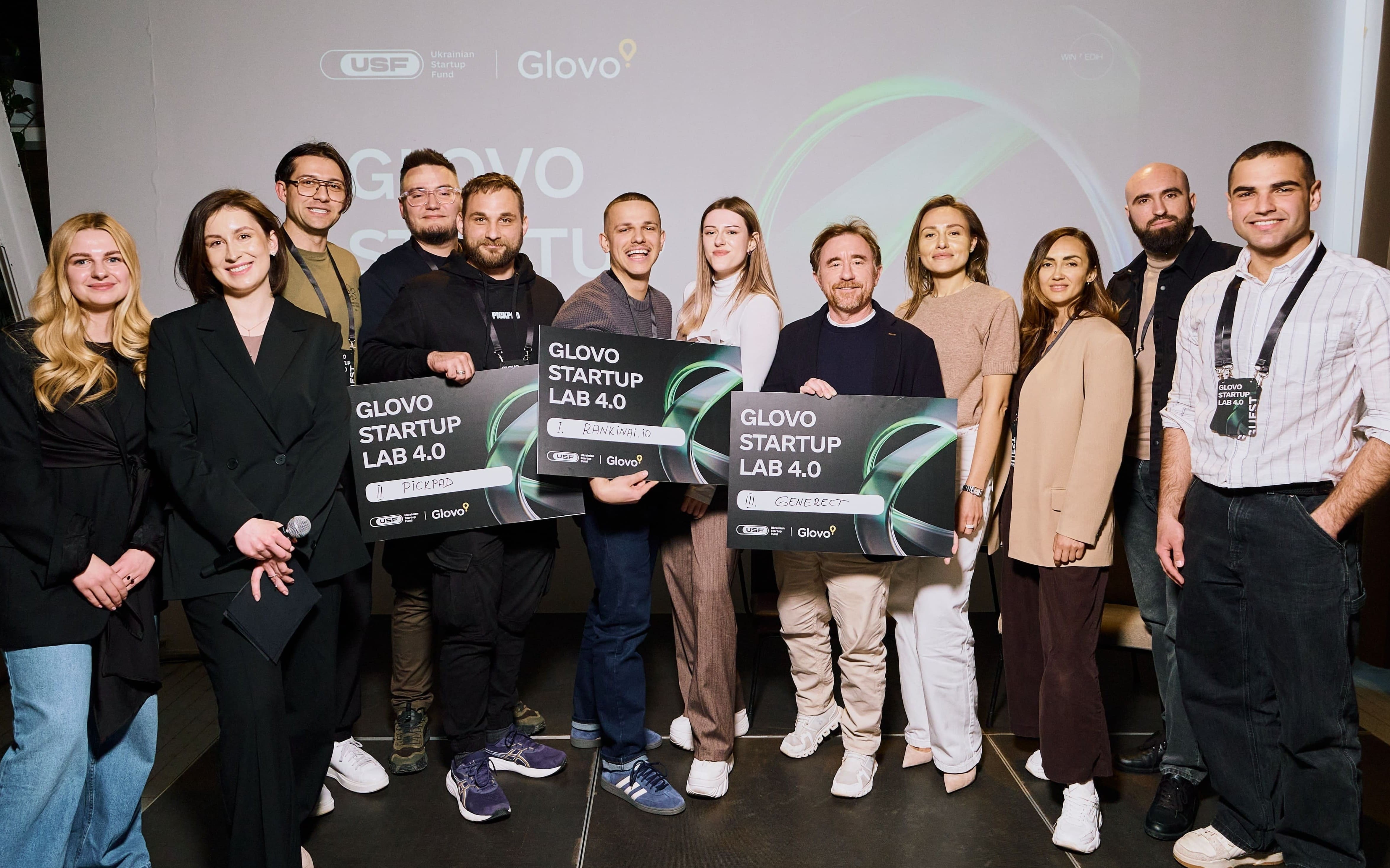
Corporate partnerships stretch the offer further. Amazon Web Services has supplied eligible startups with cloud credits, support-plan credits and architecture advice. In 2026, referrals through Microsoft for Startups could unlock as much as $200,000 in Azure credits plus developer and business software; Cloudflare added up to $100,000 in credits. Glovo's Startup Lab combines mentors, small cash prizes and internships at its Barcelona headquarters. A cloud credit is not revenue, but for a software company it can postpone a very real bill.
The pavilion is part of the product
USF also sells access without charging for it. Its tech missions select Ukrainian companies for national delegations at CES, 4YFN, VivaTech and other conferences. Depending on the mission, a startup may get exhibition space, passes, delegation events and curated meetings; some programs cover travel, while others explicitly do not. More than 500 startups have attended 50 major technology events through the fund's programs.
This is not conference tourism dressed as policy. The 2025 VivaTech call required a working company with growth ambitions, Ukrainian technology or R&D, and readiness to report subsequent investment, partnership and customer outcomes. The 2026 Panathēnea delegation produced dozens of meetings: USF reported that Wild.Codes held investment conversations with more than 20 funds and companies, while UCAT-3D identified a potential $2.2 million investment pipeline. Neither figure is a signed deal, and the distinction matters. Introductions are an input, not an exit.
The fund's market position sits between a VC, an accelerator and an export agency. Private investors can move faster and write flexible checks, but demand ownership and returns. A general grant program may provide money without understanding startup milestones. Corporate accelerators offer industry access but naturally serve corporate agendas. USF's difference is the bundle: non-dilutive first capital, market experts, a government interface, practical services and a blue-and-yellow booth in the places private investors already gather.
What another country can copy
The portable idea is not “government should pick startups.” It is narrower: government can underwrite the first risk while outsourcing much of the judgment to credible market participants. Put applications online. Publish specific tickets. Separate eligibility from investment scoring. Monitor use, then track private capital and survival after the grant. Build a partner layer so founders can receive expertise, infrastructure and market access without expanding the public payroll each time.
The model also needs conditions USF cannot manufacture alone. There must be enough capable founders to make competitive selection meaningful, independent experts willing to work, legal infrastructure for transparent grants and private capital waiting farther up the ladder. A grant will not fix weak demand or make a local-only product global. Conference travel is wasted on a team without a working prototype, fluent representative or follow-up discipline. Cloud credits help a compute-heavy company; they do little for a hardware startup whose bottleneck is certification or manufacturing.
Public funding also carries an unavoidable measurement trap. Dollars awarded, applications processed and meetings held are easy to count. Counterfactuals are harder. Would the best companies have raised anyway? Did a private round arrive because of USF, or merely after it? The fund's two-year monitoring and follow-on ratio are better than an applause line, but they are not a randomized trial. Its self-reported totals should be read as operating signals, not a clean claim of causation.
Still, the trajectory is unusually legible. A peacetime grant fund became a wartime routing layer, then a civilian platform tied to defense infrastructure, European programs, corporate laboratories and international stages. In 2026, the €1 million Startup EDGE program narrowed attention to deep tech, green tech and education; a national network linked 23 startup schools, incubators and accelerators. The fund keeps changing because the gap it was built to fill keeps moving.
On February 25, 2022, the deck stopped being the important document. The interesting work since then has been institutional: deciding what only the state could do, what independent experts should do, and what partners could do better. USF's answer is imperfect and paperwork-heavy, but concrete. Write the first check. Keep the founder's cap table intact. Then make the check an entrance, not a destination.