Udit Batra had a perfectly reasonable engineering objective: more time to play video games. As a schoolboy in India, he received an Atari his father had brought back from Britain. The machine consumed eight D batteries, which, in his recollection, lasted about an hour. Entertainment had acquired an unfortunate operating cost.
He decided to build a power supply. His electronics teacher, Mr. Gill, had taught him enough about components and soldering to attempt it, even though he was barely passing the elective. After several weeks of staying behind at school, he finished the project. Mr. Gill gave him full marks.
Years later, Batra remembered the teacher as carefully as the machine. The episode supplies a rather good introduction to the president and chief executive of Waters Corporation: an immediate problem, some technical knowledge, and somebody willing to let a student try.
Two teachers, several countries
Batra was born in New Delhi on January 7, 1971. His childhood crossed borders: he studied in Britain and Nigeria before moving to the United States at 15. Later work would take him to Australia, Germany, Switzerland and Japan. When he discusses that itinerary, he emphasizes exposure to different perspectives. Travel supplied a practical education in how differently people can see the same situation.
Both his parents were teachers. He credits his father with resilience and his mother with compassion. He has called his wife his “Co-CEO,” describing a shared commitment to education and philanthropy. In his account of family life, their two sons supplied another kind of instruction: a daily demonstration of how readily children accommodate change.
There is a pleasing continuity here. A child of teachers becomes an engineer and eventually a corporate leader, but the classroom keeps reappearing. The setting changes. The obligation to explain yourself survives.
The graduate student takes evening classes
He completed his chemical engineering degree at the University of Delaware in 1991 and his Princeton doctorate in 1996. At Princeton, his adviser was William Russel. Batra remembers the insistence on understanding a problem at its foundations, an expectation that followed him beyond university.
One research problem resisted him for months. A conversation at Princeton’s Hoagie Haven with an assistant professor produced a suggestion: try the reciprocal of the function. It worked. An academic breakthrough arrived with considerably less ceremony than a graduation procession.
His subsequent move toward business also began with a question. As his laboratory responsibilities grew, administration occupied more of his time. A friend suggested exploring business, so Batra took evening finance and accounting classes at Wharton. He wanted to understand how laboratory work connected to business decisions. The curiosity preceded the career change.
That sequence matters. The executive who later talked about commercial growth had first spent years confronting the uncertainties of experimental work. He knew the customer’s bench from the customer’s side.
Chemical engineering
Doctorate
President & CEO
A career with more than one syllabus
His early professional years were at Merck Research Labs in West Point, Pennsylvania. A research fellowship from 1996 to 2001 was followed by consulting at McKinsey, then a global brand role at Johnson & Johnson. He joined Novartis in 2006, working in corporate strategy and later leading its business in Australia and New Zealand.
These were changes of discipline as well as employer. Laboratory research, consulting, marketing, strategy and country management each require a different account of what a good day’s work looks like. A sound experiment and a sound operating plan have different audiences. Both become vulnerable when their assumptions remain unexamined.
In 2014, he took charge of Merck Millipore, overseeing its strategic direction, product innovation and worldwide operations. The business supplied scientists, engineers and researchers, a constituency whose daily needs he already understood. His career had carried him away from the laboratory bench and back to the businesses that equip it.
The chemistry of a large combination
The acquisition of Sigma-Aldrich closed in 2015. Batra led the formation of MilliporeSigma, bringing together businesses with different strengths. Merck Millipore had capabilities in processing and purification. Sigma-Aldrich brought a broad research portfolio and an established online route to customers.
His explanation of the opportunity was disarmingly ordinary: scientists needed to find and obtain what they required without a complicated shopping expedition. A portfolio could be scientifically impressive and still be awkward to buy from. The website mattered alongside the chemistry.
A large combination asks people to change while continuing to serve customers. Batra worked with Sigma-Aldrich chief executive Rakesh Sachdev during the period before closing. The challenge included keeping both organizations working while preparing them to work together. The deal announcement was one event; the integration was a prolonged series of decisions.
By the time he moved to Waters, he had run a business with roughly $8 billion in sales and more than 22,000 employees. Size had become familiar. So had the gap between announcing a plan and getting people to carry it out.
An old customer gets the keys
Batra became Waters’ president and CEO on September 1, 2020. His acquaintance with its technology was much older. As an undergraduate, he had used TA instruments during his second year at Delaware. Returning as the chief executive gave that student experience an unexpected sequel.
Waters makes instruments, chemistry and software used in analytical work. Much of the work happens outside public view, in laboratories where a result has to be reliable and another person has to be able to reproduce it. The company’s commercial challenge was to make its technical capabilities translate more consistently into growth.
One early organizational step was concrete. In 2021, Waters established an Innovation Board chaired by Batra, bringing together research and development, business development and marketing leaders. Its remit included identifying unmet needs, examining technical proof of concept and monitoring major programs. Scientific interest would have to travel through a sequence of questions before becoming a product.
“I believe that all collaboration starts with transparency.”Udit Batra, September 2020
Six weeks before the answers
At Waters, Batra and his team spent their first six weeks examining the business with employees, directors, customers and shareholders. The work included products, finances, geography and technology. He also persuaded three experienced colleagues contemplating retirement to remain for another six months.
His account of the turnaround places a premium on simplifying priorities. Instrument replacement, service and online purchasing were among the commercial tasks. He describes the leadership qualities he looks for as competence, courage and compassion: know the work, make decisions, and understand the people affected by them.
There is an instructive restraint in retaining experienced people while changing how the business operates. Institutional knowledge can be difficult to replace precisely when a new leader most needs it. Listening carries an operational benefit.
The same discipline applies to meetings. Batra wants disagreements expressed in the room, where colleagues can answer them. The private conversation afterward may feel easier; it leaves everybody else working with an incomplete version of the discussion.
A laboratory door that opens both ways
His approach to research includes an admission every company could usefully make: its own staff cannot know everything. In a 2023 interview alongside Waters research leader Steve Martin, Batra described three tests for innovation: the importance of the unmet need, evidence that the idea works, and its commercial prospects.
The Immerse laboratories give that approach a physical address. Customers and collaborators can work with Waters teams and measurement technologies. The idea is to put difficult questions close to people equipped to investigate them, rather than hoping an occasional meeting will do the job.
The Delaware partnership, announced in October 2021, connected Waters scientists with university students and faculty through a five-year research agreement. College of Engineering dean Levi Thompson helped develop it with Batra. An alumnus returned with more than a speech: a working relationship between an instrument company and a university. For students, that meant contact with problems arriving from beyond the curriculum.
- 01Does the problem
need solving? - 02Does the
idea work? - 03Can it become
a business?
Bengaluru joins the working map
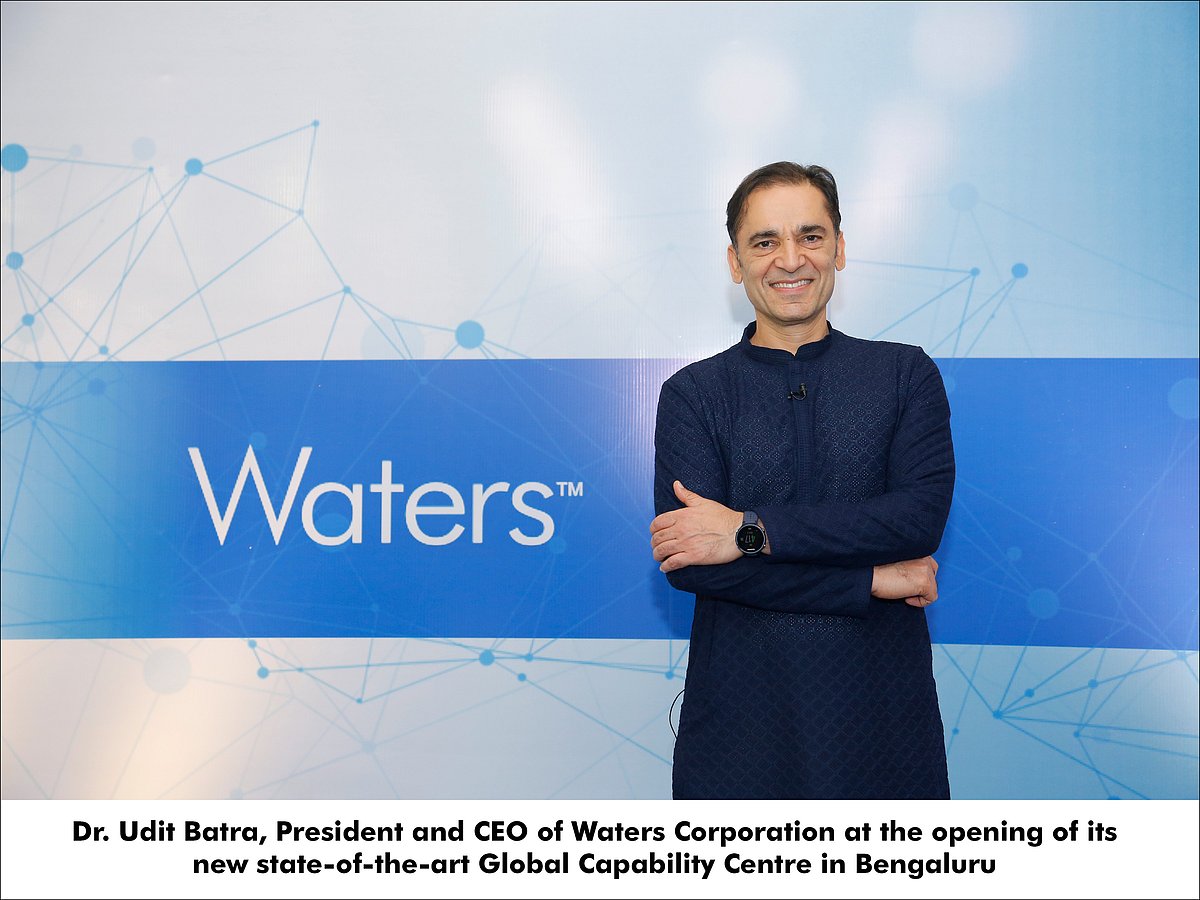
In December 2023, Waters opened a Global Capability Centre in Bengaluru with an investment of about $16 million. Its initial workforce of more than 300 included software, mechanical and hardware engineering, product development and data analytics expertise.
For Batra, India was both a market and a location for technical talent. That distinction gives the expansion its interest. A company can sell into a country while keeping its thinking elsewhere. A capability centre places more of the work of building and improving the business there.
The photograph from the opening catches him away from the conventional executive suit, standing in front of the Waters name. The occasion is a useful marker of how widely his career now travels: born in New Delhi, educated at Delaware and Princeton, leading from Massachusetts, opening an engineering centre in Bengaluru.
The CEO meets the summer students
The educational work becomes particularly tangible in Waters’ student programs. In the summer of 2021, a pilot brought Boston-area high school students into the company through partnerships with Jeremiah Burke High School and Team New England.
The program ran three days a week over six weeks. Students encountered ten departments, scientific and business topics, experiments, presentation skills and a basketball game with Waters colleagues. Batra met them as a group and individually. At the end, they presented their work to company leaders and educators. It was an introduction to working life that included the chance to be heard by people already established in it.
By 2022, the Waters Student Academy offered a five-week summer immersion, with experiments, manufacturing technology, equipment service and regular mentoring. The curriculum connected technical work with the paths people had taken to reach it. A student could ask how somebody acquired the job, as well as what the job involved.
“Diversity is a statement; inclusion is an act.”Udit Batra, October 2020
The next difficult thing
The connection to education extends to family giving. Batra and his wife support the Batra Family Scholarship for Chemical Engineering at Delaware. He joined the university’s Board of Trustees in 2024. At Princeton, he serves on the Graduate School’s Dean’s Leadership Council and was among the 2022 Clio Hall Award recipients, recognized for contributions to graduate students’ professional development.
In February 2026, Waters completed its combination with BD’s Biosciences & Diagnostic Solutions businesses, with Batra continuing as CEO. The transaction valued the acquired business at $18.8 billion at closing. By August, Waters reported second-quarter revenue of $1.645 billion and raised its full-year outlook. The enlarged company gives him another integration to carry through.
The scale has changed considerably since the Atari project. The personal thread remains visible in the scholarship, the university relationships and the meetings with summer students. Somebody once gave a barely passing electronics pupil enough instruction and encouragement to finish a useful piece of work. Decades later, Batra is helping put other students within reach of their own next attempt.