Ken Cahill used to go to Dublin airport with his father to watch the planes. They would sit by the fence with an aviation radio, following the arrivals and departures. Years later, his brother-in-law gave him a three-hour documentary about preparing a flight from Dublin to San Francisco. Cahill watched it more than once. Some people require a plot twist. Apparently, a departure checklist will also do.
He had wanted to be a pilot. His working life took him through computing, multinational technology companies and the founding of SilverCloud instead. Yet there is something useful about that early fascination with the machinery behind a journey. His own business story turns on preparation, distance and the awkward business of getting an organisation somewhere its founder cannot take it alone.
In 2017, he asked his board to let him move to Boston. SilverCloud had established itself in Ireland and Britain; America required a different commitment. Cahill decided he needed to live there. Four years later, Amwell acquired the business. The transaction supplies the obvious ending. His earlier decision to relocate supplies the more interesting question: how much of yourself must you move before a company can travel?
01 Before Boston, a shared beginning
SilverCloud became a company in 2012, emerging from a research collaboration involving Trinity College Dublin, the National Digital Research Centre and Parents Plus. Cahill joined while that work was approaching commercialisation. He entered a project with a history, colleagues and ideas already in motion. The origin matters because it complicates the familiar founder portrait: one person at a whiteboard, apparently inventing both the product and everyone else's job.
The founding group included James Bligh, Karen Tierney, Gavin Doherty and John Sharry alongside Cahill. Bligh became chief technology officer and Tierney chief product officer. That distribution of responsibility makes the company easier to understand. It brought together people who could build, design, investigate and sell. Cahill's role was to help make their combined work into a business that customers would buy and a team could sustain.
He arrived with a BSc in computing and further study in new business management. His career had included senior positions at Gateway, HP and Dell. Those names place him in the working world of established technology businesses before SilverCloud: organisations with channels, customers and management structures already in place. His next undertaking would require building an organisation rather than joining one.
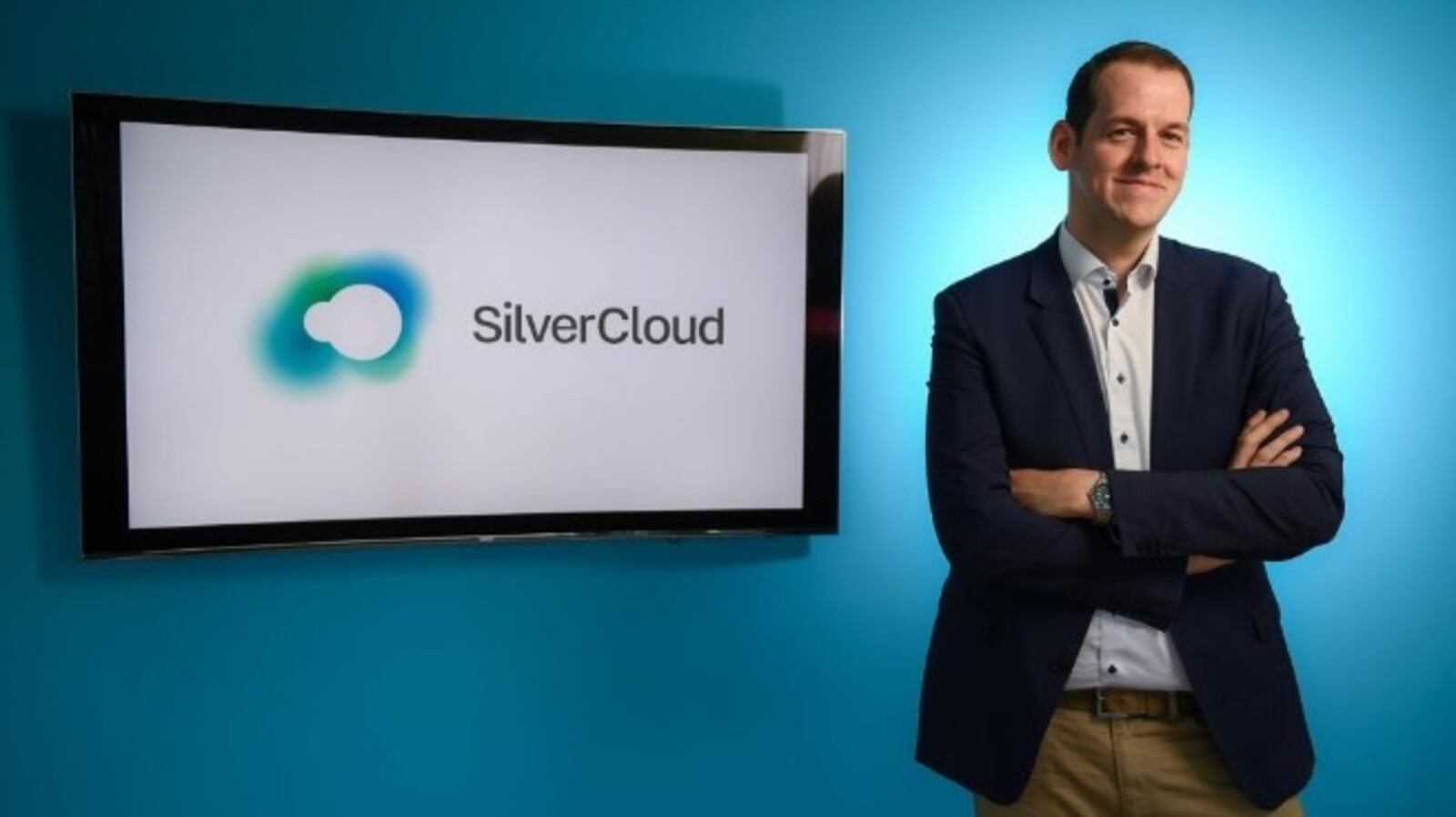
02 The Atlantic was part of the job
By January 2017, SilverCloud had raised an $8.1 million Series A. B Capital, established by Eduardo Saverin and Raj Ganguly, led the round; ACT Venture Capital and existing investors also participated. The stated ambition included expansion in North America and Europe. Raising money gave the company resources. Deciding where the chief executive should wake up in the morning was a separate management decision.
Cahill's request to move to Boston put a person behind that ambition. A foreign market can look straightforward on a presentation slide: another coloured territory, another column of projected revenue. Living there means accepting its calendar and its daily business. His move is the concrete detail that gives the expansion story its weight. He was prepared to relocate his life to pursue the market.
By March 2021, he was discussing a company that had grown from four people to around 90, with Australia and Germany among its expansion plans. Those were ambitions at that moment, rather than a licence to treat every proposed market as a completed conquest. Still, the change in scale was visible. A business spun out in Dublin had become a concern with decisions to make across countries.
His observations about Ireland were unusually specific. He saw useful support for businesses starting out and for those that had reached scale, with a thinner stretch in between. Moving from roughly 40 employees towards 200, he argued, could leave a company in a support gap. Small companies are urged to grow. The middle of that journey can be a surprisingly lonely address.
- 2012Research becomes a company
- 2017$8.1m Series A
- 2020$16m Series B
- 2021Amwell acquisition
Financing milestones, not annual revenue.
03 Money brought more people to the table
The next funding round made the American connection more substantial. In April 2020, SilverCloud announced a $16 million Series B, taking total funding above $30 million. MemorialCare Innovation Fund led, with LRVHealth, OSF Ventures and UnityPoint Health Ventures joining existing investors ACT and B Capital. Cahill spoke about using the money to deepen the company's presence in North America and Europe.
The composition of that group deserves attention. These investors brought experience in the market where SilverCloud wanted to expand. Money was part of the arrangement; knowledge of potential customers was another. For a founder trying to turn international interest into an established business, the people around the table can matter alongside the amount printed in the announcement.
Cahill also described a practical use for the funding: strengthening sales and support, with hiring across Boston, London and Dublin. It is an unfashionably ordinary detail, which makes it revealing. Expansion needs people to explain an offering, help organisations use it and keep relationships working after a contract is signed. A funding announcement fits into a paragraph. The work it finances occupies a payroll.
Recognition arrived along the way. SilverCloud received Deloitte's Export Award in 2019 and its Impact Award in 2020, after appearing in the Technology Fast 50 in 2018. In August 2021, Cahill was named Business Person of the Month by The Irish Times in association with Bank of Ireland. The sequence records a company becoming visible abroad, then a founder becoming visible at home.
04 A founder has to stop being the filing cabinet
There is a revealing passage in Cahill's account of managing growth. Asked about what excited him, he turned towards process and succession: getting knowledge out of his own head and the heads of other leaders. Anyone who has waited for the one colleague who knows how everything works will recognise the problem. An organisation can acquire more employees while keeping a single point of permission.
“SilverCloud is bigger than all of us.”
Ken Cahill, 2018
That sentence proposes a demanding test for a founder. The company should develop an ability to function beyond the people who started it. Decisions need somewhere to live; responsibilities need owners; colleagues need room to act. Read that way, Cahill's interest in process is an interest in making growth durable. A chief executive's memory is a fragile place to keep an expanding company's operating instructions.
His remarks about company values have a similarly practical edge. He wanted principles to affect choices even when following them carried a cost, and wanted other people empowered to challenge the organisation against them. The attractive words on an office wall would need to survive a less attractive decision. That is a useful standard for assessing any employer's declarations: watch what happens when the declaration becomes inconvenient.
He was also willing to say that increased demand did not automatically increase a team's capacity to deliver. In 2020, he cautioned that people's productivity had changed and that the business needed to respect that reality. It is a modest management observation with consequences. A market opportunity can arrive faster than an organisation's ability to absorb it. The customers and the colleagues still need someone paying attention.
05 The acquisition, and the morning after
Amwell announced its SilverCloud transaction in July 2021 and confirmed the acquisitions of SilverCloud and Conversa in August. The frequently reported $250 million SilverCloud figure needs its business context: the announced agreement provided approximately $210 million in consideration, with up to $40 million more linked to performance. The headline number described a potential transaction value, not a cheque made out to Cahill.
After the deal, Cahill joined Amwell's leadership. For him, the acquisition offered access to markets and resources that would have taken longer to assemble independently. In October 2021, he described an ambition to double the organisation over the following year. That was a plan, with all the recruiting work a plan of that size implies. A larger parent could supply resources; people would still have to build the next stage.
By 2022, he was discussing the journey with Gary Fox, including the move to America, slow progress and how it felt to wake up after selling the company. His reading recommendations included Richard Branson's Losing My Virginity and Marcus Aurelius's Meditations. It is an entertaining pairing: an entrepreneur inclined to attempt things, and an emperor with advice about one's response when things happen.
The public career has since widened. Cahill describes himself as an investor, independent board member and adviser. His former school, St. Conleth's College, listed the class-of-1999 alumnus as guest speaker for its business lunch on 16 October 2026. The boy who watched departures now has an entrepreneurial journey to bring back to a Dublin audience.
The aviation documentary remains a pleasing detail to set beside all those financing rounds. Three hours of preparation before a flight is a particular choice of entertainment. It also gives this story an appropriate closing image: the interest lies in how things are made ready to move. Cahill crossed the Atlantic to help a company grow, then argued that its workings had to extend beyond his own head. Eventually, other people need to know the checklist.
Follow the journey
Conversations, career connections and the next departure.