At 10 p.m. on an interstate, a truck driver has a problem that sounds trivial until the clock is running out. The next parking lot may be full. The weigh station may be open. A road that looks fine on a consumer map may have a low bridge, a weight restriction or a turn that an 80-foot combination cannot make. A missed guess is not an irritating detour. It can mean a citation, a tow, a damaged trailer or the miserable hunt for legal parking after hours-of-service time expires.
Trucker Path built its business inside that gap. The Phoenix company began in 2013 as a mobile map of truck stops, rest areas, scales, parking and other places a professional driver needs. Drivers could update what they saw, turning thousands of isolated observations into a live layer of road intelligence. The company now reports more than 11 million lifetime downloads, 5 billion miles routed, 100 million monthly check-ins and more than 1 million monthly active users.
Calling it “Waze for truckers” is useful shorthand, but incomplete. Waze helps a car avoid traffic. Trucker Path has to understand whether a vehicle of a specific height, weight and configuration belongs on the road at all - then help its driver find diesel, a shower, a scale and a place to stop. Around that map, the company has assembled paid navigation, fleet routing, a load board, dispatch software, an electronic logbook, partner deals and, since 2025, a retail insurance agency.
The first product was other truckers
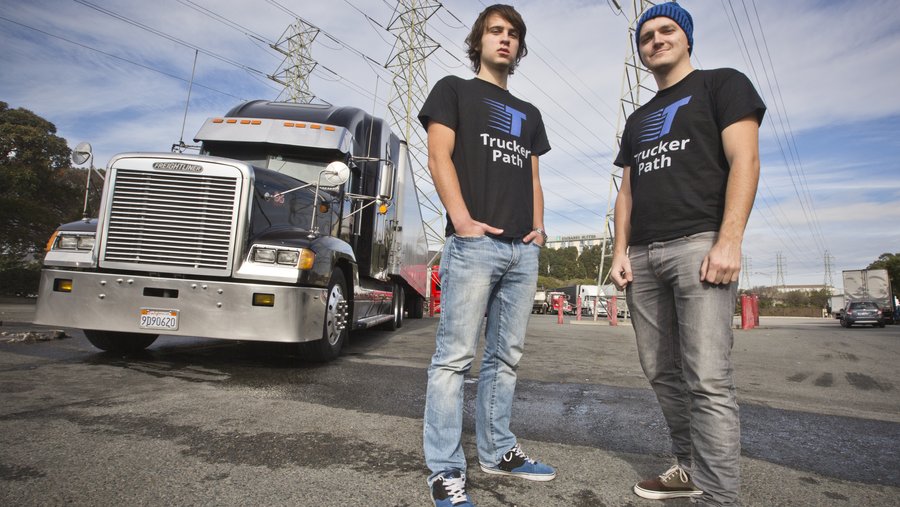
Viktor Radchenko developed the early app after hearing trucker friends complain about finding truck stops. He teamed with Ivan Tsybaev, who became the first chief executive, and the pair formally built the company in 2013. Their clever decision was to resist starting with the grand marketplace. First, they made a tool drivers had reason to open every day.
That distinction mattered. A freight marketplace is empty and useless before it has carriers and loads. A parking map can help its hundredth user even if the business has no broker revenue. Every report makes the next visit more useful: one driver marks a scale open, another rates a stop, a third reports a lot filling up. More drivers improve the map; a better map attracts more drivers.
By early 2015, Trucker Path said it had 100,000 registered users. A $1.5 million seed investment from Renren arrived in March, followed by a $20 million Series A led by Wicklow Capital that June. The company was reporting nearly 300,000 active users and launched TruckLoads, a marketplace connecting drivers and carriers with freight brokers. The fashionable pitch was “Uber for truckers.” The durable bit was less glamorous: a trusted audience already looking at the screen.
What it costs - and what the driver gets
The present model is layered. Free users can inspect truck stops, parking updates and the driver community, and search the TruckLoads board. Paid navigation is where the subscription begins. Public help documentation in 2025 listed Gold at $14.99 a month or $149.99 a year, adding truck routing, turn-by-turn directions, parking and weigh-station predictions, offline maps and an ad-free interface. Diamond was $29.99 monthly or $249.99 annually, adding unlimited stops plus hours-of-service and fuel optimization. Prices and plan names can change, so the checkout screen remains the final word.
Diamond's wager
The company asks an individual driver to pay roughly the price of a roadside meal each month for multi-stop routing, fuel planning, offline maps and parking predictions. The value is easiest to see when one avoided toll, bad turn or fuel stop covers the fee.
7-day trial
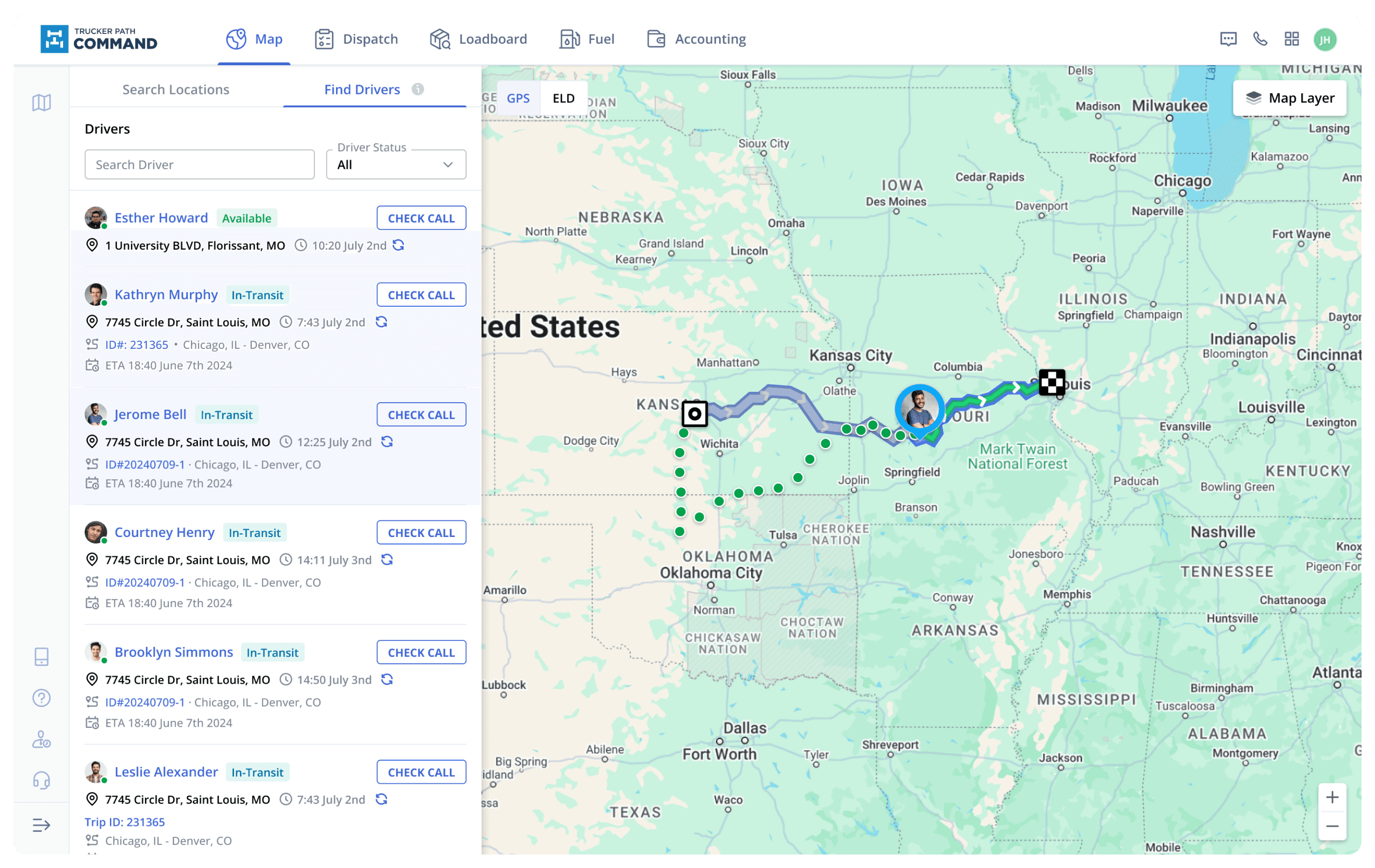
Fleets buy a different outcome: consistent routes and administrative control. Managers can create vehicle profiles, add custom locations, distribute licenses and send routes to drivers. Integrations connect order data and in-cab hardware. In one company case study, Christenson Transportation began using Trucker Path routes in 2023 after its driver council had heard about the app and liked its features. McLeod Software supplied order-location data; Trucker Path built the routes; Samsara devices put them in the cab. The carrier said driver calls about routes were nearly eliminated.
The first thing to fail is trust
The same crowdsourcing that gives Trucker Path an advantage creates its most obvious weakness. Parking status ages quickly. A weigh-station report can be wrong minutes later. A route database can miss a restriction. App-store reviews are broadly positive - Apple shows a large volume of high ratings and Google Play lists millions of installs - but the sharp complaints cluster around routing choices, changed interfaces, slow loading, inaccurate ETAs and subscription recognition. Working drivers often describe running Trucker Path beside a Garmin, an atlas or another map.
A consumer app can apologize for a wrong turn. A truck-navigation app may be answering for a low bridge.
This is where the product's promise needs adult supervision. Truck-specific routing is useful because ordinary maps ignore commercial constraints, but no screen overrules posted signs, permits, dispatch instructions or a driver's judgment. The app works best as a specialized decision layer with fresh community signals. It works poorly where participation is thin, connectivity disappears without downloaded maps, vehicle dimensions are entered incorrectly, or local restrictions have not reached the database.
There is another tension. Free participation supplies the live network; paid tiers supply revenue. Push too many useful features behind a subscription and the pool of contributors can shrink. Leave too much free and the business under-monetizes its reach. Trucker Path's answer has been to keep community basics available while charging for the computed layer - routes, predictions, optimization and fleet control. It is a sensible line, but one that must be redrawn whenever pricing or the app interface changes.
From the map to the whole operating day
After navigation and freight matching came fleet operations. COMMAND bundled dispatch and driver tools for small and midsize carriers. The ELD product added hours-of-service logs, inspection mode, vehicle reports, tracking and IFTA support. Partnerships brought roadside help from Goodyear, telematics distribution through Geotab and Platform Science, and TMS workflows with McLeod. In 2025, Trucker Path Deals turned the app into a storefront for services and discounts.
Insurance was the most revealing expansion. The company launched Trucker Path Insurance with a reported $7 million book of trucking business, matching owner-operators and fleets with carriers, wholesalers and managing general agents. The logic is distribution: more than a million active drivers are expensive for an insurer to reach one by one and valuable when grouped around work-related intent. Trucker Path had previewed an insurance marketplace as early as 2017. What changed was not the idea; the driver network, product breadth and insurance operation finally made the idea executable.
The company also moved upstream. A 2025 partnership with the National Association of Publicly Funded Truck Driving Schools put route planning, parking and time-management tools into CDL instruction. Platform Science added Trucker Path to its Virtual Vehicle Marketplace, placing the software inside a broader connected-cab environment. In 2026, Truckstop.com freight began appearing in TruckLoads with Truckstop's carrier verification and fraud controls intact. The app that once located a shower now wants to follow the driver from school to load, route, fuel, compliance and insurance.
The playbook worth stealing
Trucker Path's most copyable move is sequencing. The founders did not ask two sides of a marketplace to show up simultaneously. They solved a frequent, specific problem for one side first. Participation generated proprietary context as a by-product. Only after distribution existed did the company attach freight, fleet and financial products.
Copy this, with conditions
- Start with an urgent utility that is valuable before the network is large.
- Make contribution faster than complaint: a tap should improve the next user's decision.
- Charge for computation, coordination and control, not every raw community signal.
- Expand toward adjacent purchases only when the original workflow supplies genuine intent.
It will not travel everywhere. Crowdsourcing fails when events are rare, contributors cannot verify what they see, bad data is catastrophic and uncorrectable, or users have no reason to return. The model also struggles in a low-density market: five reports about a parking lot last week do not tell a driver whether a space exists tonight. Trucker Path benefits from a large, mobile workforce repeatedly encountering the same finite set of roads and stops.
Its place in the market is therefore broader than GPS and narrower than a universal fleet system. Garmin and Rand McNally sell dedicated navigation hardware. Hammer, CoPilot and Sygic compete on app-based routing. DAT and Truckstop.com are freight-market institutions. Samsara and Motive own more of the connected-fleet stack. Trucker Path sits across those categories with one unusual asset: a consumer-scale driver community attached to enterprise-grade routing ambitions.
That position can look messy on a product menu. On the road, it is coherent. The same person who needs a place to park may need a load tomorrow, an ELD record at inspection, cheaper diesel, a tire repair and an insurance quote. Trucker Path is betting that the map earns the right to offer the rest. Its next chapter depends less on adding another tile to the app than on protecting the trust that made drivers open it in the first place.