The motorcycle tracker had a problem that no amount of tracking could solve. It cost too much for the people it was meant to serve. Raymond Sutjiono and his friend Hendrik Ekowaluyo had the automotive knowledge to build it. They had an interested market. What they lacked was a price that made the relationship work. For a young technology business, that is a rather decisive missing part.
Their response was to change customers. Commercial transport offered fleets, valuable cargo and operators with a business reason to know where their vehicles were. The same technical foundations could serve a different set of needs. Out of that change came the direction that would define McEasy: helping Indonesian businesses manage transport through connected devices and software.
There is something pleasingly practical about this beginning. Sutjiono’s story contains research laboratories, venture funding and a pitch in Singapore. But the early turn rests on a plain commercial fact. Making something work and making someone buy it are separate engineering assignments.
An engine education
Before a fleet dashboard could become his business, the behavior of an engine was his subject. At Purdue University, Sutjiono studied mechanical engineering. A research handout from the university’s 2012 expo names him as the research assistant on a project examining diesel oxidation catalysts under Professor Peter Meckl.
The project concerned a difficulty inside an emissions treatment system: how to detect a catalyst’s aging while the vehicle was operating. The proposed method used temperature estimation and existing sensors. In ordinary language, it asked whether information already available on a vehicle could reveal something useful about a component that was becoming less effective.
That is a specific sort of training. It requires attention to things that cannot be understood by looking at the outside of the machine. A vehicle may be moving perfectly visibly while much of what matters happens out of sight. Measurement gives an engineer a way into that hidden activity.
His subsequent career included systems engineering at Cummins and Ford. Those names help explain the technical footing of McEasy. So does the division of experience between its founders. Sutjiono concentrated on engine electronics, controls and vehicle data; Ekowaluyo’s experience included structural design and program management. Their friendship began at Purdue. Their business would bring those related skills into another setting.
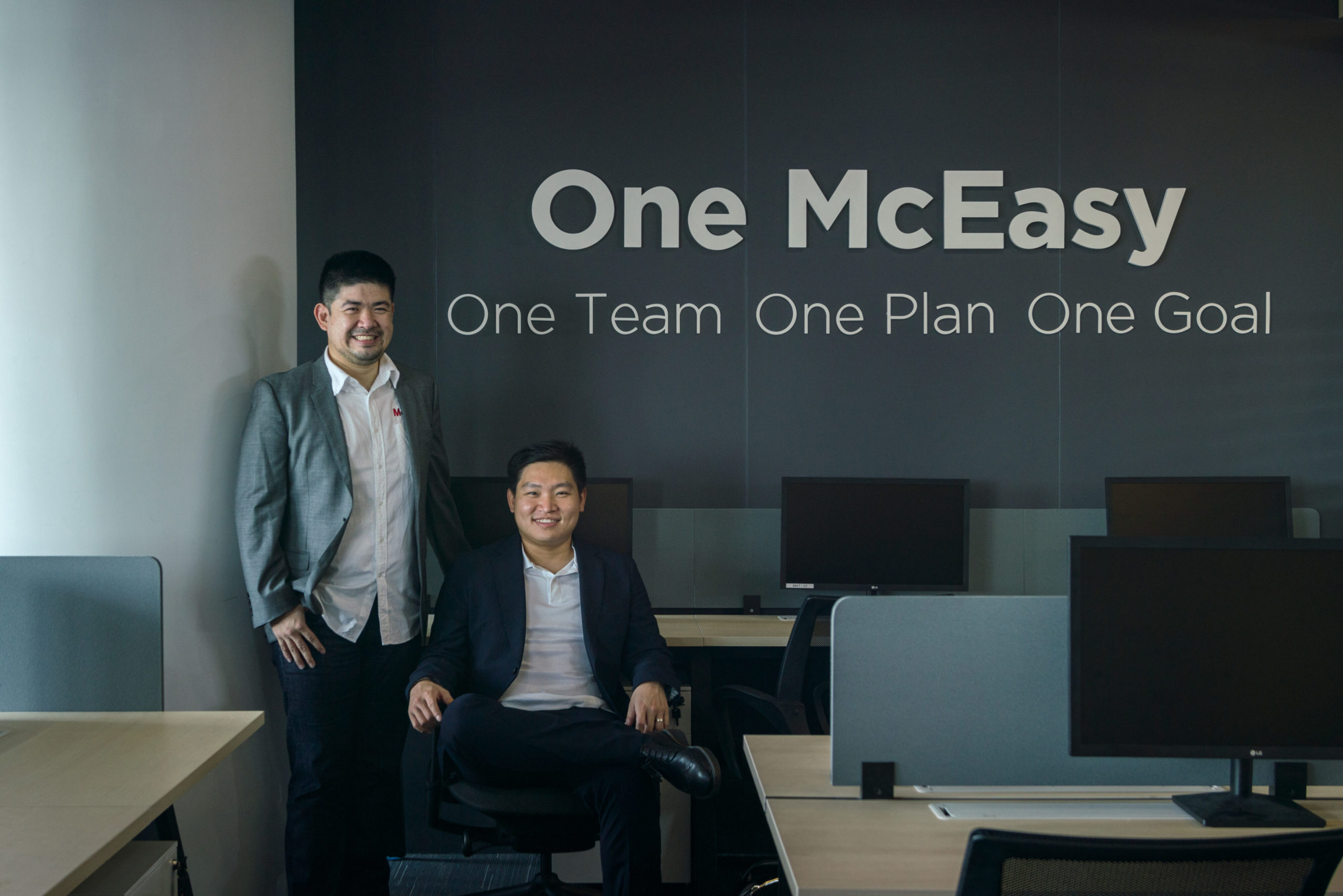
An expensive lesson on two wheels
McEasy was established in Surabaya in 2017. Its early motorcycle security concept put the founders’ knowledge in front of a difficult customer calculation. Tracking could be desirable and still be uneconomical. A product does not become affordable because its maker can explain the circuitry.
Moving into logistics changed that calculation. A business carrying goods has several reasons to care about the journey: the cargo, the vehicle, the customer waiting at the other end. A tracking service can become part of managing the operation that earns the money to pay for it.
The founders also had experience with family businesses and business customers. Their move was therefore connected to something they understood about how companies operate. The challenge became finding a useful place for their engineering knowledge inside those operations.
McEasy’s own history places its transition into subscription software for transportation and logistics in 2019. The development matters because the purchase changed shape. A customer could subscribe to an ongoing service, with the software and the work around it becoming part of a continuing relationship.
The truck comes with paperwork
Sutjiono’s descriptions of the market get more interesting when they get more mundane. He has talked about reconciling electronic delivery documents, arranging driver allowances and using a vehicle’s capacity efficiently. These are the details that a location marker on a map cannot settle by itself.
A truck can be in the right place while its paperwork remains in the wrong one. A dispatcher can know where a vehicle is without having a clear account of the costs attached to its trip. In those circumstances, more visibility has value only if someone can use it to complete the next task.
That distinction helps explain the company Sutjiono was building. Vehicle tracking supplied an entry into the operation. Planning, monitoring and managing delivery supplied further reasons to stay. The driver, the office and the business customer all belonged in the picture.
In April 2022, he joined a McEasy and Indonesian Cold Chain Association webinar alongside people from logistics operations and the wider supply chain. Such conversations put the technical product beside the people responsible for moving goods. The software has to make sense in their working language, including all the inconvenient details a demonstration can skip.
A subscription has to earn its return
There were investors willing to back that approach. In September 2021, McEasy announced US$1.5 million in seed funding from East Ventures. The intended uses included research and development, marketing and sales. Building the technology and reaching the people who might need it were both on the spending list.
By July 2022, a US$6.5 million Series A led by the same investor was intended to support the product and a stronger presence in Indonesia’s second- and third-tier cities. The geographic detail is revealing. Software may travel easily; selling it to businesses with different starting points still takes work.
A further extension led by Granite Asia, announced in June 2024, brought cumulative Series A funding to US$11 million. McEasy said it then had partnerships with 1,500 companies. These figures describe a business reaching more customers and attracting more capital. They also raise the expectations attached to every renewal.
- 2021 · Seed
- $1.5m
- 2022 · Series A
- $6.5m
- June 2024 · Series A total
- $11m
The 2024 figure includes the Series A extension. These are company funding milestones, in US dollars.
The platform’s widening scope carried its own test for Sutjiono. More functions can mean more ways to help a customer. They can also mean more to explain. The founder with an engineering background now had to keep the operator’s experience in view as the machinery behind the screen grew more elaborate.
Simple on the screen
At the October 2024 Tech in Asia conference, Sutjiono spoke in a session called “Tackling the Logistics Question in Indonesia.” His subjects included operational costs, complicated fleet management and the difficulty of seeing what was happening across an operation.
His phrase for the company’s priorities was brief: “customers come first.” He also described the ambition to make software simple for the user while accepting complexity in its development. That is a useful standard against which to judge a dashboard. The person making a delivery decision should not have to inherit every difficulty encountered by the person who built the tool.
“customers come first”
Raymond Sutjiono · Tech in Asia, October 2024
The company’s product range gives that philosophy plenty of work. GPS, sensors and video can produce information about vehicles. Delivery planning, costs and maintenance turn it toward different jobs. Connecting those jobs is the ambition; making the connection understandable is the daily product problem.
For Sutjiono, the commercial question that confronted the motorcycle tracker keeps returning in new forms. Does the customer understand the benefit? Does it fit the business? Can the people doing the work actually use it? Those are reasonable questions for readers to bring to the story, too.
An afternoon in Singapore
In May 2025, Sutjiono represented McEasy at the FedEx Asia Pacific Small Business Grant Contest in Singapore, held as part of the Forbes Asia 100 to Watch Forum. McEasy received a Special Mention and a US$13,000 grant.
It was a different setting from an engineering laboratory or an early sales conversation, though the assignment remained familiar: explain why the business should exist and what its technology can do. The room included founders pursuing other technical problems. Sutjiono arrived with the movement of goods as his subject.
That year, Tatler included him among its Gen.T Leaders of Tomorrow in Indonesia. The recognition marked the founder as well as the company. It put a personal name beside a business whose products usually live in the less conspicuous parts of a working day.
The funding story continued as well. In March 2026, East Ventures reported a US$3 million Series A2 round completed in July 2025. Each of these milestones belongs on a timeline. None removes the requirement to keep making the service useful after the ceremony, announcement or investor meeting is over.
The week, written down
Sutjiono has a quieter method for examining progress. In a February 2025 interview, he described using the weekend to look back over the previous week: what problems had appeared, what needed improvement, what he should change. He writes the review down.
The habit makes an apt companion to the business. McEasy is concerned with turning activity into information someone can act on. Its chief executive describes doing a small, personal version of the exercise. A week has happened. Before the next one begins, he gives it another look.
There is also a reader behind the executive. He has described e-books with morning coffee and an interest in learning about sales. An engineer running a business has reasons to become a student again. His wish for a small home library gives that ambition a domestic scale: a shelf, rather than another dashboard.
He has expressed the desire for McEasy to compete internationally. The existing story offers a useful measure of that aspiration. The founders began with technical skills, discovered a price problem and moved toward customers with a different need. Further progress will require more decisions of that practical kind. Somewhere between a vehicle’s signal and a customer’s next action, Sutjiono still has work to do.
Follow the road
Conversations, appearances and further reading.