The phrase Troy Kopischke uses is “controlled chaos.” It sounds like the sort of contradiction that belongs on a founder’s coffee mug, but in his case it doubles as an operating manual. The control is the engineering: constraints, evidence, models, people who know what a milestone actually costs. The chaos is everything that happens when an invention leaves a laboratory and meets customers, regulators, capital, deadlines, and the delicate egos of otherwise sensible adults.
Kopischke has worked in that collision zone for most of his career. Today he is the Co-Founder and Co-CEO of Invenshure, the Minneapolis venture studio he started with Danny Cunagin. The company builds technology and biotechnology businesses, often around intellectual property developed by scientists and institutions. Before that came research at Honeywell, a decade at product-development firm Logic PD, and an operating role at Steady State Imaging, whose MRI technology was sold to GE Healthcare in 2011.
The clean résumé version makes the progression look inevitable. It was not. A laboratory idea does not politely become a product, and a product does not automatically attract a company around it. Between discovery and scale lies an awkward territory where technical promise must be translated into budgets, teams, partnerships, and reasons for a customer to care. Kopischke chose that territory as a profession.
“You cannot solve everything but you have to manage through anything.”Troy Kopischke
The engineer learns to operate
His toolkit began with physics and electrical engineering. Kopischke studied engineering science at Bethel University and electrical engineering and physics at the University of Minnesota. He later completed executive education at Harvard Business School. The combination is revealing. Physics asks what is true. Engineering asks what can be made. Management asks whether a group of people can keep making it after the prototype stops receiving applause.
At Honeywell, where he worked as a research scientist from 1996 to 1998, the technical foundation was explicit. At Logic PD, where he served as president during a ten-year run, the center of gravity shifted toward product development and organizational execution. Then Steady State Imaging supplied the bridge to venture creation. As an operating and financial leader, Kopischke helped shape the commercialization strategy that preceded the MRI company’s sale to GE.
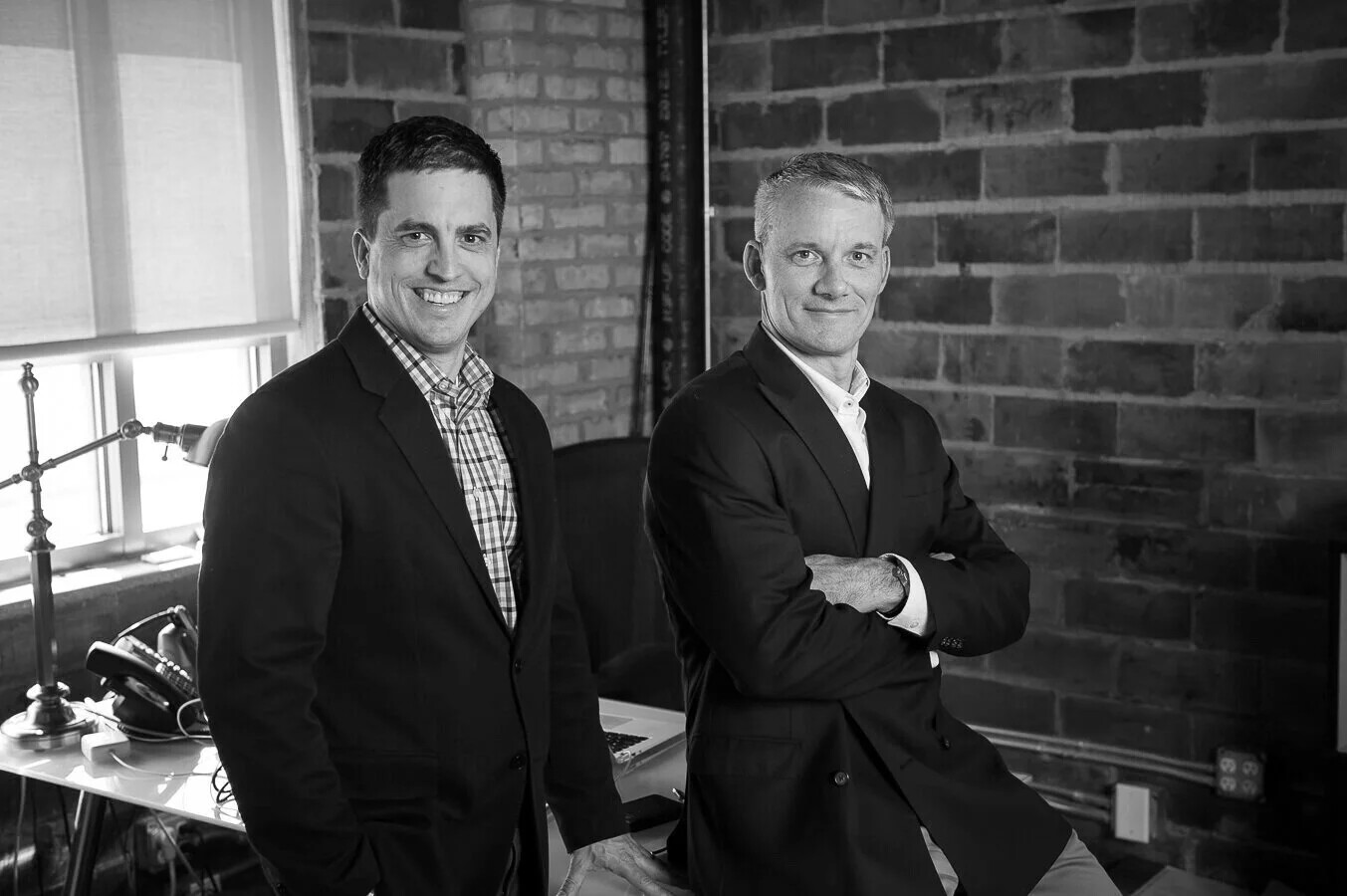
A sale can be a full stop. For Kopischke and Cunagin, it became punctuation of the semicolon variety. They formed Invenshure to repeat the part they found most interesting: finding serious ideas and assembling the machinery required to commercialize them. Their portfolio would eventually stretch across connected-device software, medical imaging, genomics, scientific-data infrastructure, therapeutics, and insurance.
A studio, not a spreadsheet
Traditional venture capital often arrives after a recognizable company already exists. The venture-studio model starts earlier, while the raw material may still be a paper, a patent, a stubborn technical question, or a scientist’s conviction. Invenshure describes its work as combining institutional intellectual property with business rigor. Its in-house scientists and engineers can develop original IP, strengthen an existing idea, and help form a company around it.
This is a subtle but important distinction. Money can purchase time, but it cannot decide what to build, recruit the first operator, design a product roadmap, or repair a partnership that went fuzzy between two meetings. Company creation requires capital plus participation. Kopischke’s public biography calls him a scientist, engineer, serial entrepreneur, and connector. The last word may do the most work. A studio lives by connecting specialists who would not otherwise share a room, much less a cap table.
The company-building loop
Exosite, co-founded in 2009, put data from physical machines into usable software. Flywheel, co-founded in 2015, built infrastructure for managing and analyzing scientific data. Other ventures approached similarly complicated domains from different angles. The categories change; the recurring bet is that valuable knowledge is stranded somewhere between specialists, systems, or incentives. A company becomes the vehicle that gets it moving.
The method also explains why Kopischke’s portfolio can look eclectic without being random. The common market is friction. He favors places where a technical insight and an operating system can remove it. Invenshure’s cultural language pairs truth-seeking with transparency, integrity, trust, and ingenuity. Kopischke puts the thesis more economically: “We believe capitalism and science can do great things. And the right things.”
The cockpit becomes a classroom
Then he learned to fly and found another system with hidden information. During flight training, Kopischke saw how much data modern aircraft and pilots can generate. He also encountered an insurance process that could rely on broad rules, age cutoffs, and limited visibility into how an individual pilot actually trained and flew. To an engineer, an opaque decision built beside a pile of useful data is less a fact of life than an invitation.
He founded 5X5 Aviation Insurance in 2022. The name comes from radio shorthand for a signal received “loud and clear.” The company’s pitch is direct-to-customer coverage informed by training, aircraft, and flight data. Its stated aim is to reward safer behavior and give pilots clearer choices. Kopischke’s language around the venture is characteristically procedural: “We’re trying to do something that’s driving truth and transparency into the system.”
The transferable lesson is not that every annoyance deserves a startup. Most deserve a shrug and perhaps a better form. The useful question is whether a frustration reveals a mechanism: relevant information ignored, incentives poorly aligned, expertise trapped in silos, or customers paying for uncertainty they cannot inspect. Kopischke’s career repeatedly begins there. First identify the missing signal. Then decide whether a company is the right receiver.
In a 2026 YPO SkyCast conversation, Kopischke and 5X5 chief underwriter Jeff Rhodes discuss flight data, disciplined debriefing, and building accountability into safer aviation.
Watch the conversation ↗A billion, twice
Kopischke has attached an unusually crisp ambition to his work: create a billion dollars of value and affect a billion lives. The two measures prevent each other from becoming too comfortable. Value without reach can become a private scoreboard. Reach without a durable economic engine can become a beautiful pilot project that lives forever in a grant presentation.
His life outside the portfolio adds context. Kopischke grew up on a family farm, a history he revisited in a 2025 podcast conversation about Minnesota beef and the future of small-town farming. He has served on Bethel University’s Board of Trustees since 2014. In speaking about older mentors from a church class, he remembered not abstract advice but practical generosity: time, a home opened to others, useful connections, and a sustained concern for younger families.
That is another form of company building, minus the company. Knowledge moves through relationships. Standards are demonstrated before they are written down. People take on harder work because someone else gives them confidence, an introduction, or a clearer view of the path. Kopischke received EO Minnesota’s Impact Entrepreneur Award in 2015 and immediately redirected attention to coworkers and the region’s fertile business environment. The response fit the connector more than the soloist.
Minneapolis is more than a dateline in this story. It is the working geography behind it: research universities, technical manufacturers, investors, clinicians, product people, and founders close enough to keep encountering one another. Invenshure’s advisory network has drawn from universities, finance, technology companies, and large enterprises. Its portfolio companies share talent and, at points, office space. That proximity can shorten the distance between a difficult question and the person willing to answer it.
It also keeps the studio’s ambition grounded in a regional craft tradition. Kopischke grew up around the practical arithmetic of a farm, studied systems, and spent a decade in product development before adopting the vocabulary of venture capital. He approaches a new market less like a tourist spotting a trend and more like a mechanic listening for an irregular sound. What is the system doing? Where does information disappear? Which assumption survives because nobody has had the incentive to test it? Those questions travel well, even when the products do not resemble one another.
“Our comfort zone is controlled chaos. It’s where bigger opportunities are.”Troy Kopischke
Controlled chaos is not romantic from close range. It contains wrong turns, failed assumptions, funding puzzles, and the weekly discovery that a supposedly minor dependency is load-bearing. The word “controlled” matters. Kopischke’s version of entrepreneurial optimism is attached to operating discipline: manage through what cannot be solved, gather better evidence, keep the team aligned, and preserve enough curiosity to notice when the problem has changed.
Three decades after the Honeywell lab, the work still follows an engineer’s rhythm. Observe the system. Find the signal. Build the mechanism. Test it against reality. The industries may range from scientific software to aircraft insurance, but the assignment stays stable: turn difficult knowledge into something people can use, then construct an organization sturdy enough to carry it.