Consider a warehouse with two entrances. One welcomes visitors. The other takes a tractor-trailer. Both belong to the same address, but arriving at the wrong one can turn a perfectly respectable set of directions into a small operational disaster. The distinction sounds fussy until you are the person trying to turn the truck around.
That is the territory Trimble Maps occupies. Its maps concern themselves with bridge clearances, vehicle dimensions, restricted roads and commercial gates. They answer a more demanding question than where a place is: how does this particular vehicle get there and get its work done?
- PC*Miler calculates truck routes and the miles behind freight bills.
- CoPilot brings commercial navigation into the cab.
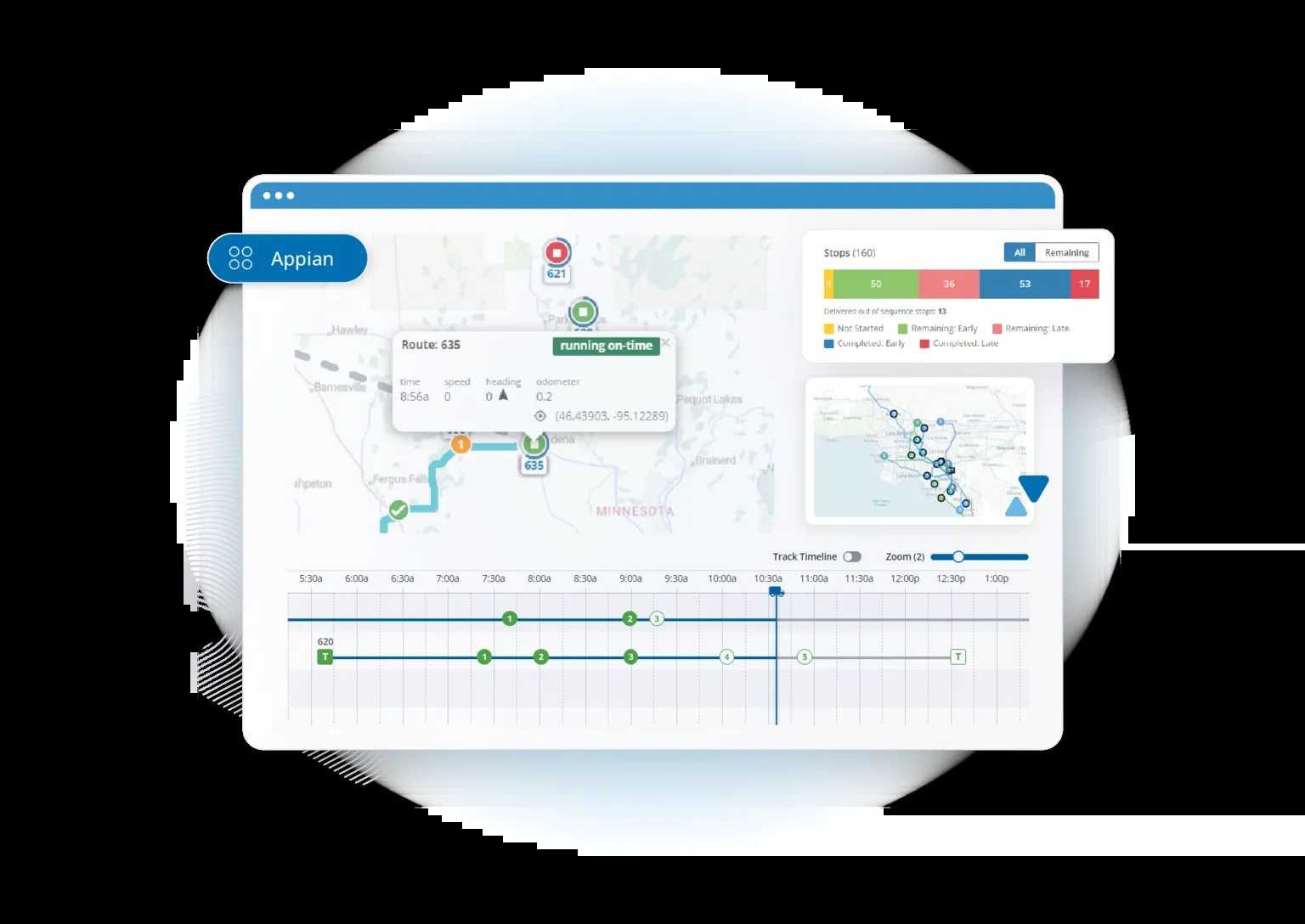
- Appian organizes routes, vehicles and delivery schedules.
- The connection: a shared commercial routing foundation.
01 First, agree on the miles
The story begins in Princeton, where professor Alain Kornhauser founded ALK Technologies in 1979. Its subject was transportation; its instrument was computation. PC*Miler arrived in 1986, giving freight operators a way to calculate routes and mileage using a digital network.
The surprisingly important problem was agreement. Before standardized digital calculations, parties working from paper maps could produce different mileage totals. In a business that pays and charges for movement, a disagreement about distance is a disagreement about money. A common calculation could serve the dispatcher, the shipper and the person checking the invoice.
Trimble announced its acquisition of ALK in January 2013. Then, in February 2019, it brought ALK and TMW Appian Final Mile together as Trimble Maps. The familiar product names survived. The larger proposition was to connect decisions made before departure with what happened afterward.
There was a detour through consumer mapping. In a 2020 interview, Kornhauser recalled the difficulty of getting route-planning software onto retail shelves, then competing with Microsoft’s pricing and rebates. He also described building ALK from internally generated cash. The episode makes its commercial focus more interesting: ordinary motorists could obtain inexpensive directions, while transport operators had specialized problems tied directly to operating costs. The opportunity lay in understanding those problems closely enough to charge for solving them.

02 The details that move the truck
PC*Miler supplies commercial routing and mileage. CoPilot handles turn-by-turn guidance. Appian tackles the combinatorial headache: which stops belong on which vehicles, in which order, within which delivery windows? The customers include carriers, brokers, shippers, distributors and private fleets. Developers can embed mapping and routing through APIs and software development kits.
The connection matters. A plan becomes awkward when the office calculates one route and the driver’s device suggests another. Trimble’s developer documentation describes back-office maps and CoPilot sharing data and routing algorithms. A 2025 integration brought PC*Miler web services into Appian’s Daily Planner and Resource Calendar, allowing vehicle profiles and routing preferences to travel further through the workflow.
HERE and PTV also offer truck-aware routing. Height restrictions alone do not make Trimble unusual. Its case rests on the combination of commercial data, a mileage reference used in freight transactions, and products spanning planning and driving. For an existing transport software customer, compatibility can matter as much as a clever new map.
03 The dispatcher’s head gets crowded
Honor Foods offers a less abstract explanation. The foodservice redistribution company’s growing operation had outstripped a planning method that depended heavily on personal experience. Senior transportation manager Steven Torres described moving information “out of my head and into Google Maps.” Some of it, he said, never reached paper.
“Out of my head and into Google Maps.”Steven Torres / Honor Foods, describing the old process
Honor Foods adopted Appian Daily Planner, bringing vehicle capacity, time windows and road conditions into daily routing. Its public account reports a more efficient process and better delivery performance. The instructive change is visible even without a percentage: information that lived with one experienced person became something dispatchers could use together.
Adoption also depends on the people driving. In its 2026 customer awards, Trimble described Jasper Engines & Transmissions using driver feedback to refine CoPilot and Smart Workflow across a private fleet of more than 170 trucks. Initial resistance gave way through participation. Buying navigation software still leaves the human work of making it usable.
04 Put a price on the decision
PC*Miler Web publicly lists $84.99 per user per month, before applicable taxes. Its signup page offers a trial lasting seven days or 35 routes. That is a concrete way to examine commercial routing without treating the whole portfolio as one purchase.
PC*Miler Web · applicable taxes extra
The broader business sells subscriptions, licenses, integrations and add-ons. A fleet’s evaluation should include the work of connecting orders, maintaining vehicle profiles and identifying delivery entrances. Those tasks belong in the budget alongside the software. A trial using the routes that already cause arguments is more revealing than a demonstration using easy ones.
05 Forty years, still checking the entrance
PC*Miler celebrated its fortieth anniversary in July 2026. Trimble reported more than four million miles of truck-navigable roads and over 62 million points of interest. The scale helps explain the investment involved: commercial mapping requires keeping attributes useful as roads and facilities change.
In September, Trimble announced a natural-language CoPilot Driver Assistant and autonomous planning for Appian Fleet Assistant. The former requires CoPilot v11.4; the latter is a licensed add-on for existing Fleet Assistant customers. Automation is arriving through specific products, with specific requirements.
The lesson a reader can borrow is practical: put the constraints inside the system. Measure the vehicle. Record the gate. Let drivers correct the assumptions. A routing engine cannot compensate for every bad input. A missing restriction or incorrect vehicle profile can spoil an otherwise careful plan; dispatchers still need to review exceptions. A simple car journey may never need these tools. But when a day contains many trucks, many promises and very little room to turn around, the small details start running the business.
Follow the route
Explore the tools, watch them work, or meet the people behind the maps.