An account number arrives in the wrong format. Someone notices, opens the file, repairs the field, and tries again. In the published LOWCODEMINDS case study, a global financial services provider faced a version of this problem across incoming customer data. Information arrived in different structures. Small errors produced rejections downstream. The institution had systems. What it needed was a dependable passage between them.
- LOWCODEMINDS connects enterprise workflows using low-code platforms and AI.
- Its packaged applications cover legal work, debt collection, and telecom sites.
- The buying decision includes implementation, platform licensing, and ongoing ownership.
The company built an Appian-based checklist and validation application. It standardized incoming information and checked bank, account, and customer details before submission to external systems. LOWCODEMINDS reports 85% less manual effort and 80% fewer data rejections. Those are vendor-reported results for one engagement, rather than a forecast for every buyer. The instructive part is the sequence: make the information usable before asking the next system to accept it.
The record that would not go through
There is something wonderfully unglamorous about this example. The obstacle was not a shortage of ambition. It was the distance between information arriving and information being ready. A person had been bridging that distance by checking, translating, and correcting. Multiply those interventions across a department and the spreadsheet becomes an unofficial piece of infrastructure.
LOWCODEMINDS works in that territory. Founded in 2020 and led by founder and CEO Sri Mookiah, it combines consulting, application development, and support with packaged business solutions. Its market is enterprise operations: the legal request awaiting assignment, the debtor account needing follow-up, the tower maintenance job moving between office and field. Each involves records, rules, people, and a next step.
Three places the work gets stuck
Legal-Hub is a useful introduction to the product side. Listed as a paid solution on Appian’s AppMarket, it brings legal requests and matters into a shared environment with tasks, dashboards, and reporting. Its listed integrations include Microsoft 365, Salesforce, and DocuSign. The premise is easy to recognize: a legal team’s work arrives from elsewhere in the business, and its progress matters to people outside Legal.
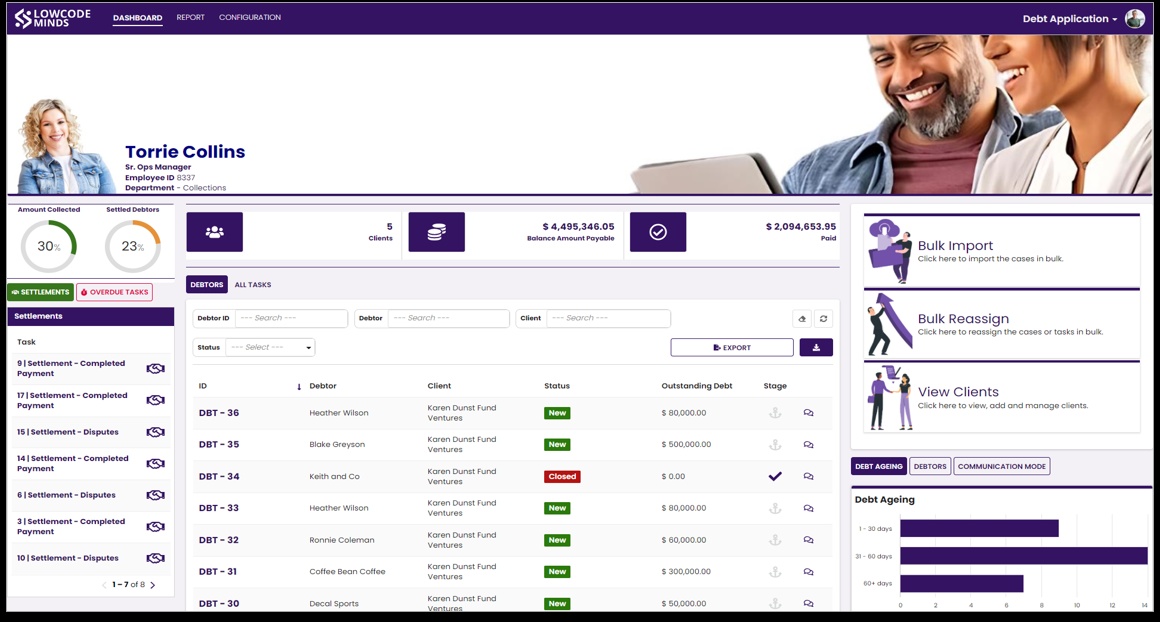
Recovr applies a related pattern to collections. It handles batches of debtor accounts, communications, investigation, and settlement options. Its AppMarket listing describes AI-assisted insights and configurable recovery strategies. A collections team can coordinate outreach and payment plans around the same account rather than treating every reminder as a disconnected task. The application supplies a working structure that still needs to fit the buyer’s policies.
Then there are telecom towers. LOWCODEMINDS’ Tower and Site Management offering covers site portfolios, leases, work orders, assets, and mobile access for field teams. It sounds far removed from a legal matter. Structurally, the resemblance is strong: a record collects history, work changes hands, someone must act, and a manager needs to see what remains unfinished.
The company also lists a contract lifecycle application on Microsoft Marketplace. Built on Power Platform, it covers intake, authoring, approvals, a repository, obligations, and renewals. Its connections to tools such as SharePoint, Outlook, and Teams position it for organizations already working inside Microsoft’s environment. The important distinction is architectural: LOWCODEMINDS builds on established platforms and sells the expertise and applications around them.
Low-code still has a bill
This makes the business harder to understand through a single subscription price. Buyers can commission design, implementation, migration, and support. They can also start with a packaged application. LOWCODEMINDS’ G-Cloud pricing document describes tailored commercial arrangements, including billing for time and resources. The relationship can therefore resemble a software purchase and a delivery engagement at once.
A public UK legal case-management listing advertises £0.02 to £300 per user per month. That enormous range is a procurement parameter, not an all-in project budget. The same listing requires an Appian platform license. A sensible comparison therefore includes the application, underlying platform, integration work, migration, and support. Reusing a component may reduce development work; it does not remove those buying decisions.
“Great workplaces are not built through policies alone”Sri Mookiah, founder and CEO, June 2026
The people behind the process
Reusable work is part of the company’s positioning. ISG’s December 2025 report describes App Labs, its research and co-creation operation, and approximately $1.5 million of investment. The commercial logic is straightforward: solve recurring industry problems with components that can travel between engagements. The resulting advantage depends on how well those components match the next customer’s actual work.
Its partnerships add routes into that work. Appian lists LOWCODEMINDS in its partner directory. In July 2025, Neota announced a partnership aimed at legal and enterprise automation, including compliance, investigations, and self-service applications. These relationships place LOWCODEMINDS among the firms implementing and adapting platforms for particular operating problems.
One small internal detail is more memorable than another automation acronym. In its June 2026 workplace announcement, the company describes an Appreciation Pillar where colleagues leave handwritten recognition. It also describes emergency financial assistance and learning programs. Paper notes inside a company selling digital workflows: apparently some messages are worth delivering by hand.
Start with one handoff
The practical lesson is an inference from these examples: pick one process and follow an item through it. Record where information changes format, where it waits, and who resolves exceptions. Establish a baseline for rework or delay. Then evaluate whether an application improves the whole journey. That gives a pilot something more useful than applause: a test.
This approach needs accessible systems, agreed rules, and people responsible for exceptions. A team with a simple, occasional task may need much less machinery. For a regulated operation moving substantial work across departments, the attraction is clearer. LOWCODEMINDS sells a way to make those crossings explicit. The modest-looking handoff turns out to be a substantial piece of the business.