There is a particular kind of helplessness that comes with opening a software manual. Everything you need may be in there. Finding the thing you need, at the moment you need it, is another matter. In 2014, Salesforce gave that problem a name and a walking route: Trailhead. The starting catalog was almost comically small: three trails, eleven badges. You could see where to begin.
- Learn for free. Salesforce, AI, data and business skills, in manageable pieces.
- Do the work. Practice in a Salesforce environment and check the result.
- Read the badge correctly. Learning progress, certification and job readiness are different measures.
The problem was the order
Salesforce already had documentation. Its own 2015 account of Trailhead’s development acknowledged the awkward part: newcomers could struggle to work out what to read, and in what sequence. Trailhead emerged from a collaboration between developer marketing and documentation teams. The expertise existed. The route through it needed work.
The solution borrowed familiar ideas from interactive education: short units, a prescribed sequence, a challenge, feedback. A trail bundled the pieces into a path. Points and badges made progress visible on a profile. Reading about a feature and finding out whether you could use it became neighboring activities.
That makes Trailhead useful to more than the person who wants to write code. An administrator can study permissions. A salesperson can learn a workflow. A marketer can explore customer data. A manager can assemble a trailmix, essentially a learning playlist, rather than send a new hire a heap of bookmarks and wish them luck.
- 01LearnOne concept
- 02TryA real task
- 03CheckGet feedback
- 04ContinueKeep the badge
Small steps. A visible result. A reason to return.
Somewhere safe to get it wrong
The most consequential feature may be the least decorative. A Trailhead Playground is a personal Salesforce organization where learners can try configurations and complete hands-on challenges without changing their employer’s production system. You can create objects, explore features and write components. Mistakes have somewhere to go.
There are practical wrinkles. Some badges require a feature-specific trial organization because an ordinary Playground lacks the necessary capabilities. Language settings can affect challenge checks. The practice space is useful precisely because it is actual software, with actual setup requirements. Read those instructions before spending an evening arguing with the checker.
Superbadges then remove the step-by-step directions. Salesforce describes them as scenario-based technical assessments: the learner must apply knowledge to a business problem. That distinction matters. Following a recipe and preparing dinner from whatever is in the refrigerator call on different abilities. A growing badge collection can reward persistence while leaving independent problem-solving untested.
A badge records a completed step. The useful question is what you can do after it.
For a career changer, this is a place to begin and build evidence. For an employer, it is a shared curriculum for developing staff. Neither should read a profile full of badges as a hiring guarantee. The sensible next question is concrete: show me how you would solve this problem.
The classroom pays the software bill
Trailhead is a Salesforce platform, launched inside the company. Its users include people learning for themselves and teams whose employers already depend on Salesforce. Uptima, a consulting business, is among the organizations represented in Salesforce’s published Trailhead testimonials. The customer for the software and the learner at the keyboard need not be the same person.
The public catalog is free. The commercial logic is straightforward: a person who understands Salesforce can help an organization use Salesforce. Training can reduce the distance between buying software and getting something useful from it. That is an interpretation of the model, rather than a claim about a separately reported Trailhead profit.
Related instructor-led courses and certification exams can carry fees. A Trailhead badge is not a Salesforce certification. Nor should a temporary offer be mistaken for permanent pricing: Salesforce’s September 2024 AI for All announcement committed more than $50 million to skilling initiatives, including free premium AI courses and certifications through the end of 2025.
Compared with broad course marketplaces, Trailhead’s advantage is proximity to the Salesforce tools and workflows it teaches. That focus also defines its limits. Someone seeking broad computer-science foundations or expertise in another cloud should choose material for that goal. Free access is valuable; relevance still decides whether the hours are well spent.
Learners announced in an official Trailhead community post, December 2025. A cumulative milestone, not a monthly active-user count.
Keep the confetti. Simplify the plumbing.
The playful surface required some unplayful decisions underneath. In a 2019 Heroku interview, engineering director Tyler Montgomery recalled that the launch team had six weeks to ship. Later, fragmented cached documents and brief cache-provider outages could trigger fresh database fetches and slow the site. The team moved caching to Redis and content into Postgres.
That simplification preceded a major traffic event the engineers called Astrogedden, after the mascot Astro. Their preference became, in Montgomery’s words, “keep Trailhead boring.” The lesson for other teams is practical: reduce fragile dependencies before a crowd arrives. Cheerful badges still need reliable plumbing.
The trail keeps moving
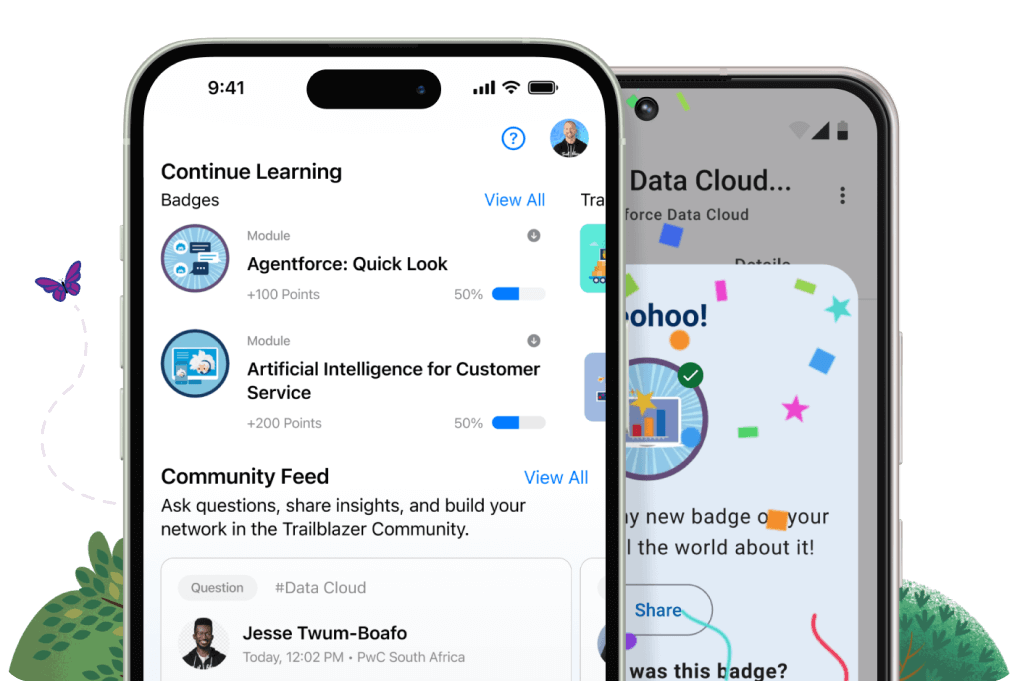
Trailhead GO extended the classroom onto phones, launching on iOS in November 2019 through Salesforce’s Apple partnership. Today, the learning agenda reaches AI agents. The current Agentblazer program has Champion, Innovator and Legend paths, with annual renewal intended to keep status aligned with changing technology.
What can a reader copy? Choose one task you need to perform. Assemble a short path around it. Practice somewhere safe. Check the result. Then repeat the task without the directions. Managers can apply the same sequence to onboarding, measuring a completed piece of work alongside course completion.
It takes time, a suitable practice environment and willingness to investigate mistakes. Without those conditions, badges can become the activity instead of evidence of it. Trailhead’s enduring design choice is to put an achievable action within reach of a beginner. The next step is small enough to take.