The curious thing about TradeStation is that one of its founders trained to play the violin. William Cruz studied at the University of Miami and Juilliard before helping build a company for people staring at price charts. It is tempting to draw a straight line from musical practice to trading discipline. The public record gives us no such line. But it does give us a useful question: where does a trader go to rehearse?
- The job: connect market analysis, strategy testing and brokerage execution.
- The audience: active traders, institutions and developers who want control over their tools.
- The catch: testing a rule can expose its weaknesses. It cannot promise tomorrow’s result.
A musician’s tool for market rules
William and his brother Rafael, also known as Ralph, founded Omega Research in 1982. Its business was investment-analysis software. The customer wanted to ask a computer what a trading rule would have done, rather than depend entirely on a persuasive chart or somebody else’s conviction. That remains a useful distinction. A market opinion can be wonderfully elastic. A rule has to say what happens next.
Then the software business bought access to the transaction. The combination with an online brokerage closed in December 2000; the integrated electronic trading platform followed in 2001. Analysis, order generation and execution could live together. For an active trader, that shortened the trip between an idea on a screen and an order reaching the market.
Give the hunch a job description
EasyLanguage is the company’s unusually literal answer to that problem. Its English-like syntax lets traders specify indicators and strategy instructions. Imagine an illustrative hypothesis: buy when a faster moving average crosses a slower one, then exit under defined conditions. Writing it down forces decisions that casual observation can conveniently skip: which averages, which interval, which exit?
TradeStation Desktop lets customers develop, backtest and automate strategies. RadarScreen scans and monitors symbols; OptionStation Pro helps analyze options positions. These are tools for people who want to investigate a process repeatedly. The appeal is less about finding a magic indicator than being able to change an assumption and inspect what follows.
- 01DefineMake the rule explicit.
- 02TestInspect historical behavior.
- 03RehearseUse simulated trading.
- 04ExecuteMonitor live orders.
There is a platform distinction worth making before downloading anything. TITAN X, introduced in January 2026, brings configurable workspaces and multi-asset order tools to Windows and Mac. The classic Desktop retains the established EasyLanguage automation environment. Choosing the newest interface and choosing a strategy-development workflow are separate decisions.
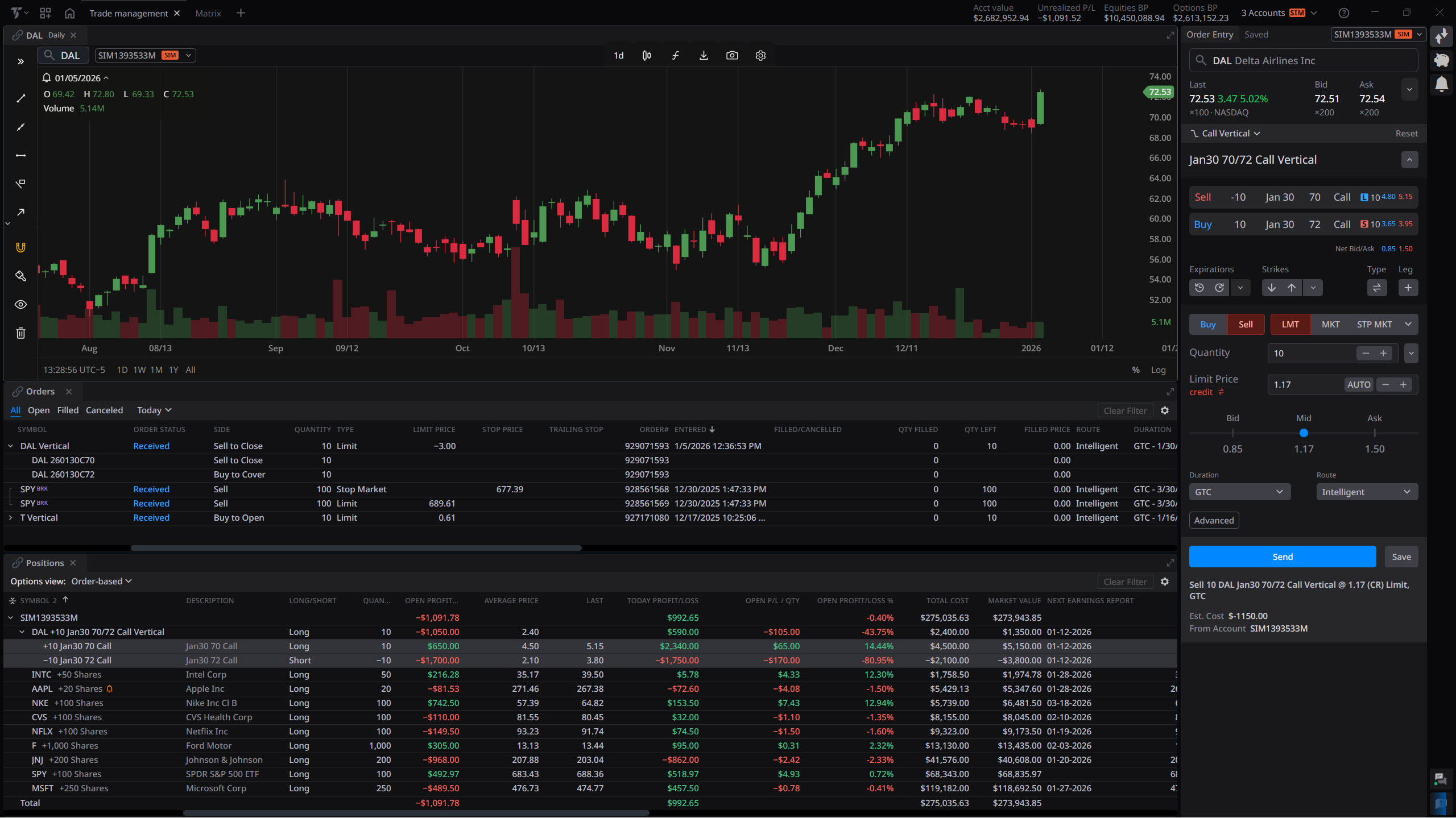
The screen is optional. The plumbing matters.
The other customer may never adopt TradeStation’s interface at all. Through its API, an application can retrieve market data, inspect accounts and submit orders. TradingView is one example of an external front end connected to TradeStation execution. For developers, the broker becomes infrastructure inside a workflow they already like.
That is a distinctive position in the market, though hardly an uncontested one. Interactive Brokers also offers programmable brokerage access. TradeStation’s particular combination is its own strategy language, its trading applications and a self-clearing brokerage. Its customers include sophisticated individuals and institutions; its developer offering lets other software companies bring those capabilities to their users.
This distribution choice has a practical benefit. A trader can keep a familiar charting environment while using TradeStation for the account and execution. A developer can build a specialized application rather than recreate a brokerage. The integration still needs testing: the API documentation offers simulated accounts, and acquiring a personal API key requires a funded account and a request to client support.
The scale is substantial without being a mass-market story. For the quarter ended December 2025, Monex reported about 150,000 TradeStation accounts and $13.8 billion in customer assets in custody. Accounts are not people, and assets are not revenue. Those distinctions matter when judging a broker built around a particular kind of customer.
The economics extend beyond the trade ticket. Brokerage charges, margin lending and income associated with customer cash help fund the business. Monex’s reporting explicitly discusses customer deposits as a source of financial income. Market-data and premium-service charges can also apply. An interface may look like a software product while the business underneath behaves like a broker.
The bill, and the bets that did not land
Costs reward close reading. The published U.S. schedule reviewed in October 2026 lists a $1.75 base commission per side for a regular futures contract in its lowest-volume tier. A round trip therefore starts at $3.50 in commission. Clearing, exchange and regulatory charges can increase that figure. Routing choices, data subscriptions and activity also matter.
Illustration only. Additional charges apply; this is not an all-in trading cost.
TradeStation’s corporate experiments have had their own bills. A proposed merger with Quantum FinTech was supposed to return it to public markets. In August 2022, after the closing deadline passed, TradeStation issued a termination notice. Monex cited economic and market conditions among the reasons. Quantum disputed the right to terminate. The proposed listing did not happen.
The former crypto interest product exposed another boundary. In February 2024, TradeStation Crypto agreed to federal and state penalties totaling $3 million over an unregistered offering. The SEC said the interest feature had stopped in June 2022. That episode concerned the crypto subsidiary’s lending product; it should not be confused with the securities broker’s current exchange-traded offering.
“more than just raw data”
DAVID RUSSELL · ON THE NEED FOR MARKET CONTEXT
More doors into the same workshop
In 2026, TradeStation added AI connections, launched news-and-price summaries through Insights AI, and opened an Amsterdam-based European brokerage serving the EEA. David Russell described the research problem neatly: traders need “more than just raw data”. Better context and easier access fit the company’s long-running effort to reduce work between analysis and execution.
The transferable habit is to make a belief specific enough to examine. Define the rule, test assumptions, rehearse the process and count the costs. That approach needs clean data and realistic execution assumptions; a strategy tuned too closely to yesterday can disappoint tomorrow. TradeStation supplies a workshop for that investigation. The trader still has to decide whether the idea deserves real money.