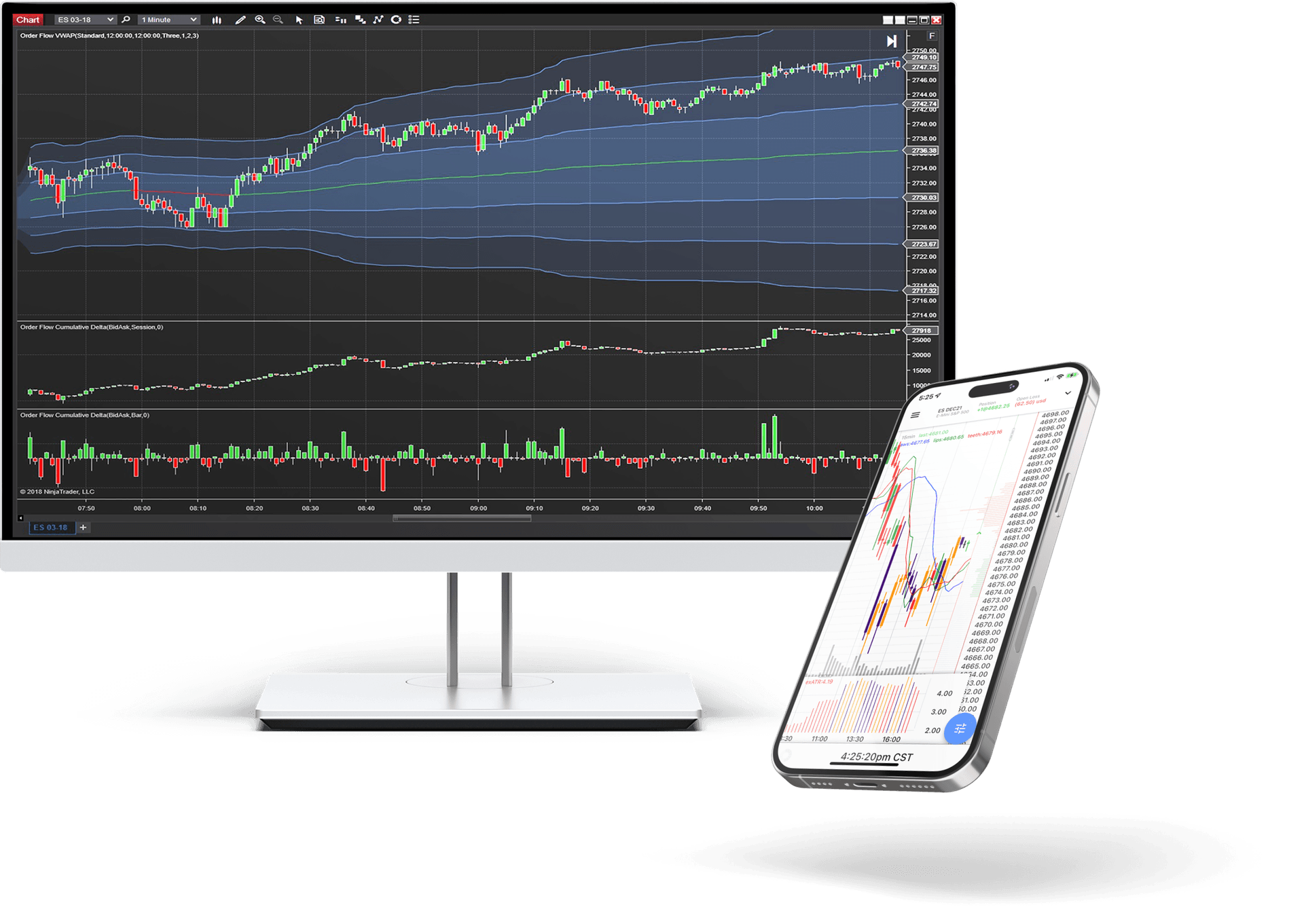
There are two NinjaTraders. The one on the screen is a dense cockpit of candlesticks, order-flow tools, ladders and tiny numbers that can make a civilian feel as if they have accidentally entered air-traffic control. The other sits behind the screen. It opens accounts, streams prices, checks margin, routes orders, holds customer funds and answers when a position refuses to behave. Kraken paid $1.5 billion for both in May 2025, but the second one explains the price.
NinjaTrader began in 2003 as software for active traders. Founder Raymond Deux gave users a programmable desktop rather than a polite investing app. In 2005, NinjaScript turned the platform into a workbench: traders and third-party developers could write indicators, automate strategies and test them against historical data in C#. Over time, that extensibility produced an ecosystem of vendors and add-ons. A trader could change brokers more easily than they could abandon years of custom code, saved workspaces and hard-won muscle memory.
The audience is unusually specific. NinjaTrader is not built for someone buying an index fund twice a year. It serves retail futures traders, from newcomers rehearsing with simulated money to discretionary day traders clicking from a chart and developers building automated systems. The company says more than two million users now touch its products worldwide.
The decisive move: stop renting the transaction
For its first decade, NinjaTrader made the interface while other firms owned much of the brokerage relationship. The company could improve the chart and order ticket, yet a trader's experience still depended on a chain of brokers, data providers and clearing firms. Deux later described witnessing brokerage inefficiency and the frustration it created. That observation changed the model.
In 2014, NinjaTrader acquired longtime partner Mirus Futures and launched NinjaTrader Brokerage. It was a vertical-integration bet with consequences: software no longer ended at the buy button. NinjaTrader could earn when customers traded, shape support around its own platform and collect feedback from execution all the way back to interface design.
Growth capital from Long Ridge Equity Partners and DRW Venture Capital arrived in 2020. NinjaTrader acquired TransAct Futures in 2021, strengthening its clearing capability, then spent $115 million on Tradovate in January 2022. Tradovate brought a cloud-native broker and a modern browser-and-mobile orientation. Together the companies had processed about 100 million futures contracts in 2021. NinjaTrader's own web and mobile apps followed in 2023.

A very effective ladder from free to frequent
NinjaTrader's acquisition engine is generous in exactly the right place. Advanced charting, strategy backtesting and simulated trading are free, with no time limit and no deposit required. A new user can learn the vocabulary, assemble a workspace and develop a routine before risking cash. That lowers the fear of a platform whose desktop version can look wonderfully uncompromising.
Live trading is where the meter starts. The Free plan has no monthly software charge but carries the highest listed commission. The $99 Monthly plan cuts the rate. A $1,499 one-time Lifetime plan cuts it further. As of September 2026, the advertised per-side commission on a Micro contract runs from $0.39 on Free to $0.09 on Lifetime; Standard contracts range from $1.29 to $0.59. A round trip uses two sides, and exchange, clearing, regulatory and market-data costs sit on top.
$1.29 Standard
commission per side
$0.99 Standard
commission per side
$0.59 Standard
commission per side
The design is behavioral. Curiosity pays nothing. Regular activity nudges a trader toward subscription math. Heavy activity makes the Lifetime purchase look like an investment in lower unit costs. It works when users trade often enough for commission savings to exceed the fixed fee. It does not work for the occasional trader, anyone who needs broad stock and mutual-fund investing, or anyone counting only the headline commission while ignoring the rest of the bill.
The backtest is the demo. Reality is the bug report.
The product's most useful feature may also create its most dangerous misunderstanding. Strategy Analyzer can backtest, optimize, run walk-forward analysis and model historical fills. NinjaScript can automate entries, exits and risk rules. But a beautiful equity curve is not money. Historical data may contain gaps; fill assumptions can flatter results; optimization can fit noise; latency changes execution; and a human behaves differently when the loss is no longer pretend.
“Automated trading does not mean go fishing while your computer trades for you.”NinjaTrader developer documentation
NinjaTrader says real-time strategy performance can and will differ from backtests. Its simulation disclosure also notes that hypothetical trading cannot reproduce the financial risk, emotion and psychology of live money. The copyable practice is a staged one: define the rule, test it across varied history, reserve data the optimizer never sees, forward-test in real time, trade the smallest viable contract and monitor the live system. The approach stops working when a user treats simulation as prediction or leaves an automated position unsupervised.
Futures leverage makes a small deposit control a much larger exposure. It improves capital efficiency and accelerates mistakes. Losses can exceed the initial investment.
The first expensive failure was supervision
Owning the plumbing creates a better business, and a heavier obligation. In September 2024, the Commodity Futures Trading Commission found that NinjaTrader Clearing lacked adequate procedures and oversight for an emergency account freeze. The firm paid a $750,000 civil penalty and $233,425.70 in restitution after an account that should have been frozen lost that amount in value.
In May 2025, the National Futures Association ordered another $250,000 fine after a settlement involving anti-money-laundering controls and supervision. NinjaTrader did not admit or deny the allegations, but the final order found violations of NFA rules. These were not interface blemishes. They struck at the operational promise Kraken was buying: a regulated system that can move quickly without skipping controls.
That is the condition under which vertical integration becomes a trap. The more of the customer journey a company owns, the fewer vendors it can blame. A futures commission merchant must segregate customer funds, manage margin, surveil accounts, respond to court orders, secure systems and remain available while leveraged positions move. Scale rewards the owner of that machinery only if compliance scales with it.
Why Kraken wanted a futures company
Kraken announced the deal in March 2025 and completed it in May. The logic was not subtle. Kraken had crypto customers and global trading ambitions. NinjaTrader had a U.S.-regulated futures commission merchant, a practiced derivatives audience and a business built around professional-style retail tools. Combining them offered a route toward an always-on, multi-asset platform spanning crypto, futures and, eventually, more traditional products.
NinjaTrader remained a standalone platform, but the plumbing started traveling. In March 2026 the company launched NinjaTrader Connect, a B2B package that lets fintechs and brokers offer regulated futures and prediction markets under their own brands. The API combines onboarding, funding, clearing, surveillance, margin, pre-trade checks and a white-label trading experience. An internal capability had become a product.
The market widened too. Eurex derivatives went live for European customers in June 2026. The next month, NinjaTrader added access to CME Group single-stock futures on more than 50 U.S. names, including Apple, Nvidia and Tesla. These contracts offer direct, leveraged exposure without option Greeks or the need to borrow shares to go short. They also introduce exactly the risk one would expect from leveraged exposure to volatile individual companies.
Start with a narrow, demanding user. Give that user a useful laboratory. Build an extension ecosystem. Then own more of the transaction only when you can carry the operational and regulatory weight.
A focused machine, not a universal broker
NinjaTrader competes with TradeStation, Interactive Brokers, tastytrade, AMP Futures and Optimus Futures for execution, and with TradingView for charts and community. Its edge is the combination: futures-first brokerage, free rehearsal, serious desktop tooling, C# extensibility and an ecosystem grown over two decades. Its weakness is the same focus. A long-term investor wanting a simple home for stocks, bonds and funds will find broader brokers more natural. A Mac-first trader who prizes browser polish may prefer a lighter product. A non-programmer can use Strategy Builder, but the deepest customization still rewards technical fluency.
The company did not win by making trading simple. Futures are not simple, and pretending otherwise would be a disservice. NinjaTrader made the workbench available, made practice cheap and gradually assembled the regulated machinery around it. Kraken's purchase put a large number on that machinery. The harder test comes after the exit: whether NinjaTrader can extend its rails across assets and other businesses without letting the controls lag the growth.