A referral can fail before a patient ever reaches a specialist. The wrong form, a missing result, a task sent to the wrong team: none makes a glamorous technology story. All can make an ordinary working day longer. At South Brent Health Centre, staff used tools already inside SystmOne to put checks and routing into the referral process. TPP’s September 2026 account reports routine referral errors falling from 48% to 8%.
That is a useful introduction to The Phoenix Partnership. TPP makes the software beneath a great deal of British healthcare: the records, requests and work lists that must survive the journey between people. Its central idea is that a patient’s history should travel with them. The commercial opportunity lies in making that idea function through the unremarkable, consequential business of getting things done.
Company-reported scale. Stored records are not the same measure as currently registered patients.
A record with somewhere to go
TPP traces its beginnings to 1997. Frank Hester, previously a software architect in finance, wanted to reduce the administrative burden on his wife, a family doctor. An early deployment connected a Bradford GP practice with a local hospital. The ambition grew out of a recognisable frustration: information collected in one place was needed somewhere else.
SystmOne is the resulting electronic health record system. Its shared record brings together clinical history across participating services, while different modules support different kinds of care. The same underlying approach can serve a general practice, community team or mental health service. Allergies, medication and previous contacts become part of a continuing account rather than material to assemble afresh.
The breadth matters. TPP reports more than 300,000 users. OpenSAFELY’s documentation offers a different, narrower measure: SystmOne is used by roughly a third of English GP practices, with records covering approximately 44% of England’s population. Those figures describe different populations. Neither means that every doctor in every organisation can freely open every record.
Information follows care, subject to access controls and local configuration.
The work between the appointments
At South Brent, the digital lead and practice secretary built referral pathways using Templates and Protocols. The software checks required information, generates documentation, applies clinical codes and sends tasks to the appropriate team. The intervention used standard functionality, without buying extra software or commissioning external development.
The practical lesson is to inspect the handoffs. Turning a form into pixels leaves plenty of room for the wrong person to receive it. Build the checks into the moment of referral, and the person doing the work has fewer separate things to remember. South Brent’s figures are a local, company-published result, not a promise that every practice will achieve the same reduction.
South Brent Health Centre, TPP case study, September 2026. Bars use a 0-100% scale.
A Nottinghamshire Healthcare post-COVID service attacked a different bottleneck. Patients with fatigue and cognitive difficulties were being asked to manage posted questionnaires, return envelopes and telephone follow-ups. The team introduced digital questionnaires, booking links and two-way communication through SystmOne’s Communications Annexe. Completed responses could return to the system and generate staff tasks.
TPP’s August 2026 case study reports referral-to-appointment offers becoming up to 13 days faster. Physiotherapist Alexandra Griffiths described the change in particularly concrete terms: “Patient replies come straight back into my task list”. The benefit was fewer separate trails to follow. For someone experiencing brain fog, an envelope is another job; for staff, an unanswered envelope becomes a telephone call.
Three doors into the same system
Patients encounter TPP through several products. SystmOnline provides web access to services such as appointment booking and repeat prescription requests. What appears depends on the healthcare organisation. A missing appointment option can reflect the practice’s configuration rather than a universal limitation of the product. Software access and appointment availability remain different things.
Airmid is the patient app. It supports record access, medication requests, appointment management, messaging and video consultations. A practice can decide which appointment slots to expose. Messages and images can be attached to the SystmOne record, bringing the conversation into the clinical account. The useful question for a patient is what their own provider has enabled.
Brigid serves clinicians on mobile devices. It provides access to notes and alerts, lets staff record observations, and supports work away from a desktop. Offline work synchronises once a connection returns. That qualification matters on a home visit: information entered without connectivity must still make its way back. TPP says Brigid is free for most SystmOne organisations, including GP sites with Mobile Working.
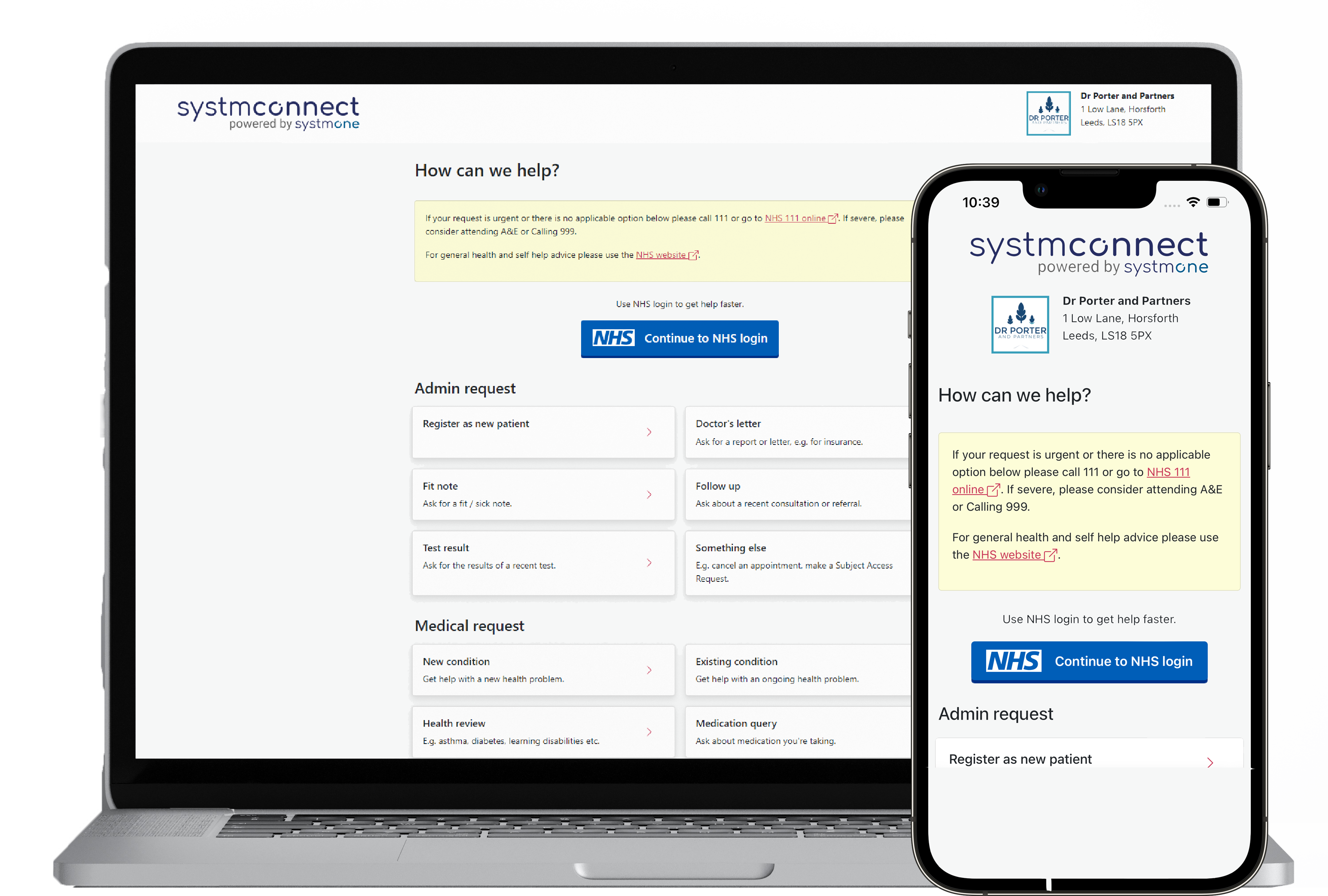
SystmConnect, announced in November 2023, handles online consultation and triage. Requests can enter through digital channels or be recorded following a phone call or reception visit. The system supports allocation to teams and patient matching. Its value depends on where the request goes next: a convenient front door still needs someone responsible for answering.
Free at the front door, contracts behind it
TPP sells clinical software to organisations. Recurring licences, deployment and support sit behind the patient-facing experience. The current SystmConnect page offers the product free to GP practices until a new centrally funded framework becomes available. That is a conditional offer for a particular product and customer group, not the price of the whole SystmOne estate.
For non-GP services, the pricing document linked from that page gives useful context. Its 2024 schedule lists £650 per year for certain single service units and £25,000 annually for organisations using the mental health module. Other trust-wide licences use unit bands; the mental health charge can be additional. Prices exclude VAT and are subject to annual RPI increases, so these published base figures should be read with their date and conditions.
Switching itself has a price. TPP advertises removal of a GP migration fee of almost £3,000 and reimbursement of eligible direct migration costs up to £10,000 per practice, subject to review and feedback. The offers are time limited and can change. They acknowledge a practical obstacle: replacing core clinical software consumes attention while the practice must keep operating.
A bigger footprint means more dependencies
In general practice, EMIS Web, now associated with Optum, is a principal alternative. TPP’s pitch rests on the reach of its shared record and the work that can happen around it. Hospitals have another set of requirements. SystmOne Hospital offers modules for beds, patient administration, emergency departments, theatres, prescribing and other functions, deployable separately or together.
That modular approach allows an organisation to address a department as well as contemplate a wider replacement. It also makes the buying decision specific. A hospital needs to assess its own workflows, existing systems and implementation capacity. A GP practice needs to consider the services around it. A feature list alone cannot settle either decision.
TPP publishes interoperability arrangements including GP Connect. NHS England also lists third-party patient services that integrate with TPP systems. The wider market therefore includes both competing clinical record suppliers and applications that connect to them. The attraction of a common record is strongest when neighbouring teams can use the information; the practical value depends on working connections and agreed responsibilities.
Keep the research close, the permissions closer
The records also support research. Through OpenSAFELY, TPP works with teams at Oxford and the London School of Hygiene & Tropical Medicine. The approach lets approved analysis run within a secure environment rather than handing researchers a conventional download of identifiable patient records. Public tools and dummy data allow analytical work to be developed without opening the real database to everyone.
ResearchOne, a separate not-for-profit partnership with the University of Leeds, uses de-identified data. TPP also describes its contribution to Born in Bradford’s work tracking health outcomes. These activities show how information collected for everyday care can become useful for population research, under the arrangements applicable to each project.
The history includes a serious failure. NHS Digital’s 2018-19 annual report records a SystmOne coding error that prevented new patient objections from being collected and sent between March 2015 and May 2018. It affected 148,873 patients. NHS Digital halted relevant data flows after discovering the problem. A choice recorded at one end had failed to arrive at the other.
Sharing works only if the instruction not to share travels just as reliably.THE OPERATIONAL LESSON
This episode makes permissions part of the engineering story. A checkbox has consequences beyond the screen on which it appears. NHS guidance now tells practices to assess disclosures, apply relevant opt-outs and maintain procedures. Connected records require staff who understand those procedures as well as software that carries them out.
The people behind the work lists
TPP describes a workplace with little management hierarchy and direct customer contact. Its recruitment material advertises early responsibility, overseas travel and a £300 birthday meal allowance. That last detail is delightfully specific. The claims describe the employer’s intended experience; they do not independently establish how every employee experiences the company.
The technical work is broader than building screens. TPP’s recruitment profiles describe data migration, underlying software architecture and customer integration testing. Its training service covers clinical and administrative users. That combination helps explain the business: a record system has to be understood by the people entering information, the people maintaining it and the people who inherit the next task.
The most transferable idea is modest enough to try locally. Find a repeated point of confusion, give the next action an owner, and measure whether fewer items come back. It needs staff time, accurate information and a process worth repeating. TPP’s shared-record ambition is large. Its everyday test is whether the next person can carry on where the last one stopped.