Person · Founder · Physician
Toyin Ajayi
A family doctor who decided the system needed a rebuild, not a referral.
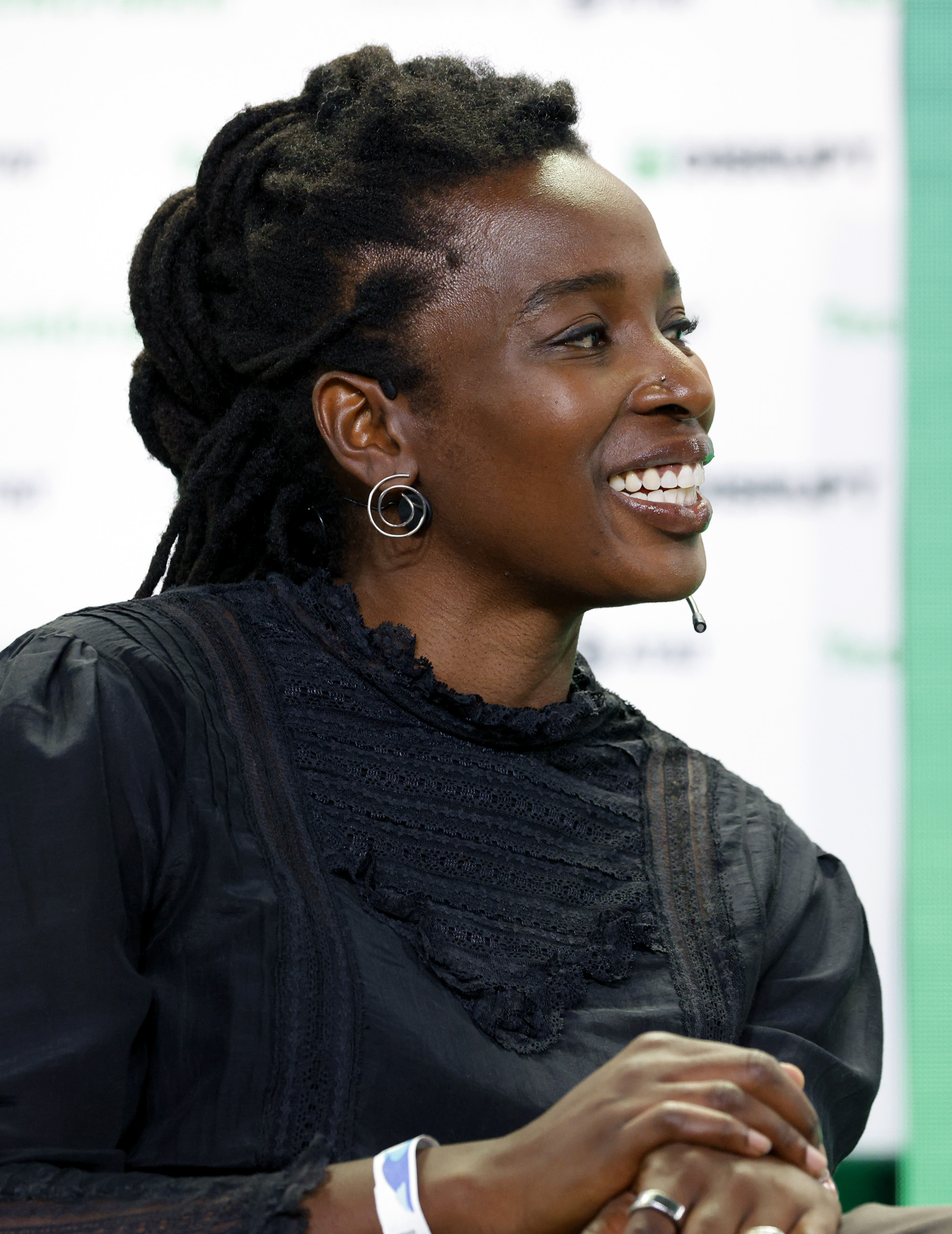
Toyin Ajayi at TechCrunch Disrupt, 2022 - the year she took the CEO chair.
A family doctor who decided the system needed a rebuild, not a referral.
Toyin Ajayi at TechCrunch Disrupt, 2022 - the year she took the CEO chair.
Most healthcare companies chase the patients with good insurance and easy zip codes. Toyin Ajayi built one around the people the system bills last - the Medicaid members, the dually eligible, the patients whose addresses make spreadsheets nervous. Cityblock Health, the company she co-founded and now runs, sends care to where people actually live: their kitchens, their stoops, their phones at 11pm. It is now worth somewhere near $6 billion, and she still keeps a primary-care panel of her own.
That last detail is the tell. Ajayi is the rare founder who can read a P&L and a patient at the same time. She trained at Stanford, Cambridge, and King's College London, then spent years in safety-net hospitals and a clinic in Sierra Leone where she was one of roughly fifty doctors serving seven million people. The arithmetic of that scarcity never left her. It is the math she has been trying to fix ever since.
Her current fixation is a quiet provocation: the most vulnerable patients, she argues, should be the place AI in medicine gets proven first - not the afterthought it usually becomes once the billing software has had its fill. In a field where most of the money flows toward optimizing invoices, that is close to heresy. Ajayi tends to say it with a smile.
Ajayi was born in Boston to Nigerian parents and grew up in Nairobi, Kenya. Her father was a physician who worked on maternal health during the AIDS epidemic - a front-row education in what medicine looks like when it is the only thing standing between a community and catastrophe. She did not so much choose service as inherit a definition of it.
The credentials piled up fast: human biology at Stanford, an MPhil at Cambridge, a medical degree from King's College London, a family-medicine residency at Boston Medical Center. She is board certified in family medicine and has always practiced with a tilt toward the hardest cases - chronic, complex, end-of-life. The patients other clinicians find inconvenient are the ones she finds interesting.
In 2009 she started a non-profit to improve healthcare in Freetown, Sierra Leone. The detail that sticks: she was one of around fifty doctors for a country of seven million. You learn something there that no business school teaches - that scarcity is not a budget line, it is a person in front of you who will not get a second appointment.
Back in the United States, she became Chief Medical Officer of Commonwealth Care Alliance, an integrated plan for people eligible for both Medicare and Medicaid. She ran clinical operations and care innovation for more than 20,000 beneficiaries across Massachusetts. It was there she saw the pattern that would become a company: the system was not failing for lack of medicine. It was failing for lack of reach.
In 2017, Ajayi co-founded Cityblock Health with Iyah Romm. The company spun out of Sidewalk Labs, the Alphabet-backed incubator better known for reimagining city streets than city clinics. The premise was almost stubbornly simple: build care around where low-income and Medicaid patients live, wire together physical health, mental health, and social needs, and stop pretending a missed appointment is the patient's fault.
She started as president and chief health officer - the clinician half of a two-founder bet. In 2022, when Romm stepped down, she took the CEO seat. The handoff did not slow the company down. Under her, Cityblock grew from startup to a roughly $6 billion business, with care teams, community health partners, and a 24/7 line that treats a phone call at midnight as the front door it usually is.
Too many patients with complex medical and social needs struggle to access the support that could fundamentally change their health trajectory.- Toyin Ajayi, on joining the Foodsmart board, 2026
Home visits, mobile teams, and community health workers - care delivered at the address, not just the office.
Physical, behavioral, and social needs stitched into one plan. Housing and nutrition count as medicine here.
Designed for the dually eligible and underserved - the populations most models leave for last.
In 2026 Ajayi published a blueprint with an uncomfortable thesis: Medicaid + AI: A New Standard for Innovation. Her argument is that the nation's most vulnerable patients should be the proving ground for generative AI - the first to benefit, not the last to be considered.
The numbers behind her point are blunt. By her reckoning, roughly 60% of healthcare AI investment chases revenue-cycle management, billing, and risk adjustment. Very little of it is aimed at the patient on the other end of the system. Cityblock's answer is "agentic AI" - voice and messaging agents that reach out to Medicaid members directly, surface social-needs signals, and hand a tidy summary to a human who can act on it.
Source: "Medicaid + AI: A New Standard for Innovation," 2026.
Founds a non-profit improving healthcare in Freetown, Sierra Leone.
Chief Medical Officer at Commonwealth Care Alliance, serving 20,000+ dually eligible beneficiaries in Massachusetts.
Co-founds Cityblock Health out of Sidewalk Labs; serves as president and chief health officer.
Appointed CEO of Cityblock Health.
Named to TIME100 Next, Modern Healthcare Women to Watch, and the BBVA Founding 50.
Elected to the National Academy of Medicine; delivers Georgetown School of Health commencement.
CNBC Changemaker, Fierce Healthcare Women of Influence, Inc. Female Founders 500.
Publishes the Medicaid + AI blueprint and joins Foodsmart's board of directors.
Trust in the U.S. health-care system is at an all-time low.
The most vulnerable patients should be the proving ground for AI, not an afterthought.
Nutrition support can fundamentally change a patient's health trajectory.
Elected member, 2024 - one of the field's highest distinctions.
Recognized in 2023 among the rising leaders shaping the future.
2025 honoree for impact on American healthcare.
Aspen Institute fellowship for values-driven leadership.