A customer opens an email, visits a website, and leaves. Later comes a text message. Somewhere else, an advertising dashboard records a click. The person has had one experience. The marketer may have three separate records. Follow that small administrative mess and you arrive at the problem Totaligent wants to solve: getting the machinery of marketing to remember the same person.
- Audience data, email, SMS, social, and advertising in one operating environment.
- Published software plans begin at $97 a month; managed campaigns are a separate business.
- A September 2026 pilot tests live work. Commercial scale remains the question.
Totaligent calls its approach person-based marketing. Its more recent language is a communications operating system. The distinction matters because its ambition extends beyond sending messages. It wants the audience, the creative, the delivery, and the response to share a usable history. That history is also the foundation of its argument for AI: an agent needs context before it can sensibly decide what happens next.
A customer should not need reintroducing
Start with the ordinary work. A business imports contacts, builds segments, creates an email or SMS campaign, and measures engagement. Totaligent’s audience tools accept CSV uploads and offer data enrichment. Its email designer supports text, HTML, and drag-and-drop creation. Ads+ reformats creative for social platforms. Pulse adds a different kind of audience work: finding journalists and publications for media outreach.
The company advertises a seven-terabyte audience database with more than 400 data points per record. Those are company descriptions of its resources, rather than proof that every contact is complete or every campaign will improve. The practical attraction is reducing the handoffs between choosing an audience and reaching it. A larger database becomes useful only when the resulting audience is relevant and reachable.
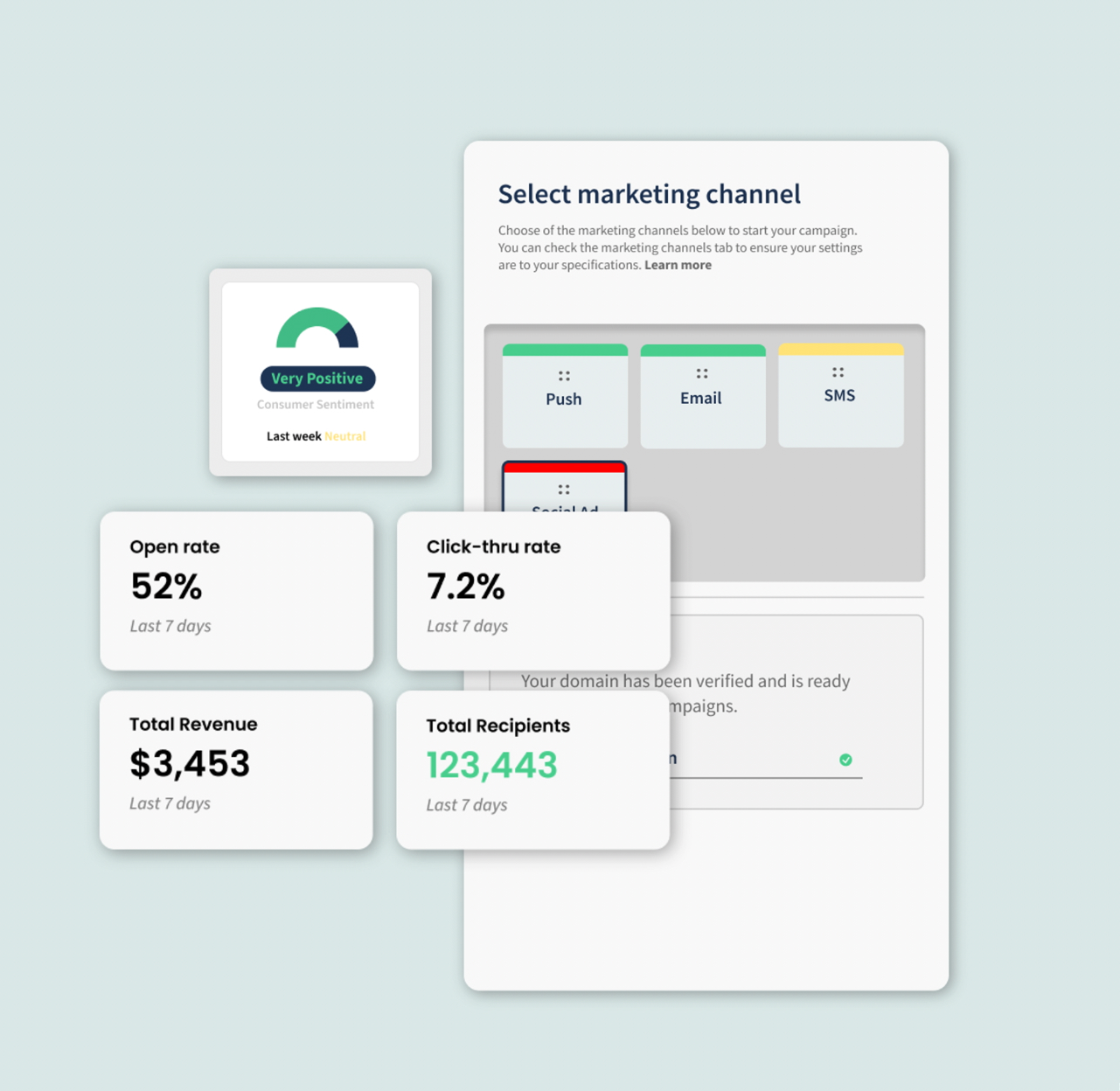
This puts Totaligent between marketing software and campaign services. Its managed business has served public companies and political candidates; its published software tiers address solo operators, agencies, advanced marketers, and enterprises. Buyers are considering a coordinated workflow, alongside the alternative of assembling separate audience, messaging, advertising, and reporting tools. The proposed advantage is continuity across those jobs.
The unglamorous work came first
The modern business reached the public company through the December 2021 acquisition of Digi Messaging & Advertising. The issuer adopted the Totaligent name in July 2022. That history helps explain a company whose expertise includes campaign infrastructure as well as software: networks, large databases, message delivery, and the less photogenic work behind a campaign button.
Brian Heckathorne, identified in the company’s director announcement as an original founder, brings experience in servers, networking, data administration, and large email campaigns. CEO Ted DeFeudis comes from finance and earlier technology ventures. Their backgrounds meet at a practical question: can an operating system built from campaign experience become a repeatable software business?
There were concrete things to repair. In June 2025, Totaligent reported identifying and addressing critical SMS and email delivery issues while introducing two-week engineering sprints. An August update described automated domain detection and DNS and email-record configuration. These details are revealing. Before intelligence can optimize a conversation, the message has to arrive and the customer has to get through setup.
- 01Audience
- 02Create
- 03Deliver
- 04Measure
Passing QA is one milestone
The public beta opened in March 2025. That December, Totaligent announced completion of quality-assurance testing across its marketing platform. In September 2026, it opened an invitation-only Founders Pilot for experienced marketers and political organizations. The sequence separates a product being available, modules passing tests, and an entire commercial process working under real conditions.
“Software that only works in a demo is still a demo.”Ted DeFeudis · September 2026
The pilot includes audience creation, distribution, measurement, onboarding, billing, support, and scale. Public self-serve enrollment is outside that phase. Its design offers a useful lesson for anyone building business software: involve customers who already understand the job. They can test whether the system carries their actual work, including the invoice and the support request.
The price tag has two columns
Totaligent publishes monthly software prices of $97 for Starter, $275 for Growth, and $575 for Pro, with custom Enterprise pricing. The tiers vary contacts, seats, clients, credits, landing pages, and ad sets. Credits are pooled across email, SMS, and Smart Capture; top-ups are available. A subscription price therefore begins the budget conversation. The channel mix and workload determine the rest.
Its managed-marketing page separately lists packages at $14,500 and $18,500 a month. Those buy service work including strategy, content, execution, and optimization. Published plans also should not be mistaken for unrestricted admission to the Founders Pilot. A buyer needs to establish the available workflow, the relevant usage allowance, and the service scope before comparing a monthly number with an existing stack.
The Starter tier lists 25,000 contacts and 50,000 monthly credits; Growth lists 100,000 contacts and 150,000 credits. These are different measures. A stored contact is an audience record, while a credit is part of the allowance for doing work. Comparing platforms fairly means matching both the audience size and the activity that audience will generate.
The business still has to earn it
The financial record makes the test consequential. Totaligent reported $444,529 in 2024 revenue and $2,248 in 2025. Its first-half 2026 filing reported no revenue and explained that resources had shifted toward platform development, reducing emphasis on managed campaigns. For 2025, operating cash use was $265,041. The accounts also carried a going-concern warning tied to losses and financing needs.
Management’s rationale has changed with the market. Its 2025 annual report describes AI as weakening the standalone value of third-party SaaS, while preserving the potential value of its platform and data. September’s white paper places shared communications memory at the center of the proposition. That is a strategy under examination, with the pilot providing the next practical test.
A reader can borrow the method immediately: trace one audience from import through delivery, response, and billing. Check where context disappears. Test setup and support alongside the attractive features. Totaligent’s approach depends on usable audience data, reliable delivery, and customers whose work benefits from coordination across channels. A team running one simple newsletter has less to consolidate. Adding channels also adds dependencies: account access, audience permissions, and the ability to interpret responses together. The sensible trial follows a real campaign through those dependencies, then asks whether the saved coordination justifies changing systems. For everyone else, the interesting question is how much work survives the trip between tools.