Tony Miller has a useful joke about selling a company. “Bind within UHG is better without me,” he said after the business he co-founded became part of UnitedHealth Group. Plenty of founders can describe how indispensable they are. Miller can describe the circumstances in which their absence might help. It is an unusual sales pitch for oneself, and a rather good starting point for understanding his career.
Bind, subsequently renamed Surest, was one chapter in a sequence that included Definity and Carol. Miller built businesses that eventually entered the orbit of a much larger company. Then he returned to building. His working life has involved both sides of the acquisition table, the exhilaration of a new enterprise and the less photogenic business of deciding what comes after it.
The interesting question is what survives those changes of ownership. A name may change. A founder may depart. Colleagues may go on to other ventures. In Miller’s case, the recurring elements are a preference for giving customers more control, an appetite for starting companies, and an investment firm designed to keep its partners close to the work. The corporate stationery has had a busier life than the underlying argument.
Before the first company, three classrooms
Miller graduated from St. Olaf College in 1989 with a bachelor’s degree in biology. He went on to earn a master’s in kinesiology at the University of Illinois and an MBA at Cornell. The sequence crosses several academic borders. It also complicates the tidy founder biography in which every classroom seems to have been a preparatory course for the eventual business.
When he talks about his education, Miller gives the liberal arts a substantial share of the credit. He has described St. Olaf as the place that helped him develop a questioning, analytical perspective, while Cornell supplied business disciplines such as finance and microeconomics. That distinction matters. Knowing how to calculate an answer and deciding which question deserves the calculation are separate accomplishments.
His early employers included UnitedHealth Group and Deloitte. At Deloitte, his work involved strategic development, acquisitions and business turnarounds. Before he founded a company that a large organization would buy, he had worked inside large organizations and around transactions. The later entrepreneur had already encountered the machinery from the inside, including the practical distance between a promising idea and a business that can operate.
The $305 million chapter
Miller co-founded Definity in 1998 and served as its CEO. By December 2004, the company had become an acquisition for UnitedHealth Group. The buyer’s subsequent SEC filing records $305 million paid in cash for its outstanding stock. The number is useful because it is precise, and because it belongs to a transaction. It is a purchase price for a company, a measure with a specific meaning.
Contemporary coverage caught another part of Miller’s thinking. He took pride in having persuaded investors to support the business even after the internet bubble burst in 2000. In his account, an exit also fulfilled an obligation to the people who had backed an uncertain proposition. That is a less romantic version of entrepreneurship than the solitary inventor’s triumph, and a more complete one.
The crash supplies necessary perspective. Definity’s early years overlapped with a period when confidence in young businesses had become expensive to maintain. Raising money under those conditions required other people to believe a company could still become something durable. The eventual buyer supplied one answer. Miller’s subsequent career would supply another: the experience could be carried into the next company.
Cash paid for the company’s outstanding stock.
A mountain pass becomes an investment firm
In 2006, Miller founded Lemhi Ventures. Its name comes from Lemhi Pass in the Rocky Mountains, associated with the Lewis and Clark expedition. The firm presents that reference as an expression of curiosity, purpose and persistence. Venture capital has no shortage of geographical names. This one comes with the suggestion that the route may require more effort than the map implies.
Lemhi describes its partners as working investors with operating experience. Its first two funds invested in fifteen companies. The firm’s published approach includes helping form businesses, taking an active role after investing, and building companies itself when it cannot find the venture it wants to back. Miller had acquired a way to support entrepreneurship while retaining the option of becoming the entrepreneur again.
Carol was one of those businesses. Miller founded and led it, and Optum acquired it in November 2011. The transaction gave his career another passage from independent company to larger owner. His professional biography also includes board service at companies such as ABILITY Network, PlanSource, Recondo Technology and Shareable Ink. The work extended beyond launching his own ventures to helping oversee other people’s businesses.
- 1998Co-founds Definity
- 2006Founds Lemhi Ventures
- 2016Co-founds Bind
- 2022Harbor begins operating
Selected company milestones, rather than a continuous employment record.
Bind grows up, then changes its name
Bind was formed in 2016. Lemhi supplied its first $12 million, according to Miller’s later account of the company’s beginnings. Additional investors followed. In February 2018, the business announced a $60 million financing round intended to support expansion and hiring. By October 2020, it had raised another $105 million in a Series B involving Lemhi, Ascension Ventures and UnitedHealth Group.
The financing history makes the relationships more interesting than a simple contest between startup and incumbent. UnitedHealth Group was already a backer before it became the owner. In a 2020 interview, Miller explained his preference for a partnership that used an established organization’s resources rather than requiring the startup to raise every dollar itself. Capital efficiency was part of the design of the business.
Lemhi records Bind’s acquisition in late 2021. UnitedHealthcare publicly introduced the Surest name in August 2022. In its announcement, the company identified Alison Richards as Surest’s CEO. Those milestones belong in order: Miller founded and ran Bind; Surest became the name of the business after the acquisition. His connection to it is a founder’s history, while his own operating career has continued elsewhere.
There is something revealing about a company outliving the name its founders gave it. The original team’s work becomes part of another organization’s everyday operations. Customers may encounter the successor brand without knowing the earlier story. For an entrepreneur who starts again, the achievement has to be portable: experience, relationships and the ability to assemble another business travel more easily than a logo.
Old colleagues, new rooms
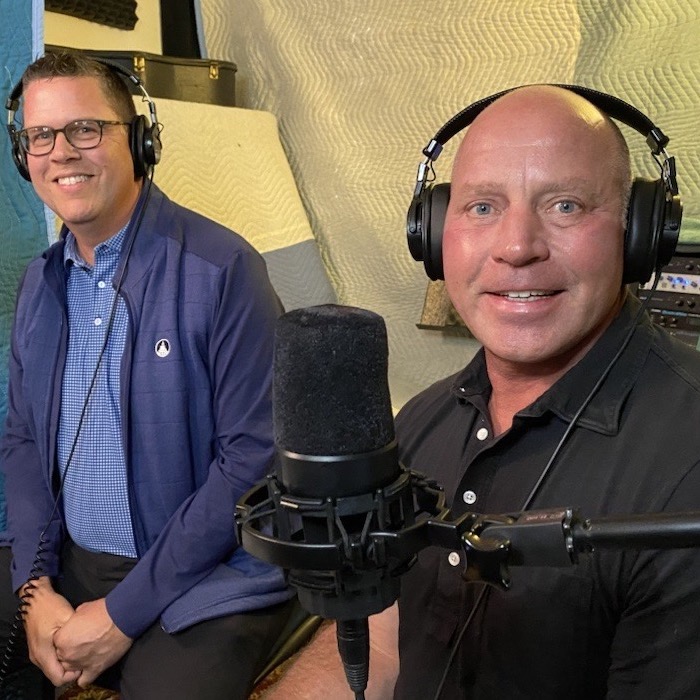
In October 2023, Miller appeared in a recorded conversation with Dave Dickey, a Bind co-founder who had also worked at Definity. Their shared history offers a more human chronology than a list of transactions. A company can be sold on a particular date; a working relationship can continue across several names, products and employers.
Another connection reaches back almost as far. TrueNorth Health Ventures lists Miller as a strategic advisor and describes a relationship with its team spanning nearly thirty years. Kyle Rolfing, a Lemhi colleague, also co-founded Definity. These links show how experience accumulates in a group of people as well as in any single founder. The next venture can begin with colleagues who remember the earlier attempts.
Miller has also returned to St. Olaf as a guest lecturer in its entrepreneurship class. In 2021, the college recognized him with an Alumni Achievement Award. A classroom gives the career a different audience: students considering their first attempt, rather than investors assessing another round. The route from a biology degree to acquisitions and venture investing becomes something that can be discussed, questioned and picked apart.
A business degree meets a changing world
At a 2018 gathering of mid-market CEOs, Miller offered a thought that sounds at home in the education of a biology graduate: an environment determines which mutations survive. The accompanying advice was to keep comparing a business with changes around it. His scientific training and his operating experience briefly occupied the same sentence.
Applied to a company, the observation places a limit on the founder’s will. A business can have a clear purpose and still need to adjust its form. It has to encounter customers, competitors and conditions beyond its own meeting room. That makes the later chapters of Miller’s career interesting to watch: a continuing concern with the customer, expressed through different companies and different partnerships.
“Bind within UHG is better without me.”Tony Miller, reflecting on life after the sale
Another company to build
Miller’s current operating role is co-founder and CEO of Harbor Health, based in Austin. His co-founder is Clay Johnston, formerly the inaugural dean of Dell Medical School. General Catalyst’s account of its investment emphasizes their complementary backgrounds. In January 2024, the firm announced it was leading a $95.5 million funding round alongside 8VC and Alta Partners.
Harbor announced a further $130 million financing in September 2025. In March 2026, Miller was still writing publicly in his capacity as founder and CEO. The dates place his Surest connection in perspective. The company he once ran has its own subsequent history, while he has taken on a fresh operating assignment with a different co-founder and another group of investors.
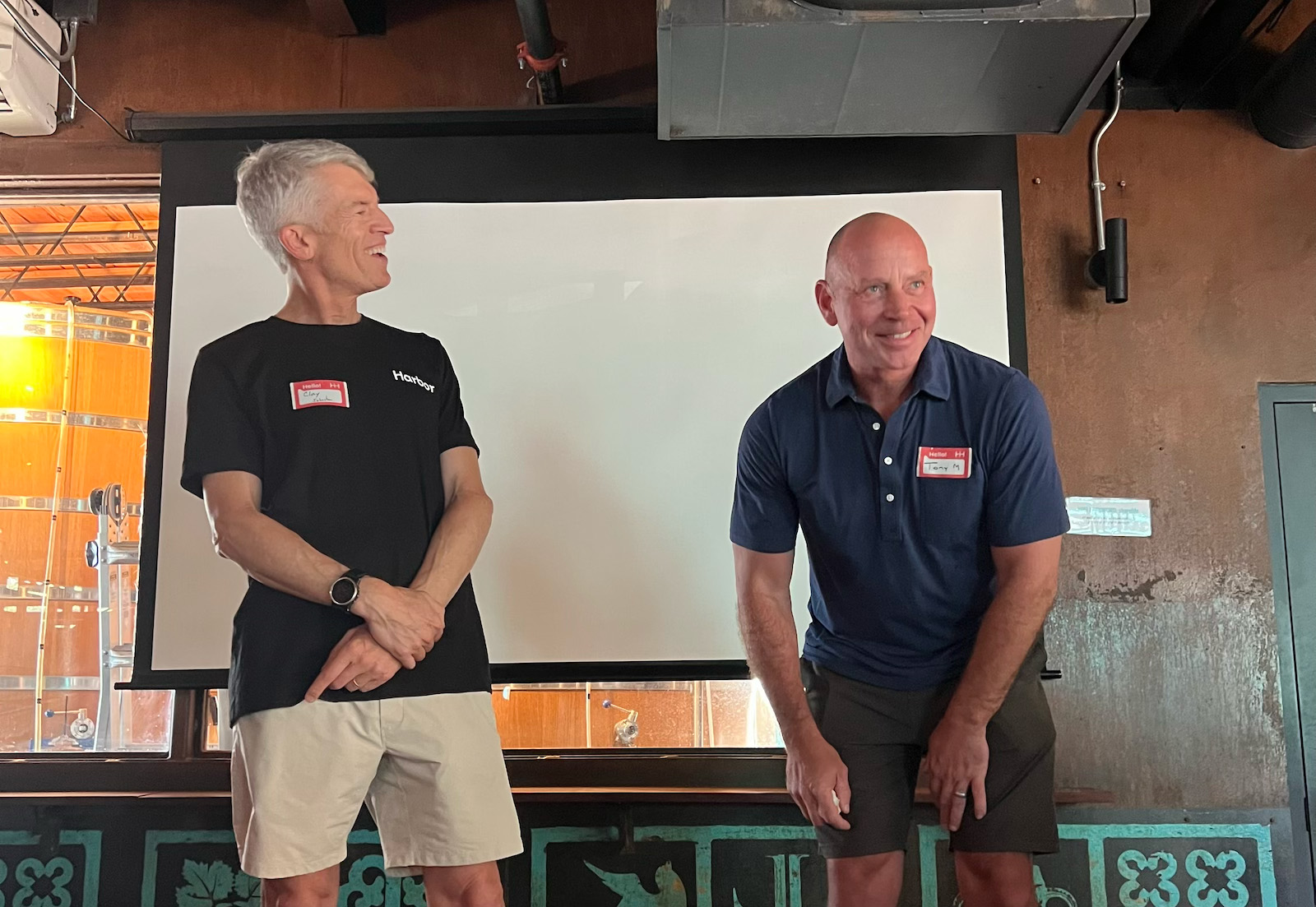
A photograph of Miller onstage beside Johnston captures an agreeable departure from the usual executive tableau: shorts, name tags, a projection screen, two people smiling. The setting is modest enough to let the people occupy it. After the acquisition announcements and financing totals, it is useful to see a founder back in a room with somebody else, explaining what they are trying to build.
Miller’s career has room for both the transaction and the next working day. A completed sale answers who owns the company. It leaves open who will build the next one, who will join, and which earlier lessons will survive the move. He has kept returning to those questions with another venture. His joke about being dispensable carries a practical ambition: build something that can continue, then find useful work again.