Before there was a public company, there was a floor to sweep. Tony Aquila worked in his uncle’s auto body shop, replacing windshields and looking at the business around him. A damaged car came with an administrative entourage: parts, estimates, insurers, repairers. The vehicle might be stationary. The paperwork had places to go.
Born in Richmond, California, Aquila left high school before graduating. His later career would stay close to the work he encountered in that shop. He started with automotive refinishing products, moved into claims software, assembled a global technology business and eventually tried to make electric vehicles. Cars recur throughout his biography. What changes is where he stands in relation to them.
His first ventures supplied the people who repaired cars. MaxMeyer America distributed European refinishing products and was sold to PPG in 1997. Ensera, his subsequent software company, addressed the flow of insurance claims and went to Mitchell International in 2001. Aquila became Mitchell’s president and chief operating officer. Those transactions gave him experience on both sides of an acquisition: creating a business someone wanted, then working inside the buyer.
There is a certain appeal to this kind of entrepreneurship. An insurance claim has little interest in being fashionable. It needs an answer. Software that helps the participants reach one can occupy a useful place in an industry that continues functioning long after a product launch has stopped attracting attention. Aquila’s early businesses were built around that practical demand.
The garage needed a balance sheet
Aquila founded Solera in 2005. The garage origin became part of its identity, but the decisive expansion required a very different piece of equipment: private equity. In 2006, Solera and GTCR acquired ADP’s Claims Services Group for $975 million in cash. Buying an established operation gave the young company a substantial business to build around. The garage story and the acquisition story belong together.
The claims group’s products connected insurers, collision shops and automotive recyclers, covering the journey from accident to resolution. Aquila knew that territory. Instead of waiting for a new product to win every customer individually, Solera bought into an existing network of work. Its stock-market debut followed in May 2007. The sequence matters: foundation, acquisition, listing. Growth arrived through transactions as well as technology.
He developed an acquisition shorthand: management, margin and core. The questions were whether a target had the right people, attractive economics and a place in the business. That is a more revealing description of his method than any founder legend. A company could be interesting and still fail the test. The discipline lay in deciding what belonged beside the businesses already owned.
Over Aquila’s tenure, Solera completed more than 50 acquisitions. The underlying ambition stretched beyond settling accident claims. In a September 2015 letter to employees, he described a company operating in 78 countries that wanted a role across buying, maintaining, repairing and selling vehicles, with an extension into the home. The accident was an entry point into a much longer relationship with an asset.
Vista Equity Partners completed the $6.5 billion take-private transaction in March 2016, with participation from investors associated with Koch Industries and Goldman Sachs. Aquila continued leading Solera afterward. The transaction value described the company deal, rather than a personal payout. It nevertheless marked how far the business had travelled in eleven years.
- 2005Company founded
- 2006ADP claims business acquired
$975 million - 2007NYSE listing
- 2016Taken private
$6.5 billion transaction
Milestones, not a valuation growth chart. Acquisition cost and take-private transaction value measure different deals.
A coach with a dry-erase marker
By 2014, Aquila had a meeting space near Solera’s Westlake headquarters where a Lamborghini and a Pontiac shared room with whiteboards. Breakfast there could turn into a management lesson. He talked about remaining humble, hungry and hunting, then drew his operating principles on the wall. An old-fashioned Coke machine completed the scene. The garage had acquired a corporate vocabulary without entirely giving up its furniture.
His favored ratios included 80/20 for concentrating effort, 30/30 for improvement and 90/10 for accountability. They made expectations memorable, and made the office sound a little like a training ground. The style was direct. Employees were expected to work out much of the route themselves. Anyone hoping for a leisurely breakfast risked leaving with homework.
EY recognized him with its national technology entrepreneurship award in 2013. He spoke about self-imposed limits and the freedom to raise capital for ideas others initially dismissed. It captures the confidence he brought to raising money and gathering people around a project. It also sets up the question that runs through his next chapter: how much of a business’s limit can its leader actually choose?
Aquila left Solera in 2019, and Jeff Tarr became CEO. In June that year, Aquila founded AFV Partners. Its investment territory included software and data businesses, with aviation among its interests. Aircraft Performance Group, RocketRoute and Seattle Avionics offered another version of the practical problem he had pursued in automotive claims: information that people need to operate something complicated.

“I’m only limited by the limitations I put on myself.”Tony Aquila, 2013
Then the software acquired wheels
Canoo brought him closer to the machine itself. He became executive chairman in October 2020 and added the CEO role in April 2021, succeeding Ulrich Kranz. Aquila was an investor joining an existing company. That distinction matters when reading his career: Solera was his foundation; Canoo was a business he took on, with designs and a history already in motion.
Canoo’s architecture placed different vehicle bodies above a common electric platform. The attraction was understandable for someone accustomed to finding connections between businesses. A shared foundation could support different uses. Yet manufacturing imposed a fresh set of demands. A repair estimate can travel through software. A van needs components, assembly, testing and a customer able to put it to work.
In July 2022, Walmart announced an agreement to purchase 4,500 electric delivery vehicles, with an option for up to 10,000. The proposed use was everyday logistics: online orders moving from stores to customers. Aquila emphasized the combination of a compact footprint and commercial cargo capacity. It was a pitch to a buyer concerned with parking, loads and delivery routes, rather than the pleasures of a Sunday drive.
The agreement was a commercial opening. It also created an obvious measure of progress: vehicles delivered. The distinction between an order and the revenue from fulfilling it became central to Canoo’s story. A fleet announcement can describe demand. It cannot, by itself, establish that a manufacturer has the money and operating capacity to meet it.
Three vans and a very large gap
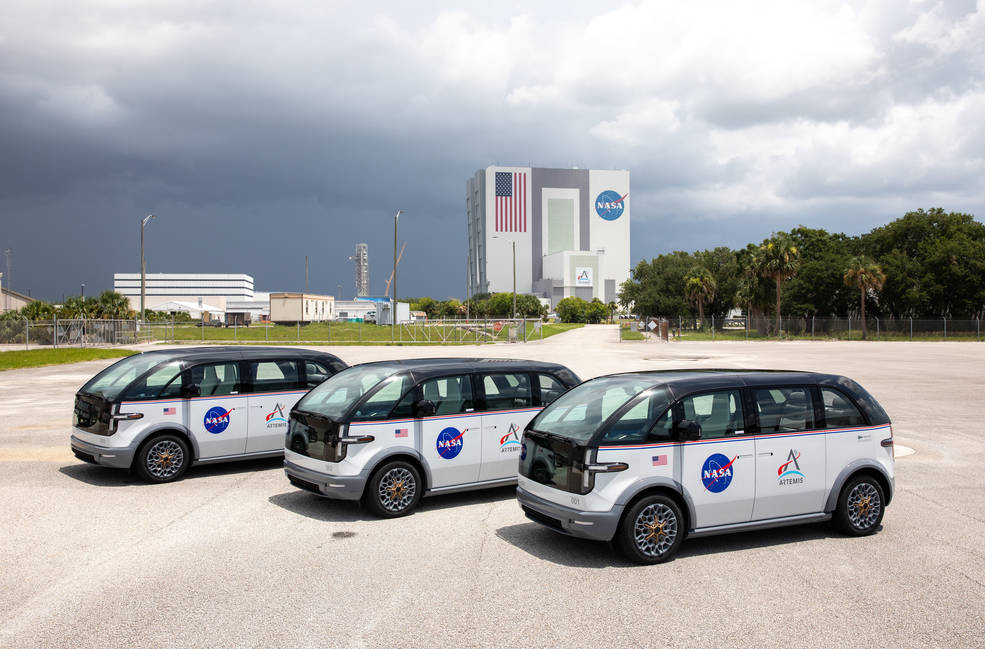
Some vehicles did reach customers. On July 11, 2023, Canoo delivered three crew transportation vehicles to NASA’s Kennedy Space Center. They were tailored for Artemis crews, support staff and equipment travelling to the launch pad. The assignment was wonderfully specific: a vehicle for people dressed to leave Earth, who still needed a lift across Florida.
That delivery gave Canoo a tangible achievement under Aquila. It also showed the difference between meeting a specialized commission and sustaining a manufacturing business. Three customized vehicles could demonstrate a design and satisfy a particular requirement. They could not answer every question about production volume, costs or the cash needed to keep operating.
For 2023, Canoo reported $886,000 in revenue and about $302 million in net loss. Its disclosures also recorded approximately $1.7 million for aircraft use from Aquila Family Ventures, alongside approximately $1.7 million for shared services. These were related-party transactions involving the CEO’s business. Set beside the small revenue base, they raised straightforward questions about spending priorities and governance.
Those figures do not supply a complete explanation for the company’s failure. They do show the scale of the mismatch it faced. The business was paying to develop and operate an automotive venture while recording less than a million dollars in annual sales. The distance between commercial interest and a sustainable operation remained painfully visible.
On January 17, 2025, Canoo filed for Chapter 7 liquidation and announced that operations would cease immediately. Its statement said attempts to secure additional financing had failed. The filing transferred control of the assets and liabilities to a bankruptcy trustee. Employees, creditors and shareholders now faced the consequences of a venture that had run out of room to continue.
Rounded figures. A specialized delivery was an achievement; sustainable manufacturing required a very different scale of sales.
What survives a second act
Aquila remained involved in the aftermath. In April 2025, the bankruptcy court approved an asset sale to WHS Energy Solutions, an entity he controlled, with roughly $4 million in cash consideration. An asset purchase carries its own possibilities, but it is a separate transaction from restoring the old operating company. Equipment and intellectual property can change hands while the original business stays in liquidation.
Later developments kept the ending from settling into a tidy comeback story. Aquila’s resignation from WM Technology’s board took effect on September 2, 2025. By December, NASA and USPS had stopped using Canoo vehicles. In July 2026, a proposed $20 million settlement involving former Canoo executives was reported in investor litigation; it concerned allegations, and was being presented for preliminary court approval.
AFV continues to identify Aquila as its founder, chairman and CEO, with an investment focus on software, data and technology. His documented ambitions have repeatedly centered on improving complicated systems. The attraction is consistent across a windshield claim, a flight operation and a delivery route. The results have varied considerably, which is what makes the career worth examining rather than merely reciting.
Solera showed that he could assemble and expand a business around work that other organizations already needed done. Canoo showed the cost of trying to turn a promising vehicle platform into an enduring manufacturer. Both belong in the portrait. The boy in the body shop learned to look beyond the damaged glass. The executive’s second act made the bill for that wider view impossible to overlook.