There is a tiny absurdity at the center of the modern automobile: the machine can accelerate two tons of metal to highway speed with millimeter precision, yet a laggy touchscreen can make the whole thing feel unfinished. CARIAD exists in that gap. The Mountain View-based CARIAD, Inc. is the American engineering hub of Volkswagen Group's software company, working across infotainment, automated driving, cloud connectivity and vehicle hardware. Its colleagues build the invisible systems beneath Volkswagen, Audi and Porsche products - the increasingly decisive part of a car that no longer arrives complete when it leaves the factory.
The original thesis was blunt and attractive. Volkswagen owns nine passenger-car brands and delivers roughly nine million vehicles in a good year. Instead of letting each brand buy and build overlapping code, put the common software in one organization. Spread the cost. Learn from the fleet. Update cars over the air. Give a Volkswagen hatchback and a Porsche SUV shared plumbing without giving them the same personality.
That thesis remains. The method did not.
The product is not an operating system. It is a stack of negotiations.
CARIAD's catalog makes more sense in layers. At the visible edge is One.Connected Infotainment: navigation that can calculate charging stops, a voice assistant that can control vehicle functions, and an Application Store with more than 100 apps in supported models. Beneath that sits a cloud and data platform connecting more than 45 million vehicles across more than 80 markets. It handles remote locks, battery status, hazard warnings, diagnostics and over-the-air updates. Deeper still are driving functions - Travel Assist, Emergency Assist, parking aids - plus software coordinating steering, braking, damping, charging and energy management.
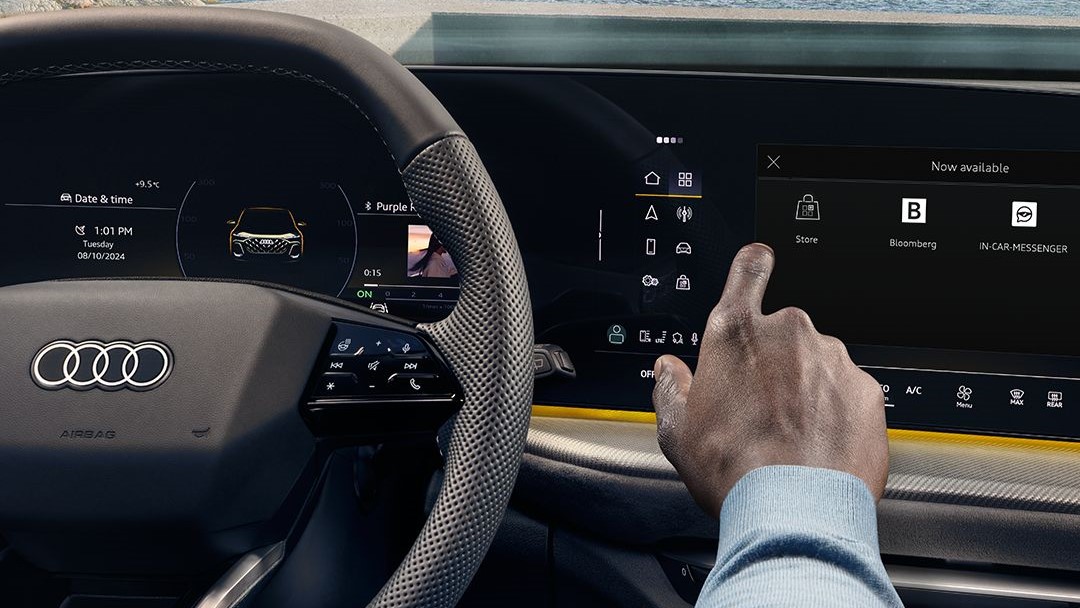
These are enterprise products wearing consumer clothes. Volkswagen Group brands are the direct customers. Drivers are the users. Revenue comes largely from development work and internal license fees as software is fitted to more vehicles. In 2025, CARIAD delivered software packages into eight new Volkswagen, Audi and Porsche model series, helping global revenue rise 34 percent to €1.8 billion.
The car, translated into four software layers
The first failure was sequencing
CARIAD began globally in 2020 as Car.Software Organisation, gathering roughly 1,200 people from Volkswagen, Audi, Porsche and existing technical units. The name arrived in 2021 - "CAR, I Am Digital" compressed into a friendly six letters - along with a huge promise: a unified, scalable architecture and operating system across the group.
But Volkswagen was not moving from one old stack to one new stack. It had vehicles already on the road, an E3 1.1 platform serving volume brands, an E3 1.2 platform due for premium electric models, and a future E3 2.0 architecture meant to unify the group. Every layer had its own hardware, safety requirements, suppliers and model deadlines. CARIAD was changing the engine while nine pilots argued about the destination.
“A platform cannot save time later if it delays the car now.”The hard lesson inside CARIAD's reset
The first public pain was delivery. Software problems delayed the electric Porsche Macan and Audi Q6 e-tron and pushed the group-wide future platform back. In 2023, Volkswagen replaced most of CARIAD's management board and installed Peter Bosch, a Bentley manufacturing executive known for turnaround work, as chief executive. This was an organizational signal dressed as a personnel change: reliable launches had become more important than the purity of the platform diagram.
The bill was industrial. Global CARIAD recorded operating losses of about €2.4 billion in both 2023 and 2024. In 2025, the loss improved to €2.2 billion. These figures include heavy upfront development and restructuring costs, so they are not a simple measure of burned cash. They do show why Volkswagen's patience came with conditions.
Operating loss, global CARIAD / € billions
Revenue rose while the loss narrowed in 2025, but this is still a turnaround in progress.
From one giant build to deliberate assembly
The new strategy is less cinematic and more credible. Volkswagen moved more responsibility for existing software toward the brands that use it. CARIAD retained cross-brand technologies where scale matters: infotainment, cloud, shared functions and integration. For the next Western software-defined vehicle architecture, Volkswagen formed a 50/50 joint venture with Rivian, using Rivian's existing electrical and software architecture as the base. Volkswagen plans to invest as much as $5.8 billion in Rivian and the venture by early 2028, subject to milestones. That is not CARIAD funding; it is the parent company's price for buying speed and reducing execution risk.
China gets a different assembly. CARIAD China works with Horizon Robotics through CARIZON on advanced driver assistance, with XPeng and Volkswagen China Technology Company on a regional electronic architecture, and with ThunderSoft on infotainment. Bosch became a development partner for automated driving, Qualcomm a compute partner, and TomTom a navigation partner. The company that once symbolized software self-reliance increasingly looks like an orchestrator of carefully chosen dependencies.
This is the important competitive distinction. Tesla and Rivian grew vehicle architectures around software from the beginning. Mercedes-Benz has MB.OS. BMW is building its Neue Klasse stack. Suppliers such as Mobileye, NVIDIA, Aptiv, BlackBerry QNX and Google sell powerful pieces. CARIAD's advantage is not clean-sheet simplicity. It is access to Volkswagen's brands, fleet data, safety expertise and distribution. Its disadvantage is the same list, read backward: legacy systems, divided ownership and many internal customers.
04 / What readers can copyFour useful rules from an expensive education
Centralize the boring parts
Identity, update pipes, data rules and common interfaces gain value through reuse. Brand voice and customer experience do not need the same uniformity.
Ship before you unify
A future platform should not starve today's products. Maintain production releases while migrating one bounded domain at a time.
Partner at clean seams
Outside architecture works when ownership, interfaces and intellectual property are explicit. A vague partnership only adds another meeting.
Measure the user, not the org chart
A shared platform wins when releases arrive faster, defects fall and customers notice useful improvements - not when more teams report into it.
The approach will not travel everywhere. A young company with one product may create overhead by splitting a stack across partners. A business without Volkswagen's purchasing power cannot summon a global architecture venture. And selective outsourcing fails when the core differentiator itself leaves the building. If your product is the autonomy model, the interaction engine or the transaction network, control of that layer may be existential.
CARIAD's version works only under specific conditions: enormous installed scale, patient capital, strict automotive safety rules, multiple brands that genuinely share infrastructure, and leaders willing to draw a bright line between common foundations and distinctive experiences. Even then, governance is the product. Someone must decide who owns a bug that crosses cloud, vehicle, brand and supplier boundaries at 70 miles per hour.
05 / The company nowA narrower mission with more road beneath it
By 2026, the reset had visible outputs. CARIAD said its Auto Edge runtime was operating in more than one million vehicles, placing modular applications close to the car's sensors while retaining a cloud connection. CARIZON was preparing a locally developed Level 2++ assistance system for seven Chinese new-energy models. The Audi software portfolio added "experience worlds" coordinating lighting, sound, climate and seating. These are specific releases, not another promise to reinvent the entire car.
The organization is also smaller. CARIAD says its restructuring made the global company roughly 30 percent leaner; public reporting put planned 2025 reductions around 1,600 jobs. It now reports more than 4,000 employees from over 75 nationalities. The U.S. hub in Mountain View lists 201 to 500 employees publicly and recruits engineers who can work across Silicon Valley partners, German development teams and automotive-grade integration.
So what does CARIAD do? It makes a Volkswagen Group car feel current after purchase. It gives brands a common way to add apps, route an EV, process data, assist a driver and update a fleet. More subtly, it decides which pieces of the digital vehicle Volkswagen must understand deeply, which pieces its brands should own, and which pieces a partner can build faster.
The old CARIAD story was a moonshot: one software brain for a sprawling auto empire. The present one is an operating manual written in scar tissue. Share the foundations. Protect the personality. Buy working technology when ideology gets in the way. Then put it in a car people can actually purchase.