In 2018, Ziyu Shen was explaining a small pleasure: listening to something in the car, getting out, and continuing on a phone or a speaker at home. He was at the Beijing Auto Show, talking about ECARX’s GKUI connected-car system. Among the screens, processors and promises, this was an unusually ordinary ambition. Your audiobook should be allowed to finish its sentence.
Shen described continuous listening through the audio service Ximalaya, alongside software that could keep improving after a car had been sold. The phone was already teaching people to expect that kind of continuity. He wanted the car to participate. Eight years later, his company’s acquisition of the Flyme software business would give that early argument a much larger balance sheet.
There is a useful way to follow Shen’s career: watch the distance between the device in your pocket and the machinery in your driveway shrink. His work has passed through General Motors, OnStar, telecommunications, automotive software and consumer electronics. The recurring problem is remarkably consistent. How do you make those systems behave as though they have met before?
A modem before a mission statement
Born in Shanghai and educated at Shanghai Jiao Tong University, Shen entered an industry in which connecting the car to the outside world was itself a substantial engineering assignment. His early jobs included engineering and senior management at Shanghai General Motors from 2006 to 2008, followed by a senior management role at Shanghai OnStar from 2009 to 2011.
In an August 2026 conversation with investors, he recalled working on embedded software and OnStar technology in Detroit in 2007 and 2008. The team put a Qualcomm modem into a car and collected vehicle data. It is a nicely concrete starting point for a career now expressed in the vocabulary of operating systems and artificial intelligence: first, get the car talking.
His next appointments widened the view. He became an industry director at T-Systems China in October 2011, then general manager at Shanghai Pateo Network Technology Service in October 2012. He stayed at Pateo until March 2016. These were different positions along the same connection, between the vehicle, its software and the services arriving over a network.
The path also brought him into contact with Geely. Shen has described supplying connected systems to Chinese manufacturers, including Geely, during his Pateo years. That work introduced Eric Li, also known as Li Shufu, to what he was building. The relationship eventually became a founding partnership. In 2017, Shen and Li established ECARX.
When an investor-conference question in 2026 turned toward his background and his relationship with Li, Shen offered a small correction to any youthful-founder mythology: “I am not young”. The useful part of the answer came immediately afterward, in his account of the engineering work. By then, the career behind the company stretched back roughly two decades.
“I am not young”
Ziyu Shen, August 2026
The screen was only the beginning
At the 2018 Beijing show, Shen was already discussing a platform rather than an isolated display. He wanted internet companies and developers to build for it. Hardware needed to support successive software improvements. Different vehicle brands could share an underlying architecture while preserving their own style. He described four planned software iterations that year, a timetable that made the system sound more like a continuing service than a finished accessory.
He also talked about voice operation and adapting applications to the experience of driving. A service that works in someone’s hand has another job to do in a moving car. That distinction helps explain the territory he chose. A dashboard is a very expensive place to discover that two software teams have understood the same instruction differently.
ECARX’s business developed around supplying the layers beneath that experience: computing platforms, software and the integration needed to make them useful to automakers. In its 2022 presentation ahead of going public, Shen described the destination as “computers on wheels”. He envisaged central computing replacing the need for more than a hundred separate electronic control units, with software updates continuing over the air.
It was an architectural ambition with consequences for the customer. If functions can keep changing through software, buying a car becomes the beginning of a longer technical relationship. The supplier has to think about what happens after delivery, and the automaker has to decide which parts of that relationship it wants to control.
A stock-market bell, then another job
ECARX began trading on Nasdaq on December 21, 2022, following its combination with COVA Acquisition Corp. The listing arrived five years after the company’s founding. At its first New York investor day the following April, Shen returned to the original premise: the vehicle was changing, and its computer system would become an increasingly important part of the product.
By then, he had taken on another substantial assignment. In March 2023, he was appointed chairman and CEO of Xingji Meizu Group while retaining his ECARX responsibilities. The arrangement connected a business supplying automakers with one focused on consumer technology. The stated purpose included developing software optimized for both smartphones and automobiles.
The intellectual link was particularly visible in his idea of a sixth automotive domain. Alongside power, chassis, body, cockpit and autonomous driving, he proposed a mobile domain, treating the phone as part of the vehicle’s connected architecture. The pocket, in this account of the automobile, deserved representation.
In November 2023, Shen received the Automotive Annual Technology Person award at the 21st Century Automotive Industry Annual Conference in Guangzhou. His keynote addressed how mobile phones could strengthen the automotive ecosystem. The recognition matched the subject he kept returning to: semiconductors, operating systems and the software communities around them belonged in the same conversation.
A global company has to speak locally
For Shen, expanding internationally has also meant accommodating different digital habits. ECARX’s Cloudpeak software offers a useful example. Developed with participation from global research teams and HaleyTek, the ECARX-Volvo Cars joint venture in Gothenburg, it is built on Android Automotive and Linux. The Volvo EX30 became one of its early applications.
The practical work includes integrating navigation, voice assistance, applications and connections to other vehicle functions. To the driver, these arrive as a single experience. Underneath, they are a collection of relationships that have to be maintained. A map, a microphone and a carmaker’s interface do not become cooperative merely because they occupy the same dashboard.
The EX30 Cross Country made the regional challenge visible in 2025. Its European version used Google Automotive Services, while the Chinese-market implementation integrated Android Automotive OS. A common software foundation supported different market requirements. This is the kind of detail that gives Shen’s international ambitions substance: the underlying platform travels, while the delivered experience adapts.
Volkswagen brought another test. In March 2025, ECARX announced a contract to supply digital cockpit technology for Volkswagen and Škoda vehicles, with initial launches planned for Brazil and India. The package combined Antora 1000 computing hardware with Cloudpeak software. A second Volkswagen agreement followed in November, extending the relationship across multiple models in Latin America.
That second agreement included an instructive distinction: Antora 1000 for vehicles configured with Google Automotive Services, and Antora 500 for specified offline versions. The idea of a connected car still has to make room for different budgets and different specifications. Shen’s platform ambition meets its commercial examination in precisely those decisions.
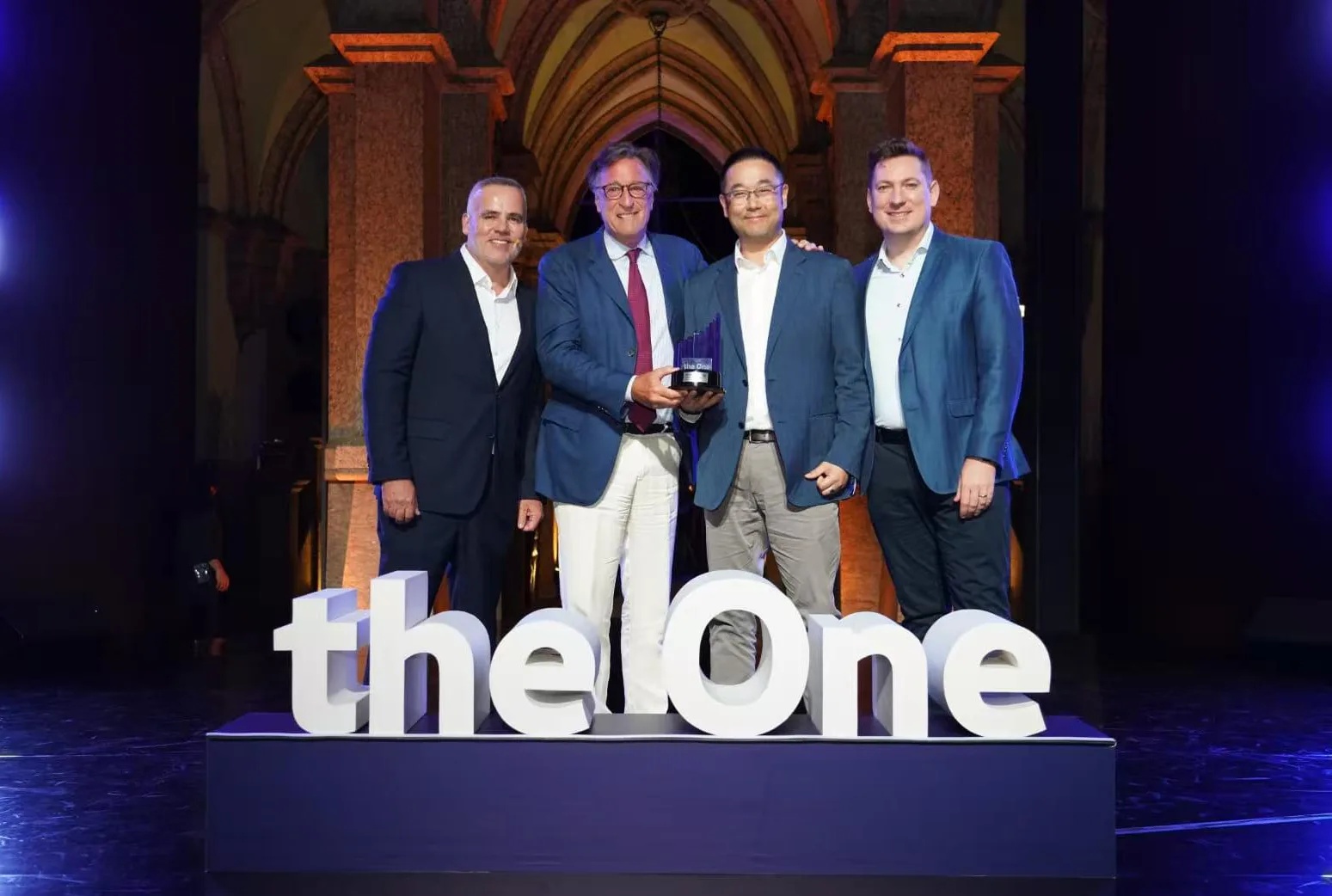
In June 2026, he accepted Volkswagen Brazil’s Partnership Connectivity Award at The One supplier summit, held at Ilha Fiscal on Guanabara Bay. The ceremony supplied a handsome setting for a business built around less photogenic work: integration, regional engineering and getting customer programs delivered. In the photograph, the software has finally acquired something it rarely gets to wear: evening clothes.
The phone’s software comes inside
The Flyme transaction brought the long-running phone-and-car argument into ECARX’s ownership structure. An initial acquisition plan in April 2026 expanded into a June agreement for the entire Flyme software portfolio. Completion was announced on October 5. ECARX acquired the business through Hubei Qiguang Technology, a company carved out from DreamSmart Group.
The price was RMB1.8 billion, approximately US$266 million. The portfolio included Flyme Auto, the cockpit operating system, and Flyme OS, which connects experiences across devices. Flyme was to operate as an independent software division. At completion, Flyme Auto was already deployed by ECARX in 3.5 million production vehicles.
Shen’s stated aim was to align the hardware and software roadmaps and improve how the layers worked together. The possible commercial returns included software licensing and integration services. The acquisition adds a new responsibility to the original engineering ambition: owning the software also means organizing its development and its continuing relationships with customers.
vehicles equipped with ECARX technology worldwide
By September 2026, ECARX reported its technology in more than 12 million vehicles across 18 automakers, 28 brands and 159 markets. Those figures describe the company’s installed footprint, rather than cars manufactured by Shen or annual vehicle sales. His influence is embedded inside other companies’ products, where a component supplier’s name can disappear just as its work becomes familiar.
Scale does not settle the financial argument. In the second quarter of 2026, ECARX recorded US$225.2 million in revenue and a US$12 million net loss. Adjusted EBITDA was positive at US$0.5 million. Shen’s expanding technology portfolio therefore sits alongside the continuing task of turning customer programs into durable earnings. The systems have to cooperate, and the arithmetic has to work.
The continuity is more revealing than any single number. In Beijing in 2018, Shen discussed audio following a listener from the car to a phone and then home. In 2026, his company acquired operating-system capabilities intended to connect those worlds more closely. Between the two sit a public listing, international customers and a series of increasingly expensive decisions about what a car’s computer should own.
His ambition can be described at the scale of a technology stack. It can also be understood at the scale of a person opening a car door. The screen wakes up. The services are familiar. The story picks up where it stopped. Shen has spent much of his working life on everything that has to happen before that moment can feel uneventful.
Follow the connections
- Shen’s LinkedIn
- ECARX: the business and its technology
- The 2018 Beijing conversation
- August 2026: Shen on his career and company
- The Nasdaq listing
- The 2023 Meizu appointment
- Shen’s mobile-domain concept and 2023 award
- Cloudpeak and the Volvo EX30
- The EX30 Cross Country across markets
- Volkswagen’s first 2025 agreement
- The second Volkswagen agreement
- June 2026: an award in Rio
- Flyme: from agreement to completion
- The September 2026 vehicle footprint
- Second-quarter 2026 results