A key fob is an unlikely place to find an argument about the future of the car. It lives in a pocket, gets misplaced on a kitchen counter and performs a job so familiar that nobody gives it much thought. In early 2023, Rivian sent its key fob an over-the-air software update. Wassym Bensaid brought up that detail when explaining how the company built its vehicles. Even something detached from the car could keep changing.
There is a pleasing absurdity to this. The little object you use to enter your vehicle has its own place in the software roadmap. But it also gives Bensaid’s work a useful scale. Start with something small enough to hold. Then follow the connections outward, through the vehicle and into the systems that support it.
Today, those connections reach beyond Rivian. Bensaid is the company’s Chief Software Officer and Co-CEO and CTO of Rivian and Volkswagen Group Technologies, the joint venture usually called RV Tech. His assignment includes helping a software approach developed at one electric-vehicle maker travel into vehicles from a much larger automotive group. The key fob was a small demonstration. This is the industrial version.
An ear for what code can change
One of Bensaid’s early software experiences involved writing code to imitate a three-dimensional audio effect. He was interested in how software could alter someone’s experience of hardware. That curiosity gives his later career a thread: the physical object stays in front of you, while code changes what it can do.
His hometown is Toulouse, France, and he studied telecommunications engineering at École nationale d’ingénieurs de Tunis. His work took him through wireless devices, Android and connected infrastructure, with roles at companies including Motorola, Intel and Silver Spring Networks. He joined Rivian in 2019.
Cars gave that background a complicated new setting. A vehicle combines devices that have to cooperate, often under conditions far less forgiving than a desk. His affection for cars also has a distinctly French footnote: he has spoken warmly about the Citroën DS, including its design and suspension.
That combination is useful to keep in mind. Bensaid’s subject is software, but the experience he is trying to shape is physical. Someone feels the ride, hears the audio and reaches for a control. The code earns its place through those encounters. An architectural diagram cannot enjoy a drive.
The battery that needed a better question
In March 2023, Bensaid described a less playful example of Rivian’s update machinery. The data team was investigating rare cases of low-voltage battery depletion. It had found a possible connection involving particular driving situations and combinations of hardware and software. The problem was elusive enough that laboratory work and a beta fleet of more than 800 vehicles had not reproduced it adequately.
The response was to improve the question the vehicle could answer. An earlier update added background logging. That extra information helped the team confirm the issue, develop protections and send out a correction within weeks. Owners did not need to see the investigative work happening behind the scenes.
In that account, the update is also a way of learning. The engineers have a hypothesis, ask for more useful information and use the result to change the product. A car already in someone’s possession becomes part of the process of making the next correction possible.
- 01ObserveFleet signals expose an edge case.
- 02InvestigateAn update adds background logging.
- 03ConfirmMore detail tests the hypothesis.
- 04ImproveSoftware protections reach vehicles.
For an owner, the practical result may be wonderfully undramatic: the vehicle behaves as expected. Bensaid has described a smooth customer experience as success. The engineering can be intricate; the morning should still be ordinary. Nobody buys a car hoping to become intimately acquainted with its logs.
The owners have questions
At a Rivian community gathering in Venice in April 2023, Bensaid had just returned to California from Serbia. He suggested a technology Q&A. People had come from across Southern California and farther away, including Oregon. It was a chance for the software team’s work to meet the people living with it.
“You are all a very important part of helping us make a better vehicle.”Wassym Bensaid, Venice gathering, April 2023
The setting matters. A customer gathering gives an engineering conversation a different shape from a product announcement. An owner can begin with a particular frustration, or an idea that seems obvious from the driver’s seat. The executive has to connect that request to the system behind it.

Later that month, Bensaid answered questions live from Palo Alto about subjects including dash cam, route planning and audio. He described a development process that moved through repeated integration and testing, from the bench to subsystems and into vehicles. Behind the feature someone wants is a sequence of checks.
By the May 2026 R2 Reddit AMA, the questions had become a remarkably detailed tour of daily ownership. Owners wanted to know about audio, navigation, gloveboxes, power use and future integrations. In a direct exchange about update quality, he described internal testing, staged deployment and an external beta group.
There was room for levity, too. Asked how he divided his days between vehicle programs and the Volkswagen venture, he answered with a playful reference to Fort Minor’s “Remember the Name.” The reply supplied no calendar breakdown. It did suggest that even a software executive can occasionally prefer a musical interlude to another allocation spreadsheet.
A bigger room, a shared set of tools
In November 2024, Rivian and Volkswagen Group announced the launch of their joint venture, with Bensaid and Volkswagen’s Carsten Helbing as co-leaders. The overall transaction was valued at up to $5.8 billion. That figure describes the broader deal involving Rivian and the venture; it is not a tally of software already shipped.
The venture’s purpose was specific: develop software and electrical architecture for future electric vehicles. Rivian contributed an approach built around integration. Volkswagen Group brought automotive platforms and global reach. The initial teams were to be based in Palo Alto, with further North American and European locations planned.
For Bensaid, this expanded the question of what should be shared. A common foundation has to make sense for different vehicles and the teams building them. The value of sharing appears when it reduces repeated work while leaving room for a product to have its own character.
employees across an international development team
USA / Canada / Sweden / Serbia / GermanyA year after its founding, RV Tech reported more than 1,500 employees, with teams in the United States, Canada, Sweden, Serbia and Germany. A new Berlin location brought collaboration closer to Volkswagen Group’s brands in their own time zone. Architecture may travel electronically; conversations still have to happen when people are awake.
The November 2025 update also set out the next steps. Reference vehicles from Volkswagen, Audi and Scout were headed toward winter testing. A production model following Volkswagen’s ID.EVERY1 concept was scheduled for 2027 with a version of the architecture. Those were development milestones and plans, each with work still attached.
The cold has a vote
On March 27, 2026, Volkswagen Group announced that RV Tech had completed winter testing of its production-intent zonal architecture. Reference vehicles from Volkswagen, Audi and Scout had undergone months of evaluation in Phoenix in the United States and Arjeplog in Sweden. Teams validated the functionality and performance of the electronics and software.
“Zonal” describes an architecture organized around physical areas of the vehicle. For the person driving, the phrase is unlikely to become a dinner-table favorite. Its consequences are more interesting: how the vehicle’s systems work together, and how a shared design can support different models.
The winter announcement puts a welcome physical boundary around the software conversation. A plan has to become hardware and code operating together in real conditions. A prototype can reveal something a diagram leaves politely unmentioned. Weather is an unusually direct reviewer.
That milestone also helps explain the demands of Bensaid’s role. The work crosses companies, locations and vehicle programs. Progress has to mean something to all of them. Completing a test phase establishes a particular piece of evidence, while the route into production continues.
A car with room to learn
Bensaid’s public work with data predates the venture. In June 2023, he gave a keynote at the Data+AI Summit in San Francisco about integrating data and AI across Rivian’s business. In 2026, Databricks recognized him with its Visionary Award, describing a common data foundation spanning vehicles, factories and enterprise operations.
In the May 2026 R2 Q&A, he singled out local computing as a long-term opportunity. His example was the potential for richer AI functions to operate in the vehicle, including away from a network connection. He framed that as future capability. A driver in a remote place has a very practical reason to care where the computing happens.
His appearance on Decoder that month brought another part of the ambition into view: AI-powered voice interaction. Bensaid argued for its place in the car and discussed Rivian’s choice to build its own experience rather than adopt CarPlay. That is a position with consequences for people who already have strong preferences about how they use their phones.
It also raises the standard for the experience Rivian supplies. A system asking people to change a familiar habit has to earn their willingness in use. The convincing moment will often be modest: a request understood, a setting changed, a journey made easier.
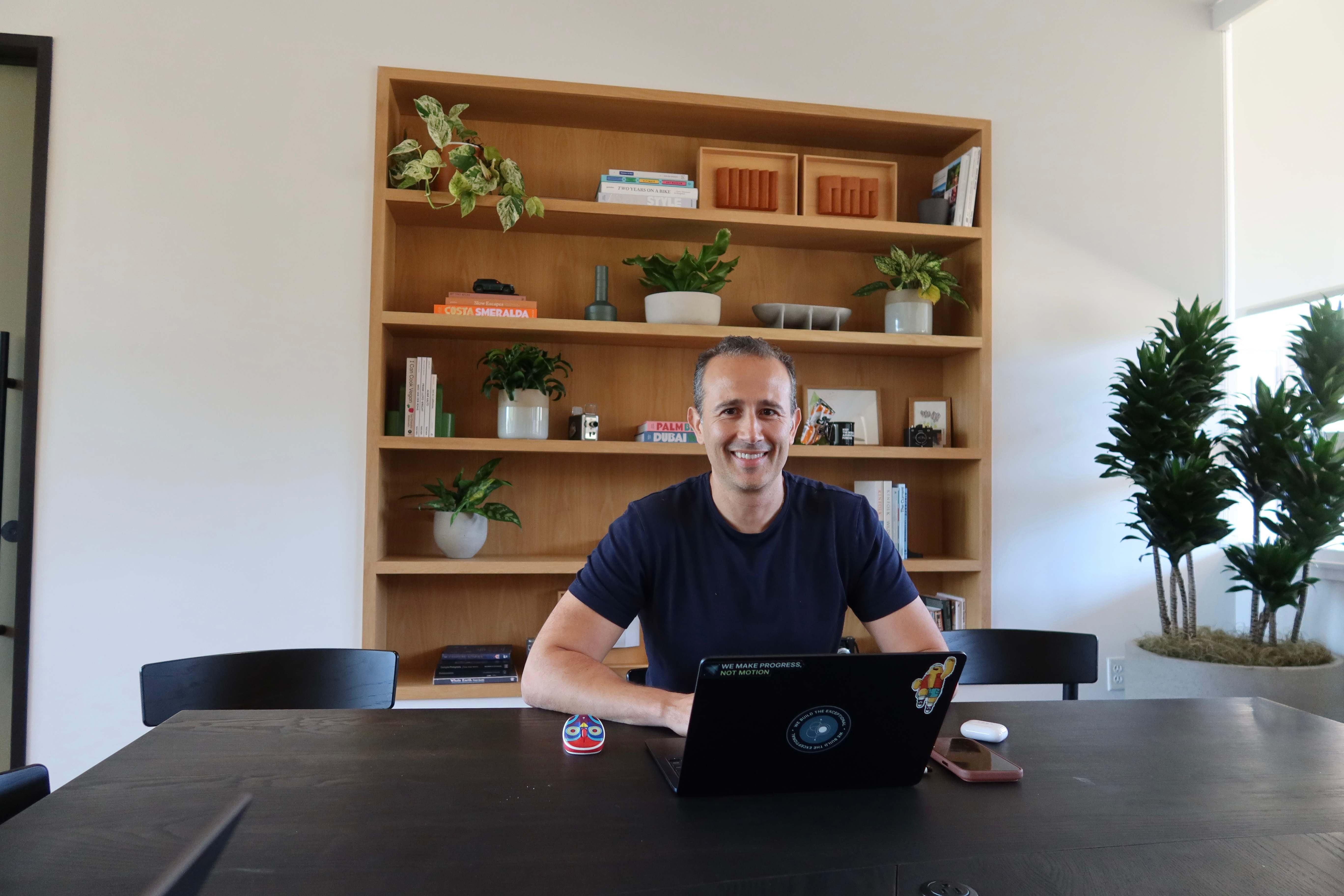
The photographs and public exchanges offer a fitting final detail. On Bensaid’s laptop during the AMA is a sticker about making progress rather than motion. There is a software version of that distinction: activity fills a release calendar, while improvement earns its meaning in the vehicle.
The key fob, the battery investigation, the handwritten owner suggestions and the winter prototypes belong to that same continuing job. Delivery starts a relationship that needs attention. For Bensaid, the unfinished car is an invitation to keep working, with its owner close enough to ask what comes next.