At Gamescom in August 2026, Tommy Thompson had another talk in about twenty minutes. He was running on coffee, by his own account, and had come prepared with a list of mistakes game studios make when adopting artificial intelligence. One of his more useful suggestions required neither a consultant nor a software licence: a studio could begin its policy with a Post-it note saying no. That would at least give everyone a rule to discuss. A blank wall, he implied, has never settled a disagreement between programmers, artists and executives.
The detail is funny because it is so small. It is also typical of Thompson’s work. He spends a great deal of time explaining complicated systems, then asks whether anyone has written down the decision those systems are supposed to help make. At Gamescom he had a harder example ready. A company says a workflow has five steps. Watch the work closely and there are 27. Inside one of those sit another 101. The tidy diagram was accurate only at a distance. Automation built around it would have to live with the closer view.
Thompson has occupied both sides of that distance. He has studied game AI as a researcher, taught it as a lecturer, built and advised on it as an engineer, and translated it for players on YouTube. The word AI became an enormous banner in the years after he started his channel. He continues to point beneath it, toward the particular machinery and the people who must use it.
Before the word got so loud
His subject predates the current fascination with chatbots. In games, artificial intelligence has long meant the design of behaviour: enemies finding a path through a level, characters choosing when to pursue or retreat, systems assembling parts of a world so that a player encounters something fresh. Those decisions can be mathematically clever. They can also be wonderfully ordinary. A character needs to get through a door without looking foolish. If the player notices the door more than the scene, the illusion has failed.
Thompson trained at the University of Strathclyde, defending a PhD in AI for games in 2010. After a brief period in investment banking, he took a teaching post at the University of Derby in 2012. He eventually led its BSc in Computer Games Programming. Later posts at Anglia Ruskin University and King’s College London kept him close to students working through the gap between a promising algorithm and a convincing game. His academic work ranged across machine learning, non-player character design and procedural content generation; his biography counts more than 50 peer-reviewed publications.
There was a practical streak outside the university, too. In the middle of the 2010s he co-owned and programmed for Table Flip Games, an indie studio making its own projects and doing work for others. Research papers ask whether a technique can work. A game project asks whether it will work by Friday, inside a budget, beside every other system that must work. Thompson’s later career would draw on both sorts of question.
A lecturer opens a second classroom
In 2014, while still teaching, Thompson started AI and Games as a personal YouTube project. Its premise was generous: show people what the intelligence inside games actually does, in language a curious player could follow and a prospective developer could learn from. His case studies have examined titles as different as Alien: Isolation, Hitman, Forza Horizon, GoldenEye 007, Halo 2, Half-Life and Doom. The attraction lies in the close inspection. A familiar encounter can change once you understand the rules that made it happen.
The channel grew across a decade of releases. AI and Games reports millions of YouTube views and an audience above a quarter of a million across its platforms. A newsletter added room for research notes and industry arguments; a second channel, a podcast and professional training expanded the classroom. Thompson marked the series’ tenth anniversary in 2024 by thanking the collaborators and supporters who had helped it grow. A lone lecturer’s video project had acquired colleagues, clients and a community.
That audience arrived because the lessons did not treat the player as a nuisance to be dazzled with jargon. Consider a game enemy that seems to hunt intelligently. The interesting questions are how it receives information, which actions it can choose, and why the designer wants its behaviour to feel fair or frightening. A perfect opponent can make a terrible game. Thompson’s explanations keep the design goal in view. Intelligence, in this setting, earns its place by improving the experience.
“My goal is to deliver a series of videos that provide insight into the realities of AI in video game development.”Tommy Thompson, on AI and Games
In 2022 he left academia to focus on the venture full time. The company had already been working with studios since 2019, on research, development support and communication. Its projects stretch from independent teams to large publishers, in Britain, the United States and beyond. Thompson now moves between explaining a system to the public and helping the people building games decide how to put one to work.
The room gets bigger
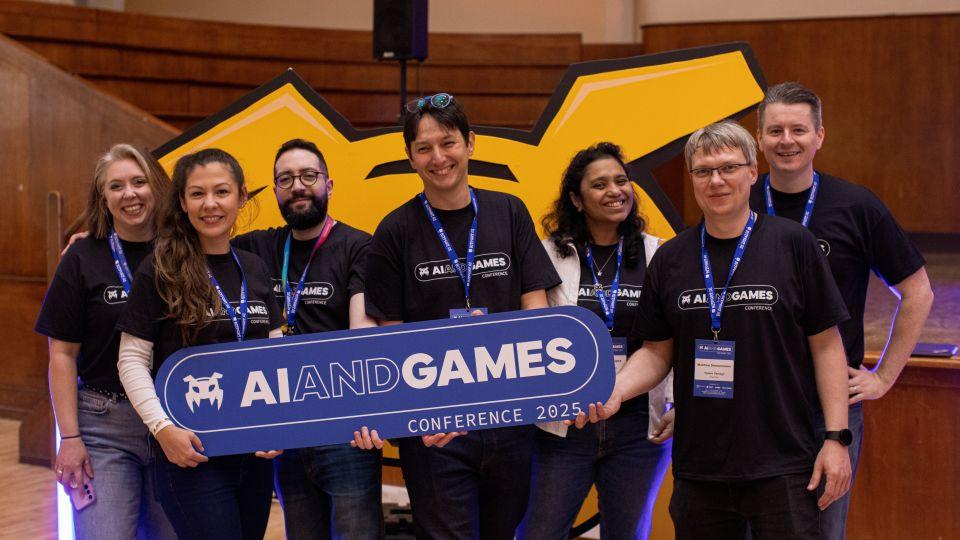
The first AI and Games Conference met in London in 2024. Thompson served as lead organiser, putting researchers and industry developers in the same conversation. It was a natural extension of a channel devoted to translation: academic ideas have little chance of improving a game if they cannot reach the teams designing one. The gathering also reflected a concern in his later writing. Knowledge about game AI can be scattered, difficult to access and overly dependent on a few people willing to keep the conversation going.
His own calendar shows how many conversations now meet there. He advises the AI Summit at the Game Developers Conference and the industry advisory board for the UK’s IGGI doctoral consortium. He wrote the foreword to the second edition of Artificial Intelligence and Games. In 2026, AI and Games launched a fortnightly podcast to interview people across the sector and take on the arguments gathering around new tools. These are several ways of asking experts to explain their work where other people can hear it.
The conference also makes visible the people around the project. Its work depends on exchanges with those who write code, shape levels, teach students and play the finished games. Thompson’s channel has always had a particular audience; his event gives that audience a place to disagree in person.
A useful machine still needs a useful question
Generative AI changed the vocabulary around Thompson’s older field. A conversation once concerned how a character navigated a level; now it may begin with whether a model can generate art, write code or speed up production. Thompson has followed that change without pretending every use case is the same. In an August 2026 interview, he described studios experimenting seriously with code and development infrastructure, while also asking whether smaller, focused models might fit games better than large, costly ones. The conclusion depends on the job.
At Gamescom he made the human part of that evaluation unusually plain. A studio can record that a task is 25 per cent faster and still discover that the developers dislike the new workflow. A tool may save time while complicating communication, obscuring how something works or creating a dependency the team cannot control. Numbers matter, he said; so does the experience of the people producing the game. In one pilot he described, the combined evidence led the team to keep its old process.
He also argued for literacy before mandates. If artists, writers and programmers are working under different assumptions about generated material, an apparently small fix can cross a boundary nobody agreed to cross. A shader bug repaired with a prompt may feel harmless until the same logic is applied to missing dialogue. A studio needs a shared language for that decision. Thompson’s Post-it note was the beginning of a policy, and perhaps a prod to make a better one.
What is the work today? What changes with the tool? Who can judge the result?
His writing in 2025 and 2026 has also defended the older craft of game AI from being swallowed by the newer phrase. Game AI for gameplay has its own research questions, skills and history. It can disappear from view when every AI discussion becomes a referendum on generative systems. That would be a strange outcome for an industry that has spent decades teaching characters to move, react and surprise. Thompson wants those skills to remain available to the next generation of developers, even as new tools demand scrutiny.
A YouTube audience can learn why a game enemy behaves as it does. A studio team can learn why a proposed shortcut fails to suit its work. The two lessons meet at the same point: look closely at the system in front of you. Thompson has made a career of pulling back the curtain, then asking whether the show improves when the machinery changes. There is no shortage of people promising a faster future. His more durable contribution may be getting them to explain what, exactly, they are speeding up.