Before Georges Harik helped build products that reached millions of people, he had a smaller audience to entertain: himself and his friends. His Apple II+ had run out of games. So he wrote some. The exercise gave him a durable answer to a practical question. When the thing you want is missing, you can try making it. That instinct would follow him through Google’s early years, a messaging company he started with his brother, and a new AI lab concerned with how people work together.
Harik has lived through several versions of the computing future. In one, search was the front door to the internet. In another, a phone gathered all of a person’s conversations. Today, a model can write a reply in seconds, but getting a group of people to agree on a plan can still take an afternoon. His latest venture, humans&, starts from that stubbornly human difficulty. The path there is more revealing than any prediction about what the company might become.
A question from his father
Harik studied mathematics before his father asked what he planned to do that was practical. Computer engineering offered an answer with room for play. In a later interview, Harik recalled that programming had begun with games he and his friends could actually use. There is no elaborate origin myth here: a computer, a shortage of games, and a parent asking a sensible question. Those details explain more than a tidy tale of destiny would.
His academic work was serious. Harik completed a PhD at the University of Michigan in 1997, studying how genetic algorithms learn which parts of a problem belong together. The subject sounds distant from messaging apps or workplace AI. Yet it turns on a familiar puzzle: the pieces of a system matter, and so do the relationships among them. Harik was publishing work on evolutionary computation before the present wave of AI became a public conversation.
After graduate school he chose a young company where, as he later put it, he hoped for fun and impact. He joined Google in 1999, among its first ten employees. At that scale, a person could move between engineering, products, and questions that had no department yet. Harik eventually worked on the company’s new-product efforts, sometimes called “Googlettes.” The list around that period includes Gmail, Google Talk, Google Video, Picasa, Groups and mobile projects. He also describes himself as a co-developer of AdSense targeting. The point is less that one person invented a portfolio than that an early team had unusual room to try things.
Gmail is the neatest example of how strange those experiments could look from outside. When Google announced it on April 1, 2004, the promised gigabyte of storage seemed so extravagant that reporters called to check whether the company was joking. Harik remembered enjoying the calls. Limited invitations, partly a necessity of the rollout, became a mark of desirability. What later looked like a perfect marketing move was, in his telling, partly accidental. The product itself had required years of work by a small team, led in its creation by Paul Buchheit. Its reception was a reminder that a useful idea can arrive looking implausible.
The Gmail story also had an uncomfortable side. Placing ads next to messages raised questions about how private email should work. Harik recalled that the team thought hard about the distinction between a perceived intrusion and a real one. Whether a reader agrees with its conclusion or not, the episode shows a recurring tension in his career: technical systems can make an experience easier while changing the terms under which people trust it.
The brothers and the broken address book
After Google, the problem became personal. Harik and his younger brother Ralph found it difficult to keep in touch with family overseas across an assortment of chat services. Their response was imo, started in 2007. The first idea was beautifully plain: bring conversations from separate services into one place. At the time, that meant stitching together networks such as AIM, Skype and Facebook so users could reach people without remembering which app contained which friend.
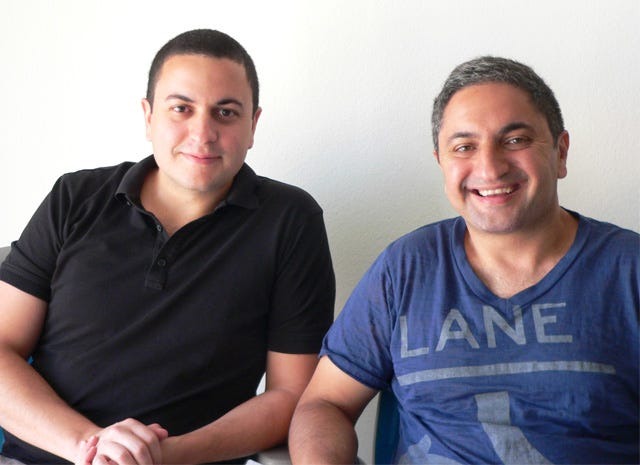
Working with a sibling does have its own product requirements. Ralph joked that he might want to go home and relax while Georges would come over and keep talking about work. Their arrangement nevertheless had scale. In 2012, Forbes reported 700,000 daily users, more than 50 million messages sent each day, and over 4 million mobile downloads. Those figures describe a particular moment, rather than imo today. They also show that the irritation of fragmented conversation was widely shared.
The stitching came with a catch. imo could improve the front end of a conversation, but it could not set the rules for the networks beneath it. Skype blocked access. Other services behaved differently for outside clients, sometimes leaving a status wrong or a message undelivered. Newer mobile messaging networks were often closed entirely. Users experienced a glitch in imo, even when the underlying service had caused it. The brothers’ answer shifted toward building imo’s own network.
Harik put the decision in the language of a sailor: “We can’t keep sailing against the wind.” It is an unusually candid line for a founder. A popular service had encountered a structural limit, and its makers changed course. The lesson was not that people wanted fewer connections. They wanted dependable ones, and dependability required more control over the path a message travelled.
A long view of AI
In public, Harik has also been an investor and supporter of computer science education. He has backed the Lebanese American University’s computer science programs and scholarships. Asked why, he described programming as a way for one person or a small group to produce something that a billion people might use. That remark is a useful key to his choices. He has said he looks for projects with broad impact, difficult technical work, and smart people. It is an investor’s filter, but also a description of the career he built.
The research thread remained active. In 2024, Harik was one of the authors of Quiet-STaR, a paper exploring how a language model might generate internal reasoning while processing ordinary text. The paper reported improvements on reasoning benchmarks in its experiments. Its title, with its suggestion of a pause before speaking, is rather apt for a person whose newest company is interested in conversation. Still, a research result and a useful product are different achievements. One demonstrates an approach; the other has to survive contact with people.
At humans&, founded in 2025 and introduced publicly in January 2026, that last question is the company’s stated premise. Its founders include Eric Zelikman, Andi Peng, Noah Goodman and Yuchen He alongside Harik. The lab says it wants AI systems shaped around relationships, memory, and collaboration. It has discussed models that can understand the needs of multiple people and help them coordinate over longer stretches of time. Harik is a co-founder and member of technical staff, and the company says he helped lead its seed financing alongside SV Angel.
The seed round was reported at $480 million. Money on that scale buys time and computing resources; it does not settle the product question. Early reporting described a team still developing its model and interface together. The ambition could touch both work and family life, but its value will have to be demonstrated in actual use. That uncertainty is part of the story, not a flaw to edit out. Harik has been near several products whose shape became clear only as people tried them.

The useful difficulty
There is a pleasing loop in all this. A child who ran out of games began writing his own. An engineer at a young search company helped try products that did not yet fit a settled category. Two brothers, annoyed by scattered conversations, built a tool for talking across them. A researcher returned to questions about how machines reason. Now a founder is asking whether AI can help several people think and act together.
The common element is not a particular technology. It is the distance between what computers can do and what people are actually trying to do. A message needs a recipient. A shared document needs a decision. A clever model needs to understand whose interests it is serving. Harik’s career does not provide an easy answer to those problems. It does show a sustained willingness to build where the gap is visible, even when the first version has to change.
That may be the most durable thing about his story. The machines get faster, the interfaces change, and each decade invents fresh language for progress. Someone still has to notice that a family cannot easily talk, that a team cannot easily agree, or that a new product seems so improbable people assume it is a joke. Harik has spent much of his working life noticing those moments. The next chapter depends on whether his newest team can turn one of them into something people use together.