David Ha once had a second office above his first one. The first was the Goldman Sachs trading floor in Tokyo, where he dealt in derivatives and eventually led interest rates trading. The second was a library in the same Roppongi Hills tower. He got in with points accumulated from buying lunch. During the break between financial markets and the rest of his day, he read about machine learning, evolution and the possibility that intelligence might emerge from many small, interacting parts.
It is an almost comically modest mechanism for a career change. There was no grand announcement. There were lunch receipts, a point card, a desk upstairs and the stubborn pleasure of trying something. Ha had studied engineering science at the University of Toronto, including control systems and neural networks, before finance pulled him toward a field where mathematics met consequences. The library let him return to an old interest while keeping a close view of what models do when they collide with the real world.
He began making machine learning experiments in JavaScript because a laptop and a browser were enough. Anyone could try them. The work was published under a handle rather than his name. The visible trail of sketches, little creatures and neural network demonstrations would eventually make its way to people at Google. Before he founded a company, Ha had made an argument for his own curiosity in the form of things strangers could click.
A model has to meet the world
The detour through finance helped shape his questions. In a trading room, an elegant model has to answer to a market that reacts to the people using it. Ha has described learning, as an options trader, how quickly mathematical assumptions can fail under real conditions. A trader does not merely observe a price. A sufficiently large trade can move it. An action changes the system that made the action sensible a moment before.
At university, he had wandered into derivatives pricing by way of a book with C++ code in its appendix. He audited an MBA class on the subject and worked through its exercises. In Tokyo, the intellectual traffic began running in the other direction. Financial risk sent him back toward probability and complex systems; a trading schedule gave him the lunchtime slot to read. He expected his move to Japan to last roughly two years. He stayed for a decade, then returned after a period in California. A temporary address became a place to build a life and, eventually, a company.
“I thought it was better to learn concepts and try to build something rather than just read books and read papers.”David Ha, discussing his library years
The experiments were often playful, which made them unusually clear. One project put neural network agents into a Slime Volleyball game. Another taught a model to draw simple objects as a sequence of strokes. His work on fake characters and generative art made abstract ideas visible, including their mistakes. Ha later argued that an interactive demonstration gives other people a chance to find holes in a research result. A paper can report a score; a browser lets the visitor ask the awkward follow-up question.
The route, in three overlapping lines
An editorial diagram of career phases, not a measurement of time or output.
The anonymous researcher gets an invitation
Jeff Dean noticed Ha’s work on evolving neural network structures. Douglas Eck, who became a colleague and mentor, saw other creative machine learning experiments. The two encouraged the anonymous author to apply to Google Brain’s Residency program, created to bring in people whose path to research did not necessarily run through a conventional AI doctorate. Ha joined in 2016 and moved to California.
Google gave him the room, colleagues and tools to turn the experiments into a research program. With Eck, he developed sketch-rnn, a model trained on drawings that could produce new ones stroke by stroke. With Jürgen Schmidhuber, he wrote World Models, work on agents that learn a compressed internal version of an environment and can even practice inside it. The titles describe technical ideas, but their appeal is easy to recognize. Could a machine make a useful drawing? Could it rehearse a world before acting in one?
He also kept exploring neuroevolution, self-organization and the creative uses of limited resources. On his personal research site, he argues that intelligence has developed under constraints, not only through abundance. That view is visible in the small agents, strange shapes and lightweight demos that populate his work. The point was rarely to make an object look grand. It was to find a simple arrangement that could do something surprising.
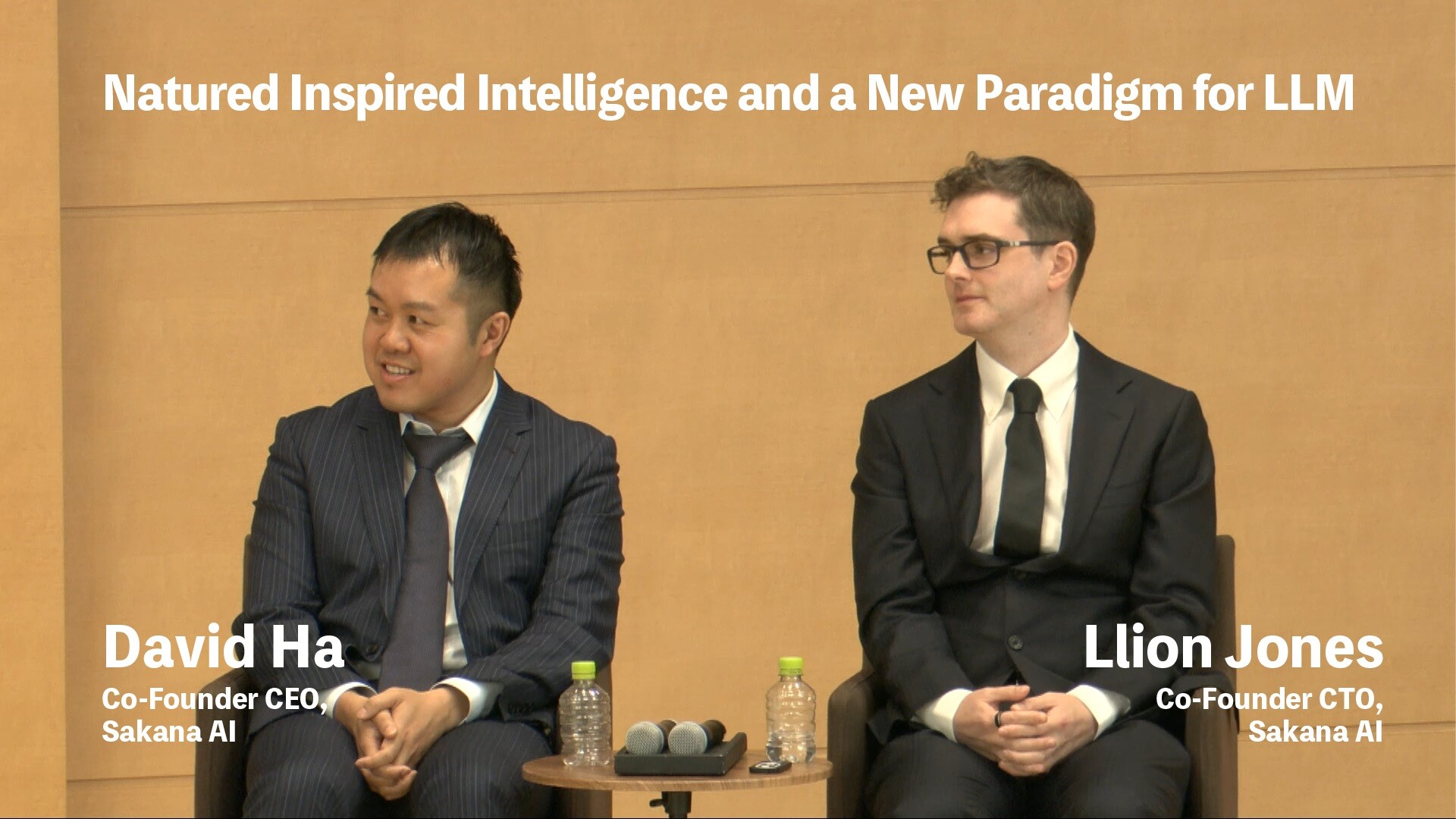
Later, he led Google Brain’s research team in Tokyo. Returning to Japan gave him a vantage point between international research and a local technology scene he already knew. In 2023, Ha left to start Sakana AI with Llion Jones, a former Google colleague and co-author of the transformer paper, and Ren Ito, a Japanese operator he had come to know through startup work and their overlap at Stability AI. Their backgrounds were complementary: research, a foundational AI architecture and experience building a business in Japan.
Why the company swims
Sakana means fish in Japanese. The company’s name points to a school moving as a group, each member limited, the motion together more capable than any single fish. Ha had been interested in that sort of collective behavior long before it became a corporate identity. His personal site includes work on evolution, swarm intelligence and neural networks that organize themselves. At Sakana AI, the same ideas became a research agenda: combine, evolve and coordinate models instead of treating each model as a sealed monument.
The company’s early work included evolutionary model merging and The AI Scientist, a system designed to automate parts of AI research. Ha was one of the authors of The AI Scientist paper. The project drew attention because it made the company’s premise tangible: use AI systems to help generate and test ideas for future AI systems. The limitations of any automated researcher remain a live question, but the question itself belongs squarely in Ha’s long-running study of systems that produce new possibilities.
The team had to decide where to build. Ha has explained that he wanted to develop AI technology for Japan, a place where he had spent a substantial part of his career and had working relationships. In an interview, he described recruiting Ito because a company that aimed to serve Japan needed more than two foreign researchers at its center. The decision linked the research ambition to institutions, language and customers. A laboratory can publish anywhere; a business has to understand the room it is in.
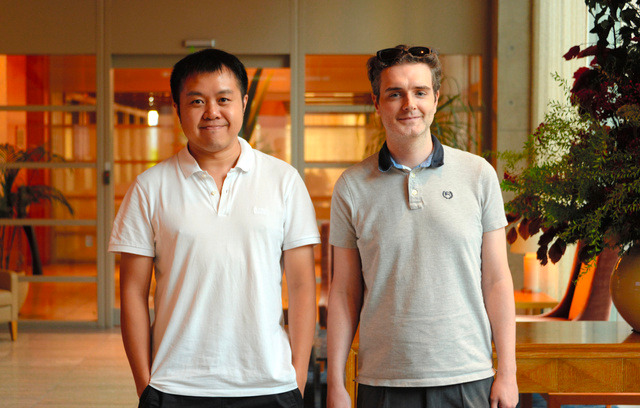
Sakana AI announced a $30 million seed round in early 2024. Its first stretch was focused heavily on research. In 2025, TIME included Ha in its TIME100 AI list, recognition that came as the company’s work on automated scientific discovery was attracting attention. Ha has said that, for a founder, recruiting comes before fundraising and business development. A distinctive research direction helped him invite people who wanted to work on automated discovery and collective intelligence. The founding team recruited from Google, other AI companies and Japan’s own technology sector. A school of fish, in practice, needs more than a good logo.
From papers to products
By 2026, Sakana AI was taking its ideas out of research posts and into products. Sakana Chat appeared in March with a Japanese-focused Namazu model. Marlin followed as a research assistant for business; Fugu offered a way to coordinate different models through one system. Translate joined the lineup, and Chat gained code execution, image and document handling, then memory and Fugu Max in September. Those releases belong to a company changing shape while keeping its central question: how can different capabilities be arranged to do useful work?
That question also travels back to the trading floor. Sakana’s applied teams have worked with Japanese financial institutions, including on an AI credit officer project with MUFG. Ha has described the work as helping a human credit officer assess documents and prepare a reasoned memo. The finance connection is practical rather than merely biographical. He has lived inside institutions where an answer must survive scrutiny and where a polished demonstration is only the beginning of the test.
His public comments about AI now often return to coordination. In June 2026, he said human intelligence grows through a cultural network of people building on earlier ideas, and argued that AI systems could become more capable in a similar way. It is a broad claim, and the products will face the ordinary judgments of cost, reliability and usefulness. Yet the through-line in his own career is unusually concrete: a stranger could try a demo, a colleague could recommend its author, and people with different skills could assemble a company around a shared question.
The library above Roppongi Hills is a good place to end because it was never a headquarters. It was simply somewhere to go at lunch. Ha’s route from there to Google Brain and Sakana AI depended on repeated acts of making his thinking visible. The point card opened the door. The experiments gave other people a reason to walk through it.