The books had to be stacked two deep. In Christian Szegedy’s childhood home, his parents taught mathematics and physics, and conversations about science came as naturally as finding another place for another volume. His older brother Márió was talking to him about quantum mechanics when Christian was six. Two of his siblings would also become mathematicians. Yet when his younger brother Balázs wrote to Márió in the late 1980s about a neural-network conference, Christian thought the idea rather silly. He was interested in artificial intelligence, but doubted that neural networks would be the way to reach it.
That is a pleasing detail in the story of someone who later helped make neural networks unusually capable. It also clarifies the ambition that survived his change of mind. In a 2023 interview, Szegedy said that since high school he had wanted to use AI to tackle mathematics on a grand scale. The intervening years would take him through a mathematics doctorate, chip design, Google’s computer-vision breakthroughs, xAI and several new ventures. The question at the end was close to the one at the beginning: how might a machine reason about mathematics in a way that can be checked?
A house with too many books
Szegedy studied mathematics in Budapest and completed a doctorate at the University of Bonn in 2005. Its title, Some Applications of the Weighted Combinatorial Laplacian, has the austere ring of a door with a very small handle. Inside was work that connected abstract mathematics to a physical task: placing components in the crowded geometry of a computer chip. After Bonn, he spent five years at Cadence Design Systems working on chip-design optimization.
He later described the path into AI as circuitous. In the 1990s, machine learning offered far fewer obvious research jobs. He went to Google believing it was a place where a new wave might arrive, but initially worked on advertising optimization. A move into Hartmut Neven’s group, which worked on machine vision for phones, gave him room to experiment with neural networks. What Neven had allowed as a secondary possibility became the center of the group’s work. Szegedy’s collaborators in computer vision included Dumitru Erhan and Dragomir Anguelov.
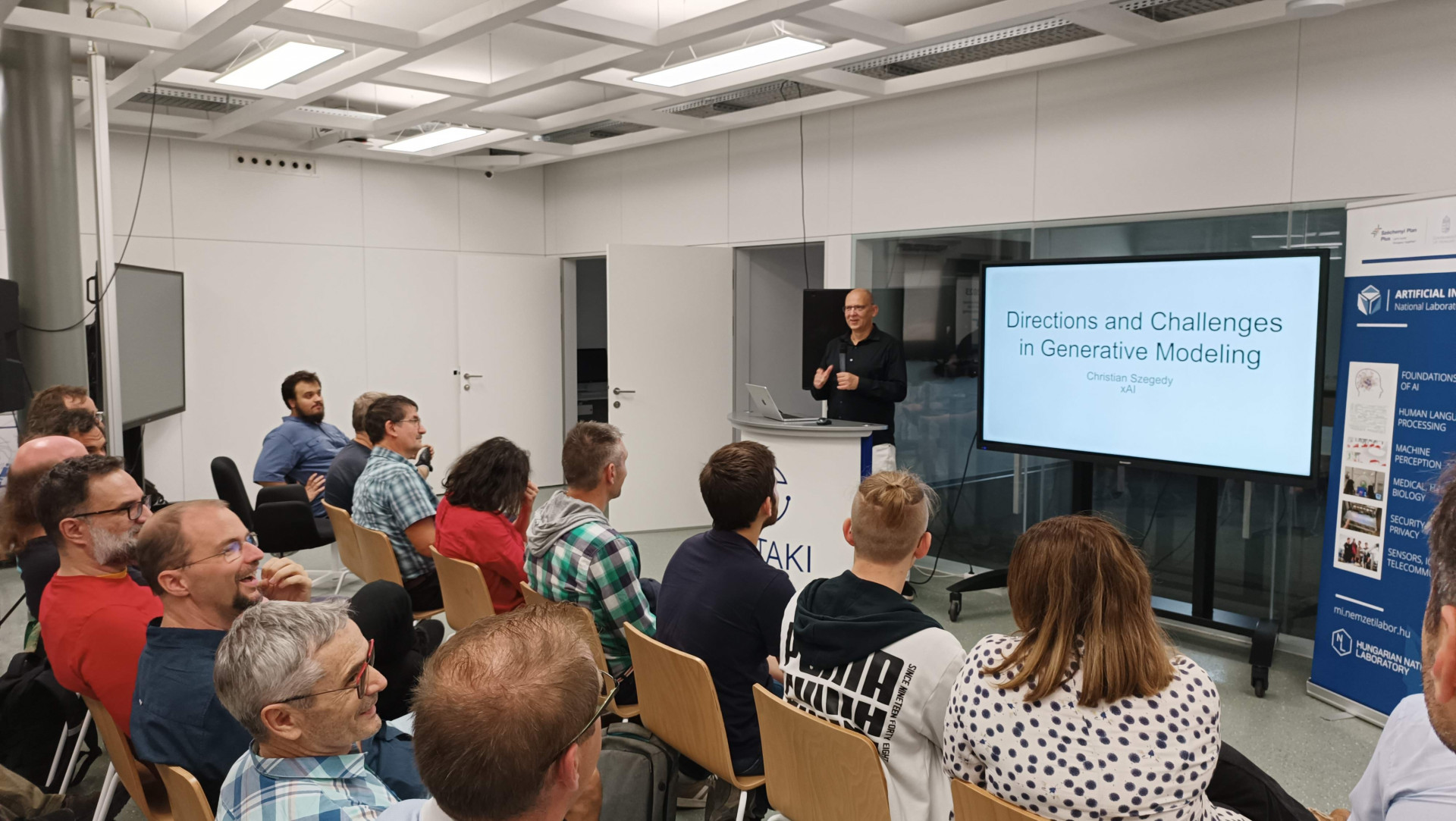
He had arrived with a mathematician’s suspicion of elegant answers that fail on inspection. In work begun around 2011, he found that a neural network could confidently misclassify an image after tiny changes to its pixels. A person might barely notice the alteration. The network could behave as though the object had changed entirely. Szegedy later recalled that Wojciech Zaremba urged him to publish the surprising result. The resulting paper, Intriguing Properties of Neural Networks, appeared in 2013 and helped establish adversarial examples as a central problem in machine learning.
The machine that learned to look
At roughly the same time, Szegedy led a team developing a more capable image-recognition architecture. Their paper, Going Deeper with Convolutions, introduced GoogLeNet, also called Inception. Its design sent an image through several kinds of filters in parallel, allowing the network to work with patterns at different scales. GoogLeNet topped the classification track of the 2014 ImageNet challenge. The paper made its way into the architecture vocabulary of deep learning.
A year later, with Sergey Ioffe, Szegedy published Batch Normalization. The technique adjusted intermediate values during training, letting researchers train deeper networks faster and with less delicate tuning. Its original explanation was later debated; Szegedy has spoken openly about revisiting the theory. The method endured. In 2025, the paper received the International Conference on Machine Learning’s Test of Time Award, a neat recognition for an idea whose practical usefulness had long outlived its first account of why it worked.
These results can be read as three different arguments with the same experimental habit. The adversarial paper asked what image classifiers failed to understand. Inception asked how to build a better one. Batch normalization asked how to train one at a useful scale. None required Szegedy to pretend that the mathematics behind neural networks was settled. In the Hungarian interview, he compared the field’s practice to cooking, or to building cathedrals before the builders had a complete account of the forces holding them up. The structures could stand. The explanation could still be unfinished.
The turn toward proof
By 2016, he had moved from seeing to reasoning. He founded Google’s N2Formal group, a name that sounds like “into formal” and also nods to neural networks. Its project was to connect the language in which people discuss mathematics with the strict notation that proof assistants can verify. A neural model might help choose which existing theorem is useful for a new proof. A later model might translate a human-written argument into a formal one. The destination was an “automatic mathematician,” the phrase Szegedy used in public talks.
The early DeepMath paper, co-authored with Alex Alemi, François Chollet, Niklas Een, Geoffrey Irving and Josef Urban, tested neural sequence models on premise selection. In plain language, it asked whether a machine could identify which facts were likely to help establish another fact. That may sound modest beside a grand promise to solve mathematics. Anyone who has watched a proof stall on a missing lemma knows it is a serious place to start.
How an informal idea becomes a checkable result
The final sentence matters. A formal proof can be perfectly valid for the wrong proposition if the translation was wrong. Szegedy’s interest has therefore extended to both sides of the bridge: generating proofs and translating the informal mathematical intentions that give them meaning. In a 2026 Bonn lecture description, he called autoformalization the theme unifying his research since N2Formal began. That continuity is easy to miss if one looks only at his employer names.
There is also a practical appeal beyond pure mathematics. Software and chip design already rely on formal verification in selected settings. A system that can help turn ordinary specifications into checked statements could make some demanding forms of verification easier to attempt. This remains an ambition, not a blanket guarantee that every useful claim can be reduced to a theorem. Szegedy’s work is most persuasive when the modest and audacious versions are allowed to sit next to each other: help with the next premise; eventually, build a collaborator that can navigate whole fields.
A lab, a departure, and a return
In 2023, Szegedy joined the founding team of xAI. The announcement put him alongside researchers from several major AI groups under a mission to understand the universe. For Szegedy, it was a chance to work on reasoning with the resources of a new frontier lab. He later said that the company’s direction centered on informal reasoning, while his strongest interest remained formal mathematics. He left, worked briefly as chief scientist at Morph Labs, and founded Math Inc. in 2025.
His later work included the Gauss agent, which helped formalize a strong version of the Prime Number Theorem in Lean. Szegedy described it at Bonn as tens of thousands of verified lines produced in roughly three weeks, work he believed would take a human team many months. The achievement is carefully worded: formalizing an advanced result is different from discovering that result for the first time. It still takes considerable mathematical and engineering judgment to translate an existing proof into statements a checker can accept.
AletheAI now lists Szegedy as co-founder and CEO, with theoretical physicist Michael R. Douglas as co-founder and chief scientist. The partnership places another mathematical researcher beside someone who has spent a decade trying to make mathematical reasoning more amenable to machines. At Bonn in May 2026, Szegedy sketched a next step beyond one agent working alone: specialized agents trading conjectures, proofs and predictions in a shared system. It was a proposal for how the work might develop, rather than a claim that this research program has been completed.
His career has a funny symmetry. The child who doubted neural networks became one of the researchers who made them work better. The scientist who demonstrated how they could be fooled now wants to pair their fluent output with a kind of verification that does not depend on fluency. In both cases, the useful instinct is to ask what a machine actually understands when it appears to be doing something difficult.
A proof checker has no interest in reputation, confidence or a well-turned sentence. It accepts a valid step and rejects an invalid one. For a field accustomed to impressive demonstrations, that is a stern little audience. It may also be the audience Szegedy has been preparing for since the books were stacked two deep.