The long proof
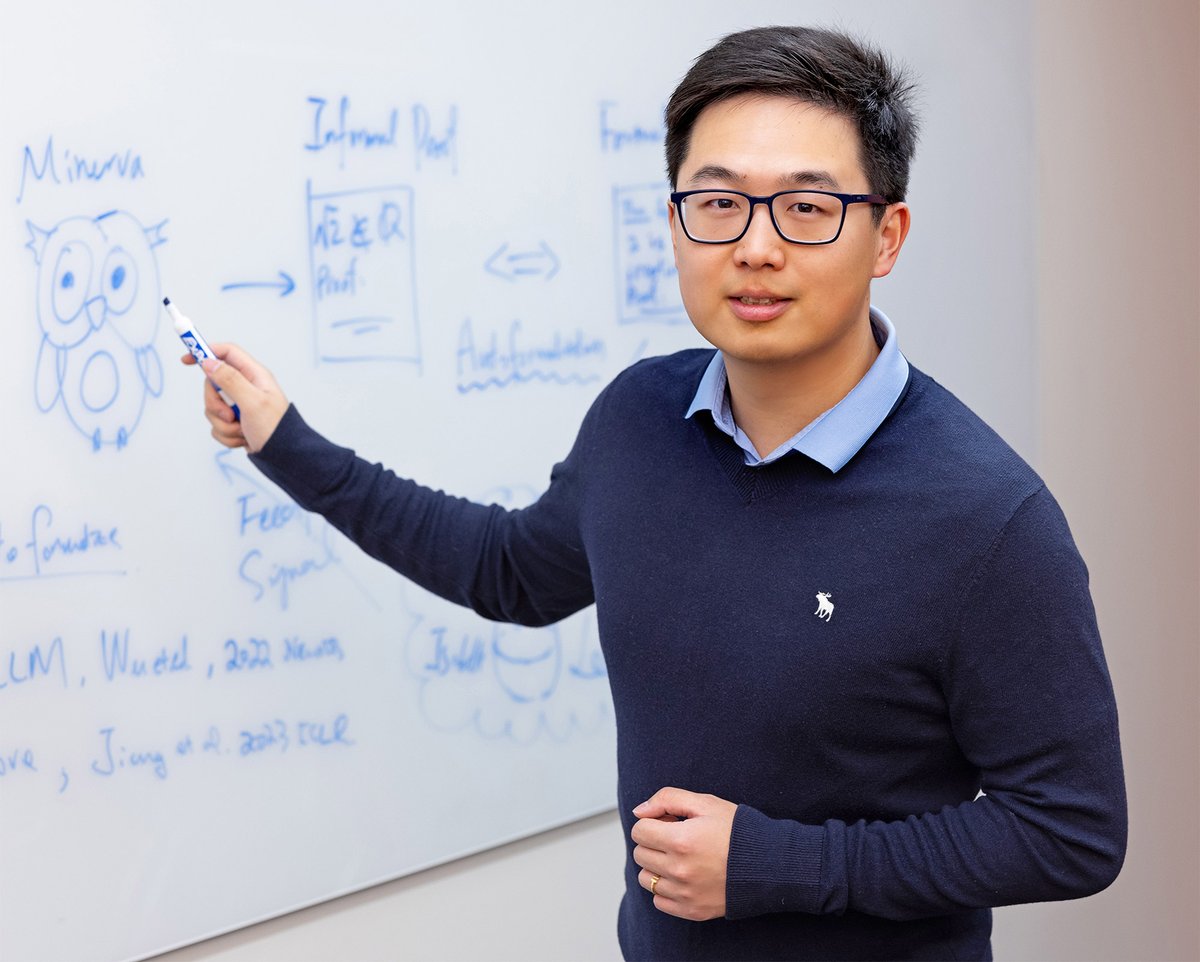
There is a small owl on the whiteboard beside Yuhuai (Tony) Wu. It stands for Minerva, an AI system built to solve mathematics and science problems. Next to it are arrows, boxes and a few spare words: informal proof, feedback, formal language. The sketch has the neat untidiness of someone trying to make a complicated idea legible before lunch. Wu holds a marker and points at the owl. One can almost see the question forming: if a machine can say the answer, can it also tell us why?
For Wu, that question has lasted much longer than the current fashion for chatbots. His published work moves through theorem proving, mathematical benchmarks, language models and systems that pair a neural network with explicit rules. The names change - INT, STaR, Minerva, AlphaGeometry, Grok - but the recurring concern is the distance between a plausible answer and a justified one. Mathematics is a useful place to measure that distance. A proof has a stern habit of asking what happened in the line before.
Before the models, there was the math
The public trail starts in New Brunswick. At the University of New Brunswick, Wu studied mathematics, and the department recorded an early result in 2013: he and fellow student Mathieu Girard placed second in the Science Atlantic Mathematics Competition. In 2014, Wu took first place in the conference’s undergraduate oral research award. His topic was not one designed for small talk. It concerned discrete equidecomposability and period collapse, questions about how geometric shapes can be cut, rearranged and counted.
That detail matters because it gives the later career a different opening scene from the usual AI origin story. Wu was working with mathematical objects before he was widely associated with language models. The undergraduate work asked whether apparently related shapes really share a deeper structure. Years later, his AI papers would return to a similar discipline: what does an apparent pattern mean when you insist on exact rules?
He moved into computer science at the University of Toronto, where Roger Grosse and Jimmy Ba advised his doctoral work. The title of his dissertation, Neural Networks for Mathematical Reasoning: Evaluations, Capabilities, and Techniques, reads almost like a table of contents for the next stage of his life. It is broad, but not vague. Evaluation asks what a system can actually do. Capability asks where it succeeds. Technique asks what might make it better.
Toronto also gave him a circle of collaborators. His work with Albert Q. Jiang, Ba and Grosse produced INT, an inequality benchmark intended to test whether machine theorem provers could generalize. The point was not simply to hand a program another stack of equations. It was to find out whether an apparent skill survived when the problems changed. A student who memorizes one answer key has learned a shortcut; a system that handles a fresh proof has learned something more durable.
Fluency meets the referee
A proof assistant is an unforgiving reader. It does not nod along because a sentence sounds scholarly. It checks whether each formal step follows from the rules it has been given. That strictness is both its strength and its inconvenience. People write mathematical ideas in flexible natural language; proof assistants want precise statements. Translating between the two is laborious even for specialists.
Wu’s work on autoformalization attacked that translation problem. In a 2022 paper with Jiang, Wenda Li, Markus Rabe, Charles Staats, Mateja Jamnik and Christian Szegedy, he explored how large language models could turn informal mathematics into formal specifications. The ambition was practical as much as philosophical. If a model can write the formal version of a problem, another system can test a solution against it. An attractive paragraph can be turned into something that has to survive a referee.
At roughly the same time, Wu was a co-author of Minerva, a language-model system trained for quantitative reasoning. Minerva could work through problems across mathematics, science and engineering. Those problems exist in abundance, written by people for people. Their breadth makes them valuable training material; their looseness makes errors harder to detect. In a 2023 interview, Wu put the ambition plainly: “We want it to understand what it’s talking about.” The line is short enough to fit on a poster and demanding enough to occupy a career.
“We want it to understand what it’s talking about.”Yuhuai (Tony) Wu
Another 2022 project, STaR, explored a related question from a different direction. Wu and his co-authors studied whether a language model could improve by generating step-by-step rationales and learning from successful ones. It is tempting to describe that as a machine teaching itself to think. The more careful description is more interesting: an experiment in whether explanations can become training data, and whether repeated attempts can improve problem solving.
These papers were never identical answers. Minerva used a large language model to handle quantitative problems. Autoformalization sought the bridge into machine-checkable language. STaR tried to improve reasoning by recycling generated explanations. Together they describe the problem from several sides. How does a system get the answer? How can it express the steps? How can those steps be checked? If one part fails, the other two look much less impressive.
The geometry test
AlphaGeometry supplied an unusually concrete result. In a 2024 Nature paper, Trieu Trinh, Wu, Quoc Le, He He and Thang Luong described a system for Olympiad-level Euclidean geometry. It combined a neural language model with a symbolic deduction engine. The language model could suggest useful constructions when a proof branched into too many possibilities; the deduction engine could follow formal rules. It was a partnership between intuition-like search and exact accounting.
On a set of 30 Olympiad geometry problems, AlphaGeometry solved 25 within the competition time limit. The earlier method named in the paper solved 10. The benchmark’s average gold medalist score was 25.9. Those figures do not mean a machine became a mathematician in every sense. They do show what the particular system achieved on a particular hard test. The paper specifies Wu’s contribution too: he advocated for the neural-symbolic setting and advised on data, training and codebase choices. That is a precise role, and a revealing one. The bridge between learned suggestions and strict proof was central to the design.
The result also made a good photograph of scientific collaboration. A paper can list five authors in one line, but each name represents decisions, disagreements and particular expertise. In AlphaGeometry, Wu’s documented push for the combined approach fits the theme running through his earlier work. A fluent model alone could roam. A symbolic engine alone could be rigid. Put them together, and the system could search for a path while keeping the proof accountable.
From proofs to a public stage
By then Wu had already moved through several research settings. He did postdoctoral work at Stanford with Percy Liang and Jay McClelland. At Google, he worked with the N2Formal team led by Szegedy. He also appears among the contributors to DeepMind’s AlphaStar project, which applied machine learning to StarCraft II. The range is wide, but the recurring question is how learning systems handle structured decisions over more than one step.
In 2023, Wu joined xAI as a co-founder. The company’s public mission was to understand the universe. It is the sort of sentence that can fill an auditorium; Wu’s earlier research had dealt in smaller, falsifiable units. That difference is part of what makes his place in the founding group interesting. A team building general AI needed people who had spent years discovering how brittle reasoning could be when the rules were clear and the test was hard.
At the February 2025 introduction of Grok 3, Wu appeared with Elon Musk, Jimmy Ba and Igor Babuschkin. The product announcement emphasized reasoning models that could spend more time exploring a problem and correcting their own work. A launch presentation cannot prove a system’s general intelligence. It can, however, show the direction a team chose to emphasize. For Wu, the move from mathematical proof research to a reasoning model intended for broad public use was a shift in scale, not a sudden change of subject.
Scale brings new trouble. A geometry theorem has a formal finish line. The questions people put to a general assistant are often messy, incomplete or open to interpretation. A model can be useful without issuing a proof for every sentence. Yet the habit Wu developed in mathematics still matters: ask what can be checked, what is merely fluent, and where the system is borrowing confidence it has not earned. The owl on the whiteboard may be a friendly mascot, but the black marker beside it is drawing a fairly severe standard.
An open next chapter
Wu announced in February 2026 that he had resigned from xAI. His message was warm about the colleagues he was leaving and forward-looking about what a smaller group might build. “A small team armed with AIs can move mountains,” he wrote. The statement is an aspiration, rather than a product announcement. It leaves the next step open.
That openness suits a story shaped by research more than by job titles. The student from New Brunswick did not set out with a single finished machine. He helped make benchmarks, tried ways to teach models from explanations, explored translation into formal mathematics, joined work on a geometry system with measurable results, and helped launch a broad reasoning model. Some of these systems are narrow by design. Others invite far wider use. All force a version of the same question back onto the desk.
What would it take for a machine’s answer to deserve belief? A persuasive voice is pleasant. A correct result is better. A chain of reasoning that can be inspected is better still. Wu’s career has lived in the space between those three things. The next photograph may have a different company name in the background. It may still feature a whiteboard, a handful of arrows, and somebody asking the machine to show its work.