Ren Ito was supposed to become a lawyer. That, at least, was the sensible reading of the degree: law at the University of Tokyo, an LLM from NYU, admission to the New York State Bar. Then the Japanese Embassy in Washington offered him a place in its political office. Later, an old high school friend invited him into Mercari. By the time Ito helped found an artificial intelligence company, the legal career had become a running joke. He has joked that he might now be a little old to start as a first-year associate.
The joke works because the training did not go to waste. Ito credits law school with giving him a feel for consistency, reciprocity and proportionality. Those are useful habits when a room contains a government official, a bank, a research scientist and a startup founder, each speaking a slightly different language. His career is full of such rooms. Today he is co-founder and chairman of Sakana AI, the Tokyo company he started with David Ha and Llion Jones in 2023. He served as its chief operating officer through its early years. The title has changed; the task of making unlike worlds talk to one another has stayed familiar.
The unfinished legal career
Ito graduated from the University of Tokyo’s law faculty in 2001 and entered Japan’s Ministry of Foreign Affairs that year. He completed his NYU law degree in 2004 and a Stanford master’s in East Asian Studies in 2005. The academic itinerary had an international shape, but it was the embassy assignment that turned study into daily practice. In Washington, he found that diplomacy rewarded two aptitudes he compared to journalism: making connections, then gathering and analyzing information. He later worked on the US-Japan security relationship, negotiations around a Japan-EU economic agreement and interpreting for a Japanese prime minister.
There is a particular comedy in the route. Every apparent detour made the original qualification more useful. Ito says troubleshooting runs through law school, the foreign service and the technology business alike. A treaty negotiator has to understand what each side can concede; a young company has to learn what its customers actually need. Neither problem yields much to a grand slogan. They yield to questions, patience and the occasional revised draft. Ito’s description of diplomacy suggests he enjoyed the human work inside the formal title: making friends, listening closely and trying to understand what was happening before explaining it to someone else.
“My legal education trained me in consistency, reciprocity, and proportionality, all of which I draw on constantly.”
Ren Ito, 2024 interview
In 2011 he began working at the World Bank in Washington during his diplomatic career. The institutional scale was different from a startup, but the cross-border work was not. He had spent years representing Japanese interests while learning how international systems make decisions. Then a friend from high school gave him an invitation with less protocol and more risk.
A friend calls from Mercari
The friend was building Mercari, the Japanese marketplace that would become a major technology company. Ito joined in 2015 as an executive responsible for global business and later led Mercari Europe. In 2018, the company went public in Japan. He helped guide its listing, which valued the company at about $6 billion. The leap from foreign service to online commerce can look abrupt on a résumé. From Ito’s account, the appeal was more personal and practical: an old classmate asked him to help build something that could operate beyond Japan.
Mercari gave him a different kind of negotiation. A marketplace has to work for people who do not know one another. Expansion adds new countries, consumer habits, teams and rules. The job also forced a shift in tempo. Governments can take years to settle a question. A marketplace has to learn from the next user and the next transaction. Ito later described the startup experience as compelling enough to keep him in technology as both an operator and investor. A diplomatic career had taught him to represent institutions; a company asked him to help invent one.
A later assignment brought him to Stability AI in the United Kingdom. He became its COO in 2022, as generative AI was moving from specialist conversation into public life. He stayed until 2023. The experience put him near a new kind of company: one where a research breakthrough could attract global attention almost overnight, while basic questions about operations, customers and institutions arrived immediately behind it. When he and two researchers began discussing a new company in Japan, Ito had already seen both the excitement and the work that follows the excitement.
Three founders, several disciplines
Sakana AI was founded in Tokyo in 2023 by Ito, David Ha and Llion Jones. Ha had worked at Google Brain in Tokyo and studies systems that organize and evolve. Jones was among the authors of the 2017 research paper “Attention Is All You Need,” a foundation of modern language models. Ito brought the operating and institutional experience. Their combined history matters because Sakana’s premise requires more than a promising paper. A research company must attract scientists, pay for experiments, choose problems and eventually explain why its work belongs in the world outside a laboratory.
The name means fish in Japanese, and the company’s emblem invokes a school. The image suggests many small agents coordinating to produce behavior that no individual controls. Ito has used a bee colony to explain a related idea: workers forage, communicate what they find and help the whole group respond. Sakana’s research into evolutionary model merging and collective intelligence gives the metaphor a technical direction. The company has also published work on The AI Scientist, a system designed to automate stages of machine learning research. Ito’s role is not to claim authorship of those experiments. It is to help create the conditions in which experiments can become an organization.
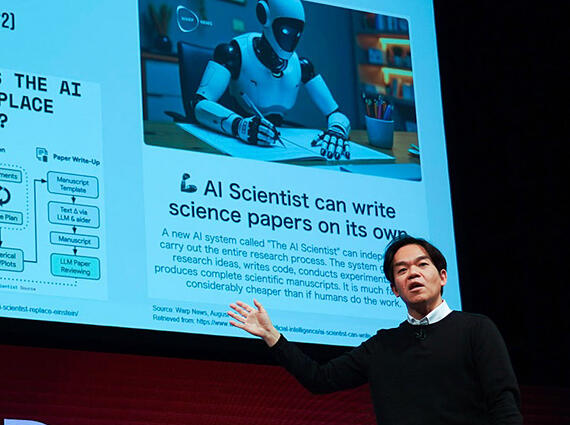
That organization was deliberately placed in Tokyo. In a 2025 interview, Ito described the doubts of overseas investors who wondered whether the company could recruit research talent there. His answer was that it had attracted people from abroad. He argued that Japan still carries a reputation for technological ingenuity, even if the timing of the current AI wave differs from the country’s earlier electronics era. It is a measured form of ambition: to understand what others are doing, then try something different early enough to matter. Ito spoke of wanting Japan to be seen as a technology power again.
“Let’s dream the dream of technology once again.”
Ren Ito, on Japan’s AI ambitions
He also sees open source as a relationship. Sakana’s work draws on ideas and tools shared by other researchers, so the company publishes its own work back into that commons. Ito described it as give and take. For a former diplomat, that may be the most natural way to understand a research ecosystem: trust is accumulated through reciprocal acts, then spent on the next collaboration. He joined Tokyo’s AI Strategy Council in late 2024, another place where the company’s questions meet a broader public setting.
When research meets a bank
A laboratory can live for a time on elegant experiments. An operating company eventually has to ask who will use them. Sakana created an applied team to bring its work into Japanese organizations. In May 2025, Mitsubishi UFJ Financial Group announced a multiyear strategic partnership with Sakana and appointed Ito as an AI adviser. The bank described a role built around advice, management connections and AI strategy. It also pointed to early work exploring whether ideas from The AI Scientist could help with demanding document tasks.
That announcement places Ito in a recognizable position: between a research group and a large institution whose pace, risks and vocabulary differ. It is close to the skill he identified in his own career as troubleshooting. The questions are concrete. Which problem is worth a custom system? What would count as useful evidence that it works? Who will carry it into daily practice? Sakana’s public material later described separate research, applied and product efforts. In a company interview published in 2026, a product leader recalled Ito asking how model development could become part of the business itself. It is an operator’s question, and it arrives exactly when research starts to meet users.
His career has long moved between Tokyo and other capitals. In a 2026 account of his morning routine, Ito said he had split work between London and Tokyo for roughly a decade, with London as his base. The detail makes the geography of his work less abstract. He is associated with a Tokyo company and Japanese technological ambition, while carrying years of international operating experience. His life crosses the same borders his work asks the company to cross.
The conversation gets bigger
In 2026, Sakana began listing Ito as co-founder and chairman. That July, the International Telecommunication Union named him a founding member of its AI for Good Global Commission. The forum gathers figures from government, business and international organizations to discuss access, trust and practical uses of AI. The appointment extends a pattern already visible in his career. Ito has worked inside national diplomacy, a global marketplace, a frontier research company and a major bank partnership. The commission gives him another setting where technical choices must be explained in institutional terms.
There is no need to pretend those settings are identical. A foreign ministry does not operate like a marketplace; a research laboratory does not behave like a bank. Ito’s story is interesting precisely because he has kept moving among them. When he said that he could never have predicted the path, it sounded less like a confession of aimlessness than a description of attention. He followed a school friend into a company, followed a change in technology into AI and followed a Japanese research project into questions about national and international use. He has kept the habit of asking what problem is actually in front of him.
He may never take that first-year associate job. Yet the lawyer’s instincts are still visible in the way he describes fairness, reciprocity and careful judgment. The diplomat’s instincts are there too: listen, make a connection and take the next meeting seriously. Sakana AI’s research will stand or fall on its work, not on a founder’s biography. Ito’s biography helps explain why the company has a person devoted to making that work legible across borders. A school of fish is a pretty image. Someone still has to make sure the water is navigable.