The first thing Mira Murati learned about a machine was that it had to work in the world. A vehicle door has to open; a driver assistance system has to operate amid traffic, weather and human error. Years before the public knew her as OpenAI's chief technology officer, she worked on the Model X and early Autopilot systems at Tesla. The experience gave a mechanical engineer an intuitive sense of what AI might do beyond a lab. It also gave her a question she has carried through successive jobs: how does a powerful system meet the person who has to use it?
Today that question sits at the center of Thinking Machines Lab, the company she co-founded and leads. Its name promises machinery. Its stated aim is more intimate: to build AI that extends human will and judgment. Murati has helped ship widely used AI products of the past decade. Her new work asks what those products leave in the hands of the people using them.
There is a neat irony in the career. A woman associated with making artificial intelligence available to millions now argues that availability alone is a small measure of power. A rented answer is useful. The ability to shape the system that gives it is something else.
A scholarship, then a workshop
Murati was born in Vlorë, Albania, in 1988. She spent her early years as the country moved from a closed communist system toward a more open, unsettled one. She has recalled an intense appetite for knowledge in that environment. Questions arrived faster than a slow internet connection could answer them. At 16, a scholarship took her to an international school on Vancouver Island in Canada. It was a geographical leap, and the beginning of a habit of crossing disciplines as well as borders.
She went on to Colby College and then Dartmouth, earning a mechanical engineering degree in 2012. The discipline is a useful clue to her later work. Mechanical engineering rarely permits the luxury of a perfect abstract system. Materials resist, dimensions matter, and the end user has a stubborn habit of existing outside the diagram. Murati later described working on complex, safety-critical systems in aerospace before Tesla sharpened her interest in AI.
At Tesla she helped bring the Model X to market and worked around the early development of Autopilot. At Leap Motion she led product and engineering work on interfaces for virtual and augmented reality. A car and a hand-tracking device seem like different worlds, yet both depend on a person understanding what a machine can perceive and what it will do next. When she joined OpenAI in 2018, the interface became a conversation.
The chatbot leaves the lab
By the time ChatGPT appeared in late 2022, Murati was OpenAI's chief technology officer. Her remit stretched across research, product and safety. She helped lead the development and release of ChatGPT, GPT-4, DALL-E, Codex and Sora, among other systems. Such a list can make an executive's career sound like a procession of product names. The cultural event was larger: people who had never read a machine-learning paper began testing an AI system with their own questions.
Murati has said that even the team had not anticipated the excitement around ChatGPT. In an early interview, she spoke of looking for uses beyond novelty and pure curiosity. She was candid about a basic weakness: the model could make up facts. Dialogue, she explained, gave users a way to push back, ask whether an answer was right and offer feedback. This was a product observation with larger consequences. The human being was part of the correction mechanism.
“This is a unique moment in time where we do have agency in how it shapes society.”Mira Murati, 2023
She also argued for input from regulators, governments, artists, social scientists and other people outside the companies building these systems. The position may sound conventional now. In 2023, as the industry learned what happens when a research project becomes a public habit, it was a reminder that capability and social permission are different things. Murati was optimistic about AI's uses in education, including more individual ways to learn, but did not pretend a developer could settle every question in private.
OpenAI's internal crisis in November 2023 put her in a role few technology leaders would have sought: interim CEO during Sam Altman's brief removal. She later described the period as intense and complex. In a 2026 interview with Bloomberg's Emily Chang, she said she stood by feedback she had given the board, and that once the company seemed at risk of falling apart she worked to preserve continuity for the mission and the team. She also said, with hindsight, that she would have pressed harder for a transition plan. The episode makes a tidy drama only from a distance. For the people inside it, there were colleagues and years of work to consider.
Back where AI got its name
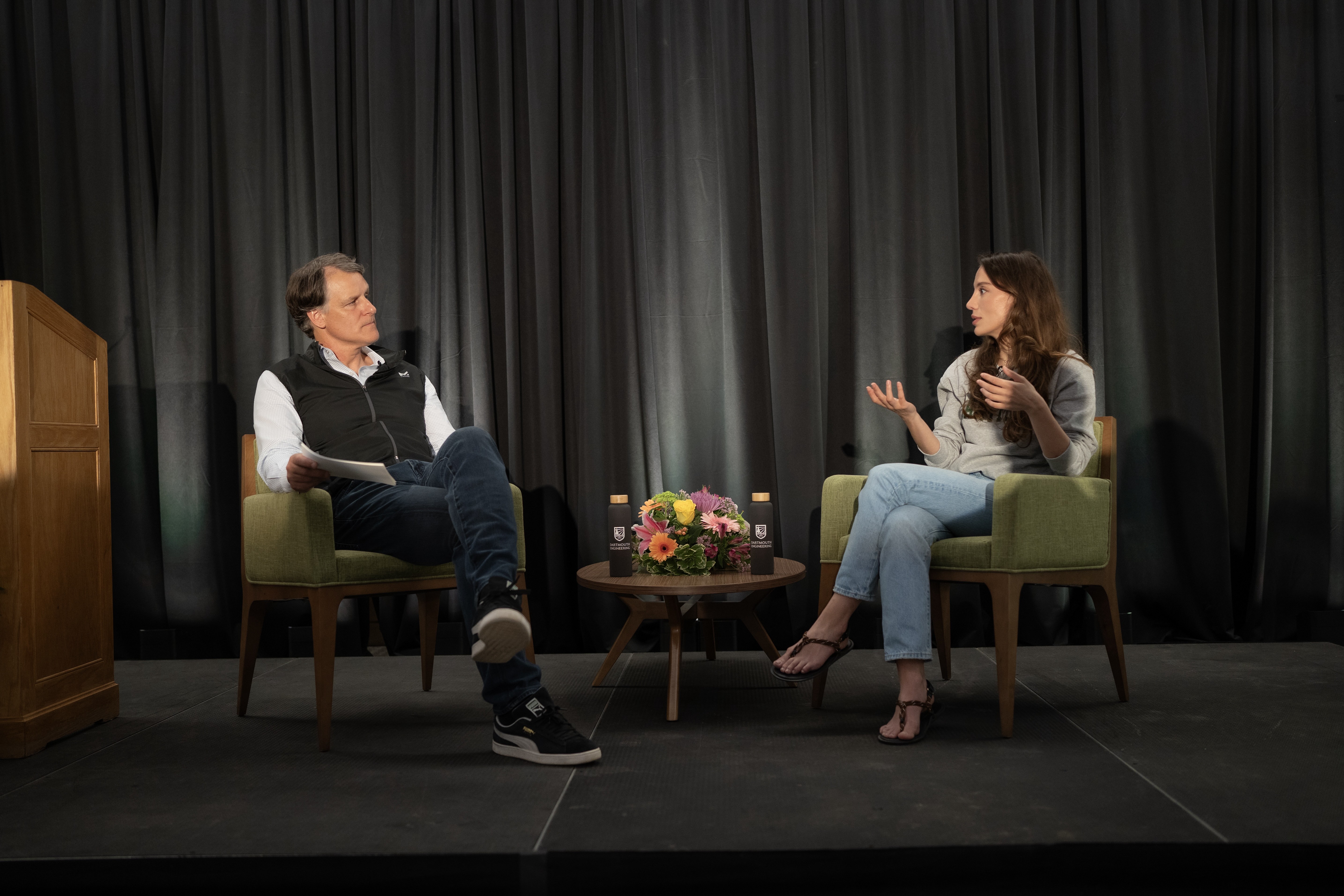
In June 2024, Murati returned to Dartmouth for an onstage conversation and an honorary degree. The setting carried a historical footnote: a 1956 summer workshop at the college helped give artificial intelligence its name. Nearly seven decades later, she told an audience of about 200 that the public release of ChatGPT had given people an intuitive sense of both the technology's capabilities and its risks. That is an unusually democratic claim for a company executive. To understand a tool, people had to encounter it themselves.
She also argued that making a system more capable could make it easier to direct within human guardrails. There is plenty to debate in that proposition; it is still a statement about direction. Who sets the limits? Who learns enough to question them? Murati's answer increasingly pointed beyond the handful of labs with the resources to train the largest models.
Three months after the Dartmouth visit, she announced that she was leaving OpenAI. In a public conversation later that year, she said she was exploring what to do next and spoke about an age of curiosity, knowledge and technological abundance. The language was expansive. The company that emerged from that exploration was more specific.
A laboratory with a user in the room
Thinking Machines Lab was unveiled in February 2025. Its work has moved along three related lines. Tinker, announced that October, gives developers and researchers a way to fine-tune models. In May 2026 the lab previewed interaction models designed to take in audio, video and text continuously, and to respond in real time. In July it released Inkling, a model trained from scratch with its weights available for others to use and customize. The models and platform are technical artifacts. Together they sketch a view of who should be able to participate in building AI.
The interaction research makes the point especially clearly. A conventional chatbot waits for one speaker to finish, then takes its turn. A real conversation is less polite. People interrupt, pause, gesture, revise a thought halfway through. Murati has described current turn-based systems as unable to perceive much of that living context while they are busy thinking. The lab's research preview tries to make a machine responsive to the flow rather than the transcript alone. It is an engineering problem with a social ambition: to make collaboration feel less like issuing orders to a distant service.
“I think, perhaps, the most significant thing that ChatGPT did was to bring AI into the public consciousness.”Mira Murati at Dartmouth, 2024
Inkling expresses the same argument from another direction. Thinking Machines says the open-weights model is a base for customization, available through Tinker for fine-tuning. The lab describes it as a flexible base for further work. That specificity is useful. A model can be measured by benchmarks and by what its users are free to change.
Murati's ambitions remain large. Thinking Machines is building costly infrastructure and competing for scarce talent in a crowded field. At Bloomberg Tech in 2026, she acknowledged the intensity of starting a frontier AI lab. Yet she rejected the idea that beating a rival is what gets her up in the morning. Her stated motivation is to create useful technology that increases human agency. The proof will be in products people can actually use, and in whether the promised control reaches beyond researchers and well-funded organizations.
There is also a harder organizational question beneath the software. If intelligence is concentrated in a small set of labs, even thoughtful product design can leave most people as spectators. Thinking Machines has chosen to publish research and release model weights while selling tools for customization. Those choices give outsiders something concrete to inspect and adapt. They do not settle every question of access, cost or governance, but they expose the lab’s stated ideas to contact with other people’s work. Murati has argued that the public learned more about AI by using ChatGPT than by being told what it could do. Her own lab now faces that same test: put the work out, and see what people make of it.
Her career now forms a curious loop. The young engineer who learned that real machines have to answer to their surroundings helped introduce a machine that answered to almost anyone. Now she is trying to give those people more than a prompt box. Whether that effort changes AI's balance of power is an open question. It is a question Murati has made concrete enough to build for, and important enough to keep asking.