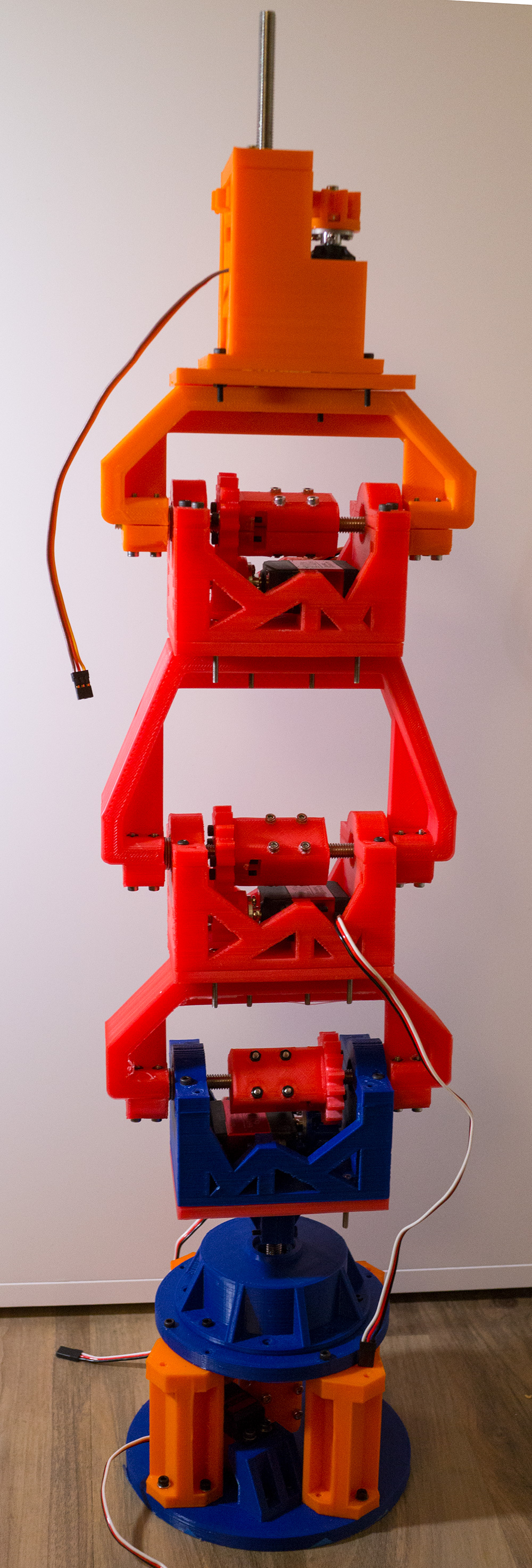
The problem took about two minutes. Luke Metz liked matcha, but preparing it often enough to satisfy the craving felt like a chore. His proposed remedy was gloriously disproportionate: build a six-axis robotic arm in his apartment. It would need printed parts, motors, sensors, software and a grip on gravity. He already worked in machine learning; the parts he knew less about were the appeal. In his 2018 project log, he called the tea premise an excuse to learn robotics and to get back into making things. A less curious person might have bought a whisk.
The arm is a useful introduction to Metz because its complications were real and publicly documented. He designed parts in CAD, printed them, bought servos and bearings, and tried to make a controller that could stop the machine from dropping when he released an Xbox controller. At first, the learned controller sort of worked. It also oscillated around the desired position. When he gave it more computation, the wobble got worse. The model was planning while the physical arm continued to move. In the gap between an elegant prediction and a moving object, timing had its say.
Years later, Metz's name would appear in the credits of major AI systems and in the founding team of an ambitious new lab. The robot story does not explain those achievements by itself. It does show a consistent interest: the machinery behind learning, the parts that fail, and the pleasure of figuring out why.
A habit of building the next question
At Franklin W. Olin College of Engineering, which he attended from 2011 to 2015, Metz was already making things that sound like prompts for a laboratory exercise. A small group built an autonomously flying quadcopter from laser-cut cardboard with a Raspberry Pi on board. The project appeared on his blog in 2012. Cardboard is an unforgiving airframe, but it is also quick to cut, change and try again. That preference for something testable over something immaculate recurs in his later writing.
After college came work at Indico Data Solutions and a paper with Alec Radford and Soumith Chintala on deep convolutional generative adversarial networks. Published at ICLR in 2016, the paper became known as DCGAN. It helped demonstrate that a generative model could learn useful visual representations and make varied images. A decade later, the ICLR program chairs gave it a Test of Time award, recognizing work that continued to matter after the initial excitement had passed. The timing offered a neat measure: research that survives ten years of rapidly changing tools has earned its place in the room.
The award is part of a much wider research trail. His own publications page runs through generative models, reinforcement learning, gradients, representations and optimization. It is also unusually modest about itself, warning visitors that the list is out of date. There is no grand self-description to decode. The papers and project logs provide a more revealing biography: someone willing to move between formal research and a robot held together with printed parts and patient debugging.
Can the teacher learn, too?
At Google Brain, Metz spent years on a question that sits one level beneath most machine-learning demos. A model learns from examples, but a human still chooses the optimizer - the procedure that changes the model's parameters during training. They also tune the optimizer's settings. A good choice can save time and computation; a poor one can leave a system wandering or unstable. Metz and collaborators explored whether that procedure could itself be learned from many training tasks.
He explained the motivation in a 2021 conversation about learned optimizers. Machine-learning methods could outperform people on many tasks, he observed, while the methods used to train them were still designed by people. That dependence was, to him, a bottleneck. He wanted tools that might work across varied problems without asking every user to inherit years of unwritten craft. His comparison to a self-hosting compiler was especially vivid: once a learned optimizer exists, perhaps it can help train the next optimizer, and that successor can help with the next.
“The fact that these optimizers can start to be used to optimize themselves.”Luke Metz, on the result that most excited him in a 2021 interview
The work was less tidy than the analogy. He described training across roughly 6,000 tasks and a large amount of compute, with many models and machines operating at once. Some runs were unstable. Watching the system meant watching thousands of signals, then deciding whether an apparent discovery was a real property of the method or a bug. He also said the learned optimizer worked well across its training distribution but did not yet beat carefully tuned conventional approaches on every task. This is the kind of qualification that can make a result more interesting: the reader sees the boundary of what was actually learned.
His 2022 writing about scaling laws made a related point. Small models can create a handsome trend line that predicts how larger models should behave. Keep one training setting fixed as model size grows, though, and the big model may miss the predicted curve. In his worked example, learning rate changed the picture. The lesson was practical and expensive: a compelling graph can be a map of the settings you happened to choose. He did not suggest abandoning prediction. He argued for checking it against experiments at larger scales.
A low-key preview finds an audience
Metz moved from Google Brain to OpenAI in 2022. He later described being part of the initial group that built a “low-key research preview” with John Schulman, Barret Zoph, Liam Fedus and others. The preview became ChatGPT. When he announced his departure from OpenAI in 2024, he wrote that the team had been excited to work on it but had not expected its reach. The millions of people who eventually used the product were once absent from the room where it was being assembled.
Large AI systems make individual credit hard to see, yet Metz's role appears in unusually specific places. The GPT-4 technical report's attribution lists him as an infrastructure lead and a ChatML format lead. OpenAI's GPT-4o system card names him and Liam Fedus as post-training leads. Those credits do not reduce collective work to one person; they clarify what sort of work the collective needed. The most visible moment may be a model answering a question. Beneath it sit formats, training procedures, evaluation, infrastructure and the countless decisions that make a system usable.
The contrast with the robot arm is charming. In his apartment, Metz could identify exactly which wire was in the wrong place. In a frontier lab, the same instinct for tracing causes had to operate inside vast teams and computational systems. He has written more about the arm than about the internal details of ChatGPT. The public evidence supports a narrower, sturdier picture: he was there on the initial team, and later project credits assign him substantial technical responsibility.
The lab, the return, the move
After leaving OpenAI, Metz became a co-founder of Thinking Machines Lab, the company led by former OpenAI chief technology officer Mira Murati. It launched publicly in 2025. The move reunited several people whose work had intersected at OpenAI, including Schulman and Zoph. The new company made AI research and products its remit and later released Tinker, a service for fine-tuning models. Metz's specific contribution to that product has not been publicly itemized, so the firmest claim is the one his title supplies: he helped start the lab.
In January 2026, Metz left Thinking Machines and returned to OpenAI. The return lasted months. In August, Axios reported that he had joined Meta Superintelligence Labs and would report to Alexandr Wang. The sequence is brisk even by the standards of an industry where researchers change organizations quickly: a new lab, an old one, then another new team. It invites speculation about motives. His public record offers something more useful than a guessed explanation - a long-running interest in making learning systems more capable, practical and understandable.
The ICLR award arrived between those moves, tying the present back to work published ten years earlier. That is the more unusual rhythm in this story. Company names changed within months; the old paper was still being read after a decade. The professional map and the intellectual map have different scales.
The stubborn pleasure of a real test
Metz's personal site says he is excited about bringing AI technology into the world. It also lists robotics, programming languages, electronics, 3D printing and graphics among his free-time interests. Those details keep the technical career from becoming a procession of logos. There is a researcher interested in abstract rules, and there is the same person choosing bearings for a plastic arm because he wants to understand what the rules feel like when they meet a motor.
His robot-arm write-up ends with a modest result. The controller came close to its target and then wavered. He had ideas for correcting the timing, but the next iteration would require more weekends; for a while, he shifted back to the mechanical design. It is an excellent ending for an experiment because it leaves the problem intact and the investigator thinking. The machine had taught him something, even if it had not yet made the tea.
That scene gives the career its human scale. Metz has helped build systems used by enormous audiences and worked on methods with long afterlives. Still, the clearest image of his curiosity may be a brightly colored arm in an apartment, moving a little too far, correcting, then moving too far again. There is no straight line from a cardboard quadcopter to ChatGPT. There is a habit of testing, watching carefully, and asking what the next attempt might learn.