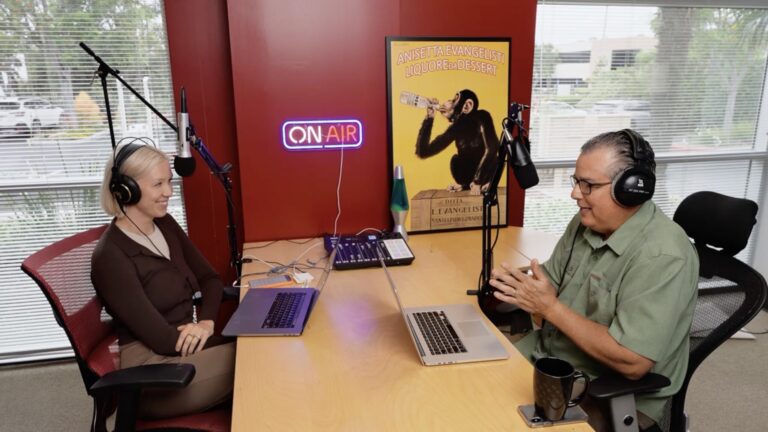
In the photograph, Tom Gallego is mid-conversation. His hands are together, his laptop is open, and Kate Houser sits across the table wearing headphones. Behind them, an illuminated sign says ON AIR. It is a modest piece of office theatre, but it gets the assignment right. A founder who has already put his advice into a book has found a reason to keep talking about it.
The book is called Adapt or Die. The podcast is called Adapt & Thrive. Between those titles lies a small improvement in the atmosphere. The first sounds like something a deadline might say. The second allows the possibility that learning the next thing could be enjoyable.
Gallego founded L7 Creative in 2001. His public working life now stretches across agency leadership, creative direction, writing and conversations with colleagues. Adaptation is the recurring subject. What makes him interesting is the range of places in which he has chosen to practice it: a branding workshop, a marketing plan, a recording table, and a separate company he runs with his children.
The geology degree before the agency
There is an unexpected entry near the beginning of Gallego’s professional chronology. He studied geological sciences at San Diego State University from 1980 to 1984. The degree is a useful reminder that a career can end up some distance from the subject printed on its first set of credentials.
By June 2001, he had founded L7 Creative. The agency’s base is Carlsbad, in San Diego County, the region where his professional profile places him. Its work combines brand strategy with the practical business of campaigns, content, websites and audience response. Gallego’s responsibilities include creative direction and brand and account management strategy.
A founder with those responsibilities occupies an awkwardly useful position. There is the idea itself, with all the pleasures of making it. There is also the client relationship, where the idea needs an explanation. A campaign can be charming and still require someone to answer why this audience should care.
His résumé also includes teaching that question to people at the beginning of their own companies. His volunteer history dates his work as a branding workshop facilitator for the CONNECT Springboard Program to January 2010. The workshops were for entrepreneurs and early-stage businesses. Before an established brand has years of recognition to lean on, it has to explain itself.
A founder who likes the making
In September 2016, Gallego appeared in a Forbes Agency Council member Q&A as L7 Creative’s CEO and chief creative officer. His answer about staying creative was brief. He described surrounding himself with creative people who pushed him to improve, then supplied the sentence that needed no corporate translation: “I live for the creative process!”
The enthusiasm is worth keeping beside the job title. CEO can suggest a person who has gradually moved away from the work. Gallego’s account puts the work, and the people doing it, close to the reason for showing up.
The brands listed in his agency biography include Kingston Technology, HyperX, Harman International, iHome and Vizio. That is a substantial range of consumer technology contexts, each with its own audience and reasons to buy. A television, a gaming brand and an audio product do not arrive with interchangeable explanations.
For a creative director, that variety supplies a recurring challenge. The team needs an idea that belongs to the particular business. Then it needs the patience to carry that idea through the materials people actually encounter. The title on the business card does very little of this work by itself.
“I live for the creative process!”
Tom Gallego, 2016
Seven principles, then a conversation
Adapt or Die: How to Survive in the New Era of Digital Marketing turns Gallego’s professional concern into a book-length proposition. The book organizes digital brand engagement around seven principles. It addresses marketers responsible for service and product businesses, offering a framework for competing in a connected marketplace.
The appeal of a numbered framework is partly practical. A marketer can return to it when several decisions are demanding attention at once. Seven principles fit inside a working memory more comfortably than an entire agency’s accumulated experience. A framework gives the reader somewhere to begin.
A book also fixes a conversation at a particular moment. Marketing keeps producing reasons to reopen it. In May 2021, Gallego and Houser introduced Adapt & Thrive: A Survival Guide for the Modern Marketer. The first episode, published on May 26, offered an introduction to the hosts and the subjects ahead.
Houser brought a background in social media. Gallego brought agency leadership and decades in advertising and branding. Their launch description promised discussion and debate, with guests joining along the way. Early guests included technology executive Erik Ljung and GoodLife CEO Patrick Mahaffey. The format gave the founder’s subject more voices, and a recurring appointment.
Even the photograph carries that sense of exchange. The table has room for equipment and conversation. Gallego is visibly engaged with the person opposite him. The ON AIR sign may announce the recording, but the other chair does the more interesting work.
An idea with a return address
In 2024, Gallego and Theresa Boxberger used the podcast to discuss the L7 Marketing Machine. Boxberger is L7 Creative’s chief operations officer. Their series moved through the agency’s named phases, explaining a process that connects positioning to execution and continued improvement.
The Brand Blueprint discussion concerned brand analysis, strengths and market opportunities. The Build & Run installment covered the development of ideas intended to generate leads, conversions and continuing customer relationships. By the October episode, the subject was Calibrate & Refuel: monitoring, analytics and adjustments after campaigns are running.
- 01Brand BlueprintAnalyze the brand and establish positioning.
- 02Build & RunDevelop and execute the campaign.
- 03Calibrate & RefuelMonitor, learn, adjust, repeat.
A sequence with a return trip: the audience’s response informs the next decision.
The sequence matters because a launch can look wonderfully final from a distance. The site is live. The creative is approved. Everyone can admire the finished thing. An optimization phase gives that apparent ending a set of further obligations.
Gallego’s August 2024 writing on marketing plans makes the same concern concrete. He recommends defining goals and audiences, developing an integrated strategy, and continuing to optimize. Audience research, clear measures and testing all have jobs in that account. The plan includes the possibility that its first version will need work.
There is a quiet demand on the creative ego here. The audience gets a vote after the team has fallen in love with its idea. Making room for that vote is easier when revision already has a place in the schedule. Otherwise, feedback has a habit of arriving dressed as an inconvenience.
The family at the other L7
Gallego also founded L7 Advertising, which serves small businesses across the United States. The company describes itself as family-run: he operates it alongside his son and daughter. Its offices are in Carlsbad, California, and Gilbert, Arizona.
The distinction between the two L7 businesses is useful. L7 Advertising presents its relationship with L7 Creative as part of its offer, combining the parent agency’s creative work with services for smaller companies. Its stated aim is to manage a business’s online presence so the owner can concentrate on running the business.
One member of that family team is Derrick Gallego, the director of customer engagement. His role includes working with clients on goals, lead generation strategies and execution. In a profile filled with frameworks and marketing vocabulary, that description brings the work back to a recognizable conversation: what does the business need, and what happens next?
The family detail gives Gallego’s career another scale. There is the agency founder’s long professional history, and there is a company built with the next generation at the table. Both involve colleagues who must turn a broad intention into daily work. A family surname adds continuity; customers still need a reason to choose the service.
The next revision
Gallego’s subjects keep changing with the channels. A March 2022 article under his name offered guidance on Discord communities, including feedback spaces and member roles. In September 2024, he wrote about how AI and large language models could change organic search. He anticipated a greater role for conversational questions and useful, specific answers.
Those were predictions about an emerging medium. Their place in his career is revealing without requiring every prediction to become a victory lap. The author of a book about adaptation was publicly working through another change in how businesses might be discovered.
In July 2025, he joined social media manager Caroline Morris for a third-season podcast conversation. Its agenda included short-form video, content creators, social search and private communities. The names and formats had moved on from the first recording. The practice of sitting down with a colleague to examine them continued.
There is a small joke on his LinkedIn profile. Alongside English, Gallego lists “Brand Speak” as a language, with full professional proficiency. It is a cheerful admission from someone whose business contains plenty of specialized terms. Even a Brand Blueprint benefits from a speaker who remembers there is another person listening.
Back at the recording table, the sign is still the right detail to end on. ON AIR describes a state of work, something happening between people in the present tense. Gallego has a company dating to 2001 and a book with a forceful title. He has also kept a chair open for the next conversation.