When Lila Wallrich started her company, she gave it six months. When she prepared to hand it over, the planning took ten years. Between those two deadlines lies a Sacramento career spent learning how to make a creative business last. The second deadline may be the more revealing one. Starting required a wager on herself. Succession required sustained confidence in somebody else.
In 2026, Jennifer Gall succeeded Wallrich as CEO of Wallrich Creative Communications. Gall had joined the agency in 2000. The new leader was arriving with 26 years of experience inside the business, while its co-founder was stepping away after more than 36 years at the helm. There is a pleasing lack of theatrical machinery here. No stranger sweeping through reception. A colleague, already familiar with the work, taking the next seat.
Wallrich’s name remains attached to a company whose assignments include branding, marketing, advertising and interactive work. Her life also includes a second leadership vocabulary: the Vortänzerin, or female dance leader, of Sacramento’s Alpentänzer Schuhplattler. In one setting, people need a brief. In the other, they need to know the steps. Both arrangements become difficult when everyone insists on leading.
Six months, two houses, one beginning
The business began on April 15, 1990. Wallrich had studied Visual Communications at California State University, Chico, then spent four years at a Sacramento design firm. She left to start a company with that firm’s studio manager. They borrowed against their homes and set themselves a six-month deadline to make it viable. An entrepreneurial ambition had acquired a repayment schedule.
The economics of a small agency help explain the scale of that decision. A designer can make a compelling piece of work and still need another assignment next month. The client has to find you, understand you, hire you and come back. The work of running the firm continues after the work in the portfolio is finished.
By 2025, the agency was marking its 35th anniversary. Its clients included small businesses, corporations and nonprofits, in Sacramento and nationally. The elapsed time is worth pausing over. A business built around communications had remained useful through changes in how organizations communicate. Print, advertising and websites could sit within the same client relationship, asking different things of the same team.
The conversation before the logo
Wallrich has a particular objection to treating design as a contest with a large pile of entries. In her 2016 argument against crowdsourced branding, she describes the advantage of a designer who can learn about a client’s business, discuss the brief and develop directions through an ongoing exchange. The client brings knowledge of the company; the designer brings the ability to turn that knowledge into choices.
Her concern is practical. Somebody must explain why an idea fits, absorb conflicting reactions and help people agree. The finished mark is only the most visible part of that process. A roomful of attractive possibilities can still leave the person paying the invoice unsure what to do next. Even beauty occasionally needs a meeting agenda.
That position gives some shape to her working identity. She is interested in the reasoning around an image, the words beside it and the business that must use it. The agency’s services extend from naming and message development to graphic standards, advertising and web development. Its stated approach starts by identifying needs and missed opportunities, then considering the budget and the most pressing work.
A client may arrive wanting a thing: a website, a campaign, a name. The more demanding assignment is deciding what that thing must accomplish. Wallrich’s published defense of conversation places the designer inside that decision. It makes the relationship part of the work itself, with a responsibility to understand before producing.
Permission to be a little ridiculous
Her appetite for process had its limits. By 2020, Wallrich was describing herself as ambitious and goal-oriented, with routines covering pitches, production and project management. She also described becoming creatively stuck as structure occupied more of the working day. She had built procedures to help the business function. She then had to make room for something less predictable.
The response included more freedom to brainstorm, more silliness and occasional office Nerf gunfights, which she sanctioned and sometimes joined. It is an agreeable addition to the usual account of executive responsibilities. Somewhere between overseeing projects and making decisions, the boss might participate in a foam-dart exchange.
Her point was that creative teams need chances to improvise and explore. An idea offered too early can look foolish. A first attempt can fail. Colleagues have to be willing to participate before they can discover whether anything useful is happening. She argued for giving writers, designers and project managers latitude in how they worked, while keeping a place for structure and the required result.
“I am an intellectual property snob.”
Lila Wallrich, writing in 2020
Original work comes with obligations
The playful manager also has firm views about borrowing other people’s creations. In her 2020 essay on creative ownership, Wallrich calls herself an intellectual property snob. The description is cheerfully unambiguous. She has made original work for a living and believes the work has value, including when it belongs to somebody else.
She takes aim at a familiar business habit: lifting an image, article or graphic because it is convenient and available online. Her preferred options include making something original, finding suitable stock or asking the creator. The essay places everyday communications choices within a larger creative economy. The people supplying the pictures and words have businesses, too.
Her writing also follows the less glamorous obligations of maintaining a digital presence. In 2021 she addressed website security for business owners whose sites help people find them and make contact. The subject belongs beside design because a website continues to do its job after launch. Its usefulness depends on attention beyond the moment when everyone approves how it looks.
Read together, these interests offer a practical portrait of her profession. There is the imaginative work of making something. There is the care involved in using what others have made. There is the ongoing responsibility for what happens once the work enters the world. A beautiful launch is a beginning with a very good outfit.
A Sacramento life, in several rooms
Wallrich’s professional connections have a local geography. PBS KVIE includes her in its Business Advisory Group, whose members help build partnerships and represent the station in the business community. Her public career record includes board service with the Sacramento Children’s Home and the Arts & Business Council of Sacramento. These commitments put her among organizations whose work extends beyond the agency’s client assignments.
She is also a member of the Sacramento Professional Advisors Network, or SPAN. In 2026, the network recognized her with its Downtown group’s Spirit Award, citing her consistency, service and years of contribution. The wording points toward the ordinary repetition behind a professional community: returning, participating, being useful again.
She has considered online connections with more caution than a simple enthusiasm for bigger numbers. In a 2016 essay about accepting strangers on social media, she weighs the opportunities of wider networks against the implications of association. A connection can suggest trust. It can also create an awkward request for an introduction to somebody you have never met.
That is a recognizably human complication for a communications professional. The visible connection and the actual relationship can be different sizes. Her advice favors thoughtful participation, including a personal note when approaching someone new. It is a small courtesy with a clear purpose: give the other person a reason to open the conversation.
And then, the waltz
At Sacramento Turn Verein, Wallrich’s responsibilities become considerably more physical. She joined the Alpentänzer dancers after watching her sister and cousin play in the accompanying band. Her son Jake and niece Allison Wilbanks became part of the troupe, too. A family connection had become a commitment to rehearsals and performances.
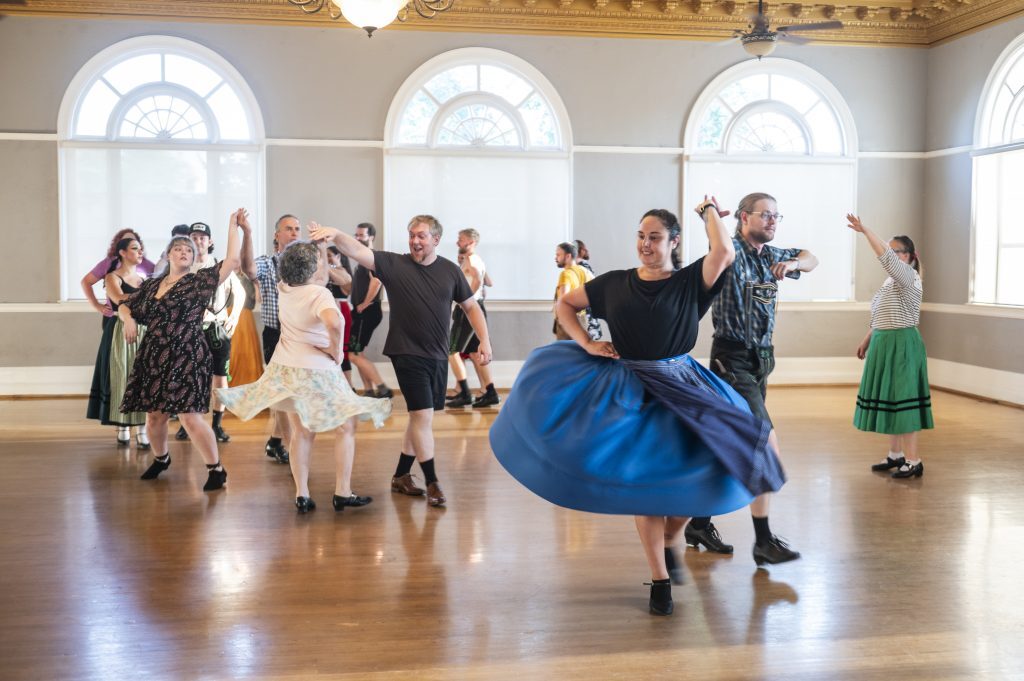
At one July rehearsal, she cued music from The Sound of Music and worked from a repertoire of more than 30 dances. The troupe performs traditional Bavarian and Austrian dances, with waltzes, ländler and polkas among the forms. This is a group with a schedule to keep and steps to learn before the Oktoberfest performances arrive.
Its 2026 roster lists Wallrich as both president and female dance leader. Jake is the male dance leader. The troupe belongs to a wider network devoted to preserving Bavarian and Austrian dance, music and traditional dress. Here, the creative task includes keeping an inherited form in motion with other people.
There is pleasure in finding this alongside the agency biography. A person who has spent years deciding how a company should present itself also spends time helping dancers move together. The rehearsal photograph gives the point its proper proportions: a room, partners, raised hands, the work of practicing.
A different place in the formation
The CEO succession gives that long professional biography a new shape. The agency described ten years of preparation for the transition to Gall. Wallrich’s own departure message left room for occasional strategic or creative assignments and for seeing people at local restaurants, bike paths and golf courses. Stepping away from the top job still allowed for relationships with the firm and the city around it.
Her curiosity also remains specific. In her anniversary reflections she listed learning a language, mastering a dance technique and understanding AI among the things she wanted to explore. These are modestly stated interests with plenty of work concealed inside them. Each offers the experienced founder a chance to become a learner again.
The company that began with a six-month deadline now has another leader. Wallrich has a continuing place in its history, a dance group with its own commitments and a list of things she would like to understand. After so many years of directing, she can choose which assignments to take. There will still be occasions to lead. There will also be new steps.