Tom Fallenstein went shopping for a suit with his mother. He had finished college, and there was a sensible question hanging over the costume business he had been running alongside his studies: should he find a regular job? His mother thought that might be wise. The next day, he arrived at her house wearing the new suit, ready to begin work for himself. Clothes had already helped give him a business. Now they supplied an announcement.
Years later, he would give a business tour in an orange tuxedo resembling Jim Carrey’s outfit in Dumb and Dumber. There is a pleasing continuity here. Fallenstein could dress for the job he wanted, then dress as a film character while doing it. In 2006, the family company recorded more than $2 million in sales. A million dollars came in during October alone. The orange suit was entertaining; the order book required attention.
The company now known as FUN.com grew from a household where costumes were made rather than merely purchased. His mother, Jenice, sewed elaborate outfits for her children. Friends wanted to borrow them. In 1992, sisters Julie and Lisa began renting costumes from the family garage, and the operation became Costumes Galore. Tom’s later contribution was to bring that existing appetite onto a screen. The sewing machine had already supplied the merchandise and the family had already found customers.
A dress, a closet, a checkout
At Minnesota State University, Mankato, Fallenstein studied computing and graphic design. The combination mattered: he wanted to understand how a website worked and enjoyed creating something people could see. A costume business offered a practical place to try both. His first online shop, FlapperCostumes.com, concentrated on one style of dress in a small selection of colors. His sister modeled it. Inventory lived with him at college.
That is an unusually modest opening scene for an online retailer. There was no need to pretend that the shop contained everything. A person searching for a flapper costume could find a site devoted to flapper costumes, look at the dress, and pay through PayPal. In the early search market, a narrow subject could earn attention. The website did a particular job for a particular customer, which made its limitations useful.
Fallenstein borrowed $5,000 from his parents for initial inventory. He thought through what would happen if demand disappointed him: the costumes could be sold elsewhere, including on eBay, to recover the purchase cost. Suppliers also understood Halloween’s calendar, sometimes allowing retailers to pay after the season. His approach to starting was practical and bounded. He was testing a market he knew, with merchandise whose alternative uses he could understand.
After graduating in December 2004, he committed to the business. By October 2005, the family’s shipping effort was overwhelmed. Relatives packed orders; friends helped late into the night. Products sold beyond available stock, some orders had to be canceled, and the phones were unplugged because the business could not handle more requests. The problem had changed. Getting found was working. Fulfilling what people wanted was now the task.
October needs a very large backstage
Halloween comes with a deadline a retailer cannot negotiate. A costume arriving after the party has lost much of its reason for being ordered. Fallenstein’s early success therefore contained a second challenge: build an operation capable of absorbing a rush, then keep that operation useful when the rush ends. The business had to learn how to recruit, train, stock, pick, pack, and ship around an unusually concentrated calendar.
He has described customer service as an extension of the interests that brought people to the store. Employees might keep talking about a show or superhero after the transaction was complete. Costume tutorials and creative projects gave visitors another reason to return. Those conversations could make a distant online company feel more familiar. They also required people who knew the products well enough to enjoy talking about them.
The physical business expanded far beyond the garage. Its Minnesota warehouse reached 200,000 square feet; the company combined with costume accessories business Elope in 2020. In July 2023, FUN.com announced a ribbon cutting for a 285,000-square-foot distribution center in Elsmere, Kentucky. Fallenstein explained the location in delivery terms: it could put the East Coast, from Boston to Miami, within two-day ground shipping.
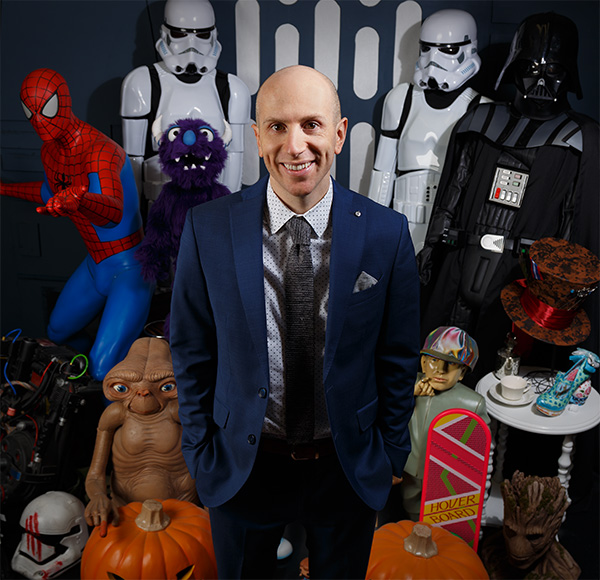
The Kentucky celebration had its own logic. Visitors could explore on scooters, Darth Vader and a Stormtrooper were due to appear, and a 25-foot inflatable Stay Puft Marshmallow figure would mark the occasion. Warehousing is often presented as a sober affair of square footage and delivery zones. Fallenstein’s version allowed a film character to stand beside the shipping argument. Both belonged to the business he was building.
A fan needs more than one night
FUN.com offered an answer to the months between Halloweens. The team already understood licensed characters and had experience handling clothing and accessories. It could use those skills for gifts, collectibles, and everyday apparel. A fan’s interest in a film does not disappear on November 1. A shop selling that interest has a longer calendar available to it than a shop selling an outfit for one evening.
By 2021, the product range included clothing for people who wanted their enthusiasm to be visible in different ways. Some merchandise announced a fandom from across the room. Other pieces kept the reference in a lining or a small detail. Designers Kristi Kelly and Kurt Anderson considered where someone would actually wear an item, alongside the characters and stories it represented. A workplace blazer and a convention outfit could start with the same affection and finish very differently.
That work turns on a familiar question for any enthusiast: how much of this interest do I want to show today? Fallenstein’s company gives customers several possible answers. Its designers bring their own interests and technical experience, while licensors set boundaries for how characters can appear. The result is a business in which creativity has to fit a product, a customer, and an agreement. An appealing idea still needs a wearable shape.
The collaborations also extend into Halloween’s more theatrical equipment. In 2023, HalloweenCostumes.com worked with YouTuber Brick Thunder on the Cain animatronic and a drop-down clown decoration. In 2024, a partnership with Distortions Unlimited brought back a licensed Alien Xenomorph mask using a cast from an original foam master. Fallenstein appeared with Ed and Marsha Edmunds to discuss the project. These are products for people who care about the details.
The founder learns to leave room
Fallenstein’s own writing makes clear that he enjoys examining how things are done. During a Las Vegas trip, he noticed how a hotel clerk introduced an available room as a compromise. The room’s view turned out to be excellent, yet the opening description left the family wondering what they had missed. He wrote about how a better first explanation could have changed the experience. Even a holiday check-in became material for thinking about communication.
In another post, he considered why would-be entrepreneurs kept their ideas private. He had encountered people who feared an idea would be stolen before they could act on it. His response was to emphasize the work of making it happen. “An idea is only as good as the person who actually executes it.” Coming from a retailer, the observation has concrete weight. Someone must build the page, buy the inventory, answer the question, and get the parcel away.
Running a growing business also meant confronting his own desire to do things himself. He described learning to accept work done differently from how he would have done it. Delegation allowed more work to move forward; with time, people could become better at their responsibilities than he had been. It is a consequential adjustment for someone who began with inventory within arm’s reach. A founder’s standards have to become something other people can use.
Today, Traction Capital lists him on its advisory committee, whose members invest in the fund and help evaluate deals. Northern Lakes Capital also includes him on its advisory council. These roles give his operating experience a setting beyond his own company. The questions travel easily: how does a promising idea find customers, what happens when demand arrives, and how does the person who started it learn to work through a team?
“An idea is only as good as the person who actually executes it.”Tom Fallenstein / personal blog, 2012
Back to the people wearing the costumes
Fallenstein remains personally interested in the worlds his company sells. He has described himself as a movie buff, with a theater room at home, and listed skiing and golf among his other interests. In August 2025, he sat down at FUN headquarters with Disney Dan Becker for a podcast conversation about preparing for Halloween and creating Star Wars costumes. The overlap between leisure and work is easy to see. Watching a film can also mean knowing the customer better.
In 2026, HalloweenCostumes.com announced its first public headquarters experience, scheduled for August 29. The plans included warehouse tours, costume design, animatronic demonstrations, and spaces made for photographs. A September visitor account described Fallenstein leading a tour with team members, followed by a trip to the nearby warehouse. Customers could see the physical work that normally sits behind product pictures and a checkout button.
For a business that expanded by removing the distance between a Minnesota garage and customers elsewhere, inviting people inside is a fitting move. The visitors could meet the people and inspect the creations. The company could give its audience another occasion to gather around a shared interest. A warehouse has fewer flattering angles than a product photograph, but it has the advantage of explaining how the photograph becomes a delivery.
The opening suit story still suits Fallenstein. He took a family business seriously enough to make it his job, while keeping the affection for dressing up that gave it a beginning. The work since then has involved websites, inventory, design, shipping, and people. Each expansion has required another practical decision. Somewhere along the way, a flapper dress in a college closet became a company with room for an inflatable marshmallow and customers from around the world.