In April 2005, Tom Cuthbert was sitting at his regular corner table at a Krispy Kreme in San Antonio, reading about click fraud. Coffee, doughnuts, a business problem. It was his thinking place, an office with unusually good reasons to linger. He had begun to see a gap between what online advertisers bought and what they actually received. A click could register perfectly and still be worthless.
His former parent company, Optimal iQ, had found fake clicks. The question occupied a useful intersection: advertising was moving online, search marketing was growing, and someone had to decide whether the numbers deserved to be believed. Cuthbert saw room for a company. The doughnut shop supplied the table; the advertising industry supplied the dispute.
Two decades later, he spends much of his working life in private conversations with CEOs. The setting has changed. So has the equipment. The recurring interest is recognisable: get beneath the reassuring surface, find out what is happening, and make it possible for people to act on it.
A sign with two words
Before the company had a substantial history, its founders tried a small experiment. Cuthbert, Chuck Wall, Jason Smith and Tom Charvet took a table at an online advertising trade show and put up a sign: “Click Fraud.” People came over. A business plan had acquired something more useful than another approving conversation among its authors: attention from people with the problem.
The eventual outcome can make this beginning look inevitable. At the time, it was a test. A table and a sign asked a fairly unforgiving question. Would anybody stop? The response helped establish that the concern extended beyond the founders’ own observations. It also gave the company a subject around which advertisers could gather.
Cuthbert dates Click Forensics’ launch to January 2006. Its purpose was straightforward: “help ensure advertisers get what they pay for.” Delivering that promise involved confronting the companies whose advertising systems were producing the clicks. A measurement business was about to become a relationship business, too.
Click Forensics published its Click Fraud Index in spring 2006, drawing attention to traffic quality and provoking a public disagreement with Google. Cuthbert’s retrospective makes clear that raising awareness was deliberate. A disputed number could force a conversation that a polite introduction would never secure.
A recorded click tells you that an event happened. An advertiser still needs to know whether that event was worth buying.
From argument to infrastructure
Public disagreement was only part of the work. The Click Quality Council gave advertisers a collective voice, while Click Forensics worked with advertising platforms on practical responses. Its FACTr system with Yahoo automated click tracking and reconciliation. Identifying questionable traffic mattered; creating a route for advertisers and providers to address it mattered as well.
There is a difference between winning attention and changing a process. Cuthbert’s account of these years spends time on both. The company helped develop industry standards alongside other advertising businesses and the Interactive Advertising Bureau. In a market built on vast quantities of automated transactions, shared definitions were consequential. People had to agree on what they were counting.
The company also changed geography. It moved to Austin in 2007 to find talent and investment. That decision would remain important to Cuthbert after his own operating role ended. San Antonio had produced the idea, but another city offered the conditions for its next stage.
His later civic work carries that experience with it. He became a founding participant in Tech Bloc, the San Antonio technology advocacy organisation. For someone who had watched a company leave, attracting and retaining talent was a concrete concern. A promising local business should have a plausible route to growing locally.
- 2006Click Forensics launches
- 2007The company moves to Austin
- 2010Cuthbert steps back from the CEO role
- 2011Click Forensics buys Adometry and adopts its name
- 2014Google acquires Adometry
The exit before the acquisition
Cuthbert stepped back to a board role in 2010. In explaining his decision, he described a changing role and a desire to explore what came next for himself and his family. The business continued. In 2011, Click Forensics acquired the Redmond company Adometry and took its name. Paul Pellman was CEO when that transaction was announced.
The combined company expanded its work in advertising verification and attribution: helping marketers understand how different advertising contacts contributed to a purchase. Google acquired Adometry in May 2014 for an undisclosed sum. By then, Cuthbert’s career was already moving in a different direction.
That chronology gives the story its proper proportions. He co-founded and led the business from which Adometry developed. Its later acquisition belongs to the history he helped begin, alongside the work of colleagues who carried it forward. An entrepreneurial career can continue beyond the job that becomes its most familiar introduction.
The coach brings a bell
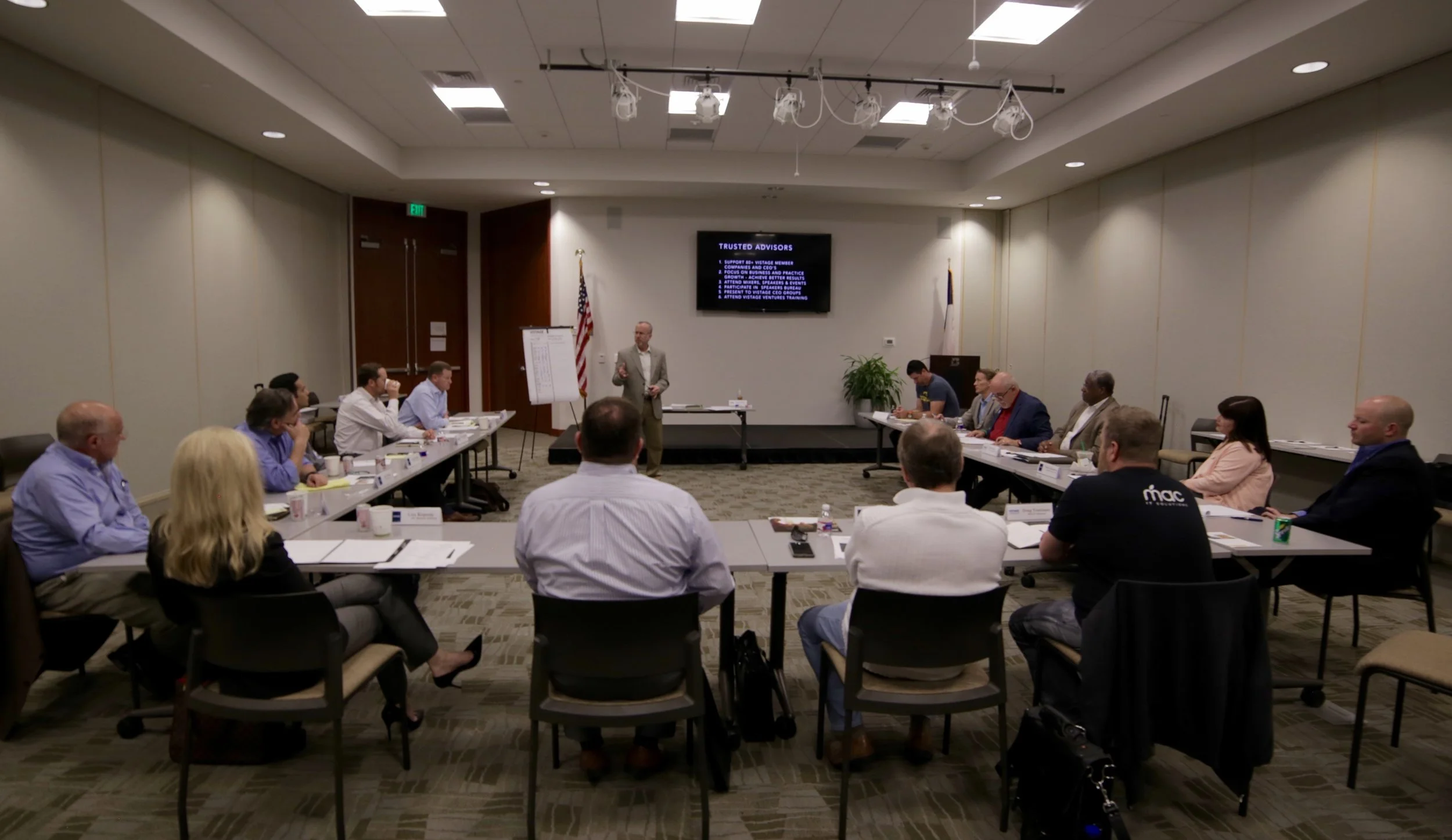
Cuthbert began facilitating CEO peer groups in 2012. His current practice includes eight Vistage groups and more than 175 CEOs and business leaders in San Antonio, according to his professional website. He also offers individual coaching. It is work organised around conversations, with the awkward questions given room on the calendar.
His approach has a surprisingly audible prop. In a high-school speech class, a teacher rang a bell whenever students filled their speeches with verbal clutter. Cuthbert remembers wanting to avoid the sound badly enough to change his speaking habits. He later brought a bell into his own meetings.
He calls vague language “nebulosities.” The word sounds as though it might need its own committee, although his examples are ordinary: instructions softened until nobody knows precisely what has been requested. His remedy includes asking people to demonstrate or repeat what they understand. A nod may be encouraging. A demonstration is considerably more informative.
The bell story offers a glimpse of his teaching style. An abstract complaint about communication becomes a small, memorable event. People can hear the problem. They can also do something about it before an ambiguous instruction travels through an entire organisation collecting interpretations.
“To help leaders see what they cannot, while equipping them to achieve more than they imagined possible.”
Tom Cuthbert’s personal mission
A promotion at the ice-cream counter
Another teaching example comes from his own early employment. At Polar Bear Ashburn’s Ice Cream Parlor, his job title was Super-Duper Dipper. Promotion made him Senior Super-Duper Dipper and put him in charge of two people who had been his peers. Corporate vocabulary has seldom made responsibility sound so cheerful.
He remembers feeling unprepared. Being good at serving customers and scooping ice cream had led to responsibility for other people’s work, without the training that new responsibility required. He uses the experience to explain why companies need to invest in their middle managers.
In his essay about companies breaking in the middle, he asks readers to imagine bending a stick held at both ends. The pressure exposes the middle. His concern is the layer between a CEO’s intentions and employees’ daily experience: people managing upward, downward and sideways, often while learning a new job.
The example keeps his leadership advice close to work as people actually encounter it. A promotion changes relationships before it changes competence. Yesterday’s colleague can become today’s supervisor with very little preparation beyond a new title. Somewhere between the scoop and the staff rota, an employer has acquired a training obligation.
The award with a second piece of news
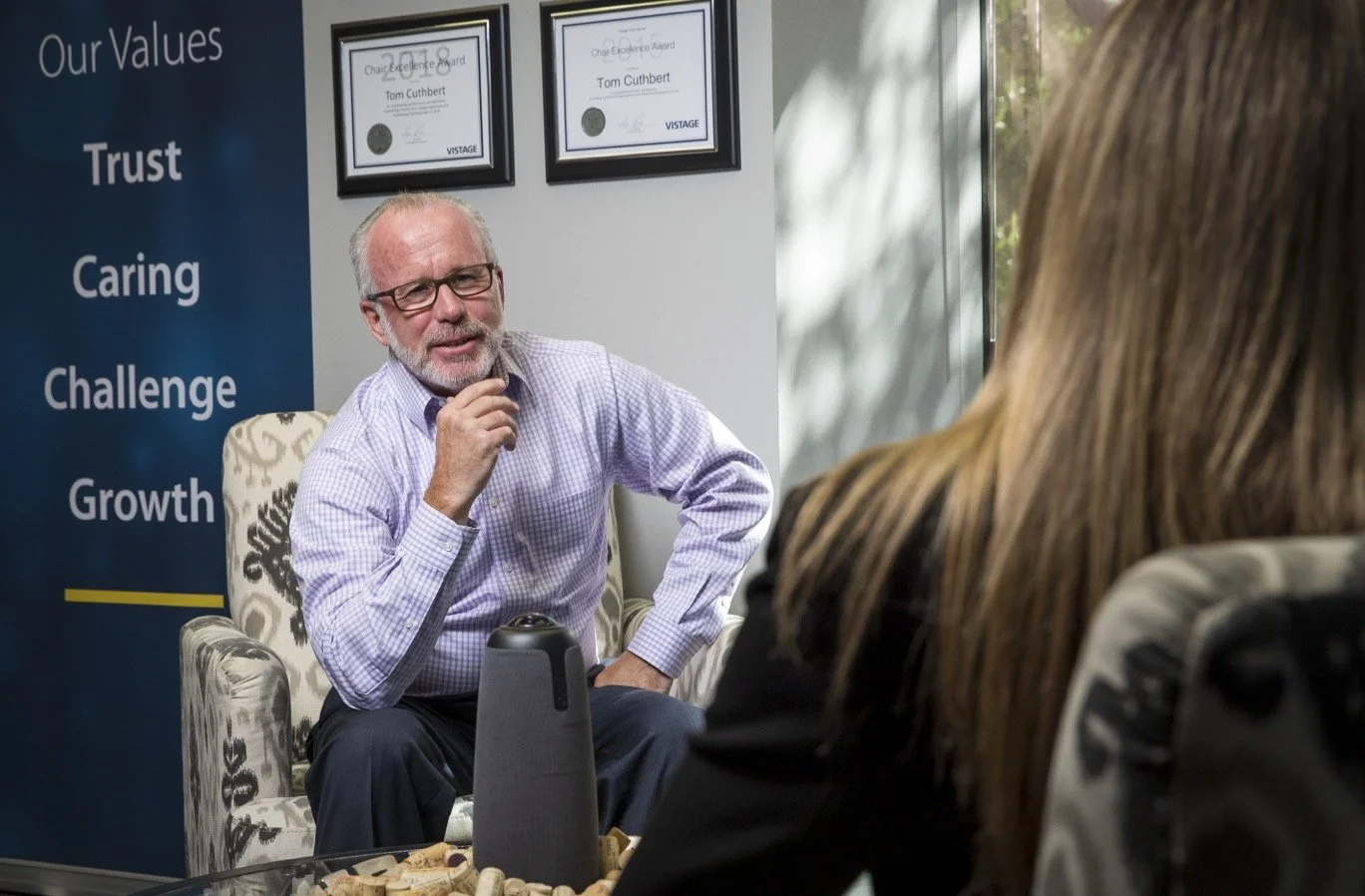
When Vistage executive Tim Gray called about the Pat Hyndman Award, Cuthbert remembers being told there were two things to discuss. The first was his nomination. After he expressed his appreciation, he asked about the second. He had won.
Vistage identifies him as its 2018 Hyndman Award recipient in a release published in March 2019. The award recognises service to the Vistage community. His own account turns quickly toward people who had helped him: Brant Houston’s searching questions, Bob Dabic’s demanding instruction, and Robin Stanaland’s candid feedback after visiting a meeting.
That emphasis gives the coaching career some welcome reciprocity. The person asking leaders to accept challenge has benefited from being challenged himself. His account of receiving recognition ends with wanting to serve more effectively. The trophy is allowed a moment; the teachers get a substantial share of the conversation.
Room in the calendar
His newer work includes the ChairLife Podcast, a short-format programme aimed particularly at people building a coaching and chair practice. Its subjects include priorities, boundaries, peer groups and practical working habits. In September 2026, his LinkedIn profile listed a new article, “The Work That Eats Itself.” Work design remains an active interest.
He has a fairly concrete practice of his own: taking July away from his customary schedule. His 2025 recap mixed family time, the beach, reading and a trip to Guatemala to help train Vistage chairs. He spoke to business leaders there and worked with prospective members. Apparently a month off can still contain a meeting, provided it is the right meeting.
That summer also included model rockets, fishing and time with grandchildren. At the beach, the boys ate doughnuts. The detail makes a pleasing return to the beginning of his entrepreneurial story, without requiring every pastry to carry a business lesson. Some are simply part of a good afternoon.
There is an appealing continuity in the tables Cuthbert has chosen: the corner at Krispy Kreme, the trade-show stand, the meeting room, the private coaching session. Each gives a question somewhere to land. His career has moved through companies, cities and job descriptions. He still makes a living by paying attention to what deserves a closer look.
Keep the conversation going
Tom’s website · LinkedIn · X · His blog
ChairLife Podcast · The reading shelf · July 2025 recap
Watch: Nebulosities · Watch: From Here to There · YouTube: Click Quality Council
The Click Forensics origin · Companies Break in the Middle · Nebulosities Kill Clarity
The award phone call · Vistage’s Hyndman announcement · The Google acquisition · The Adometry name change
Photographs: Tom Cuthbert’s public website. Meeting photograph / Coaching photograph.