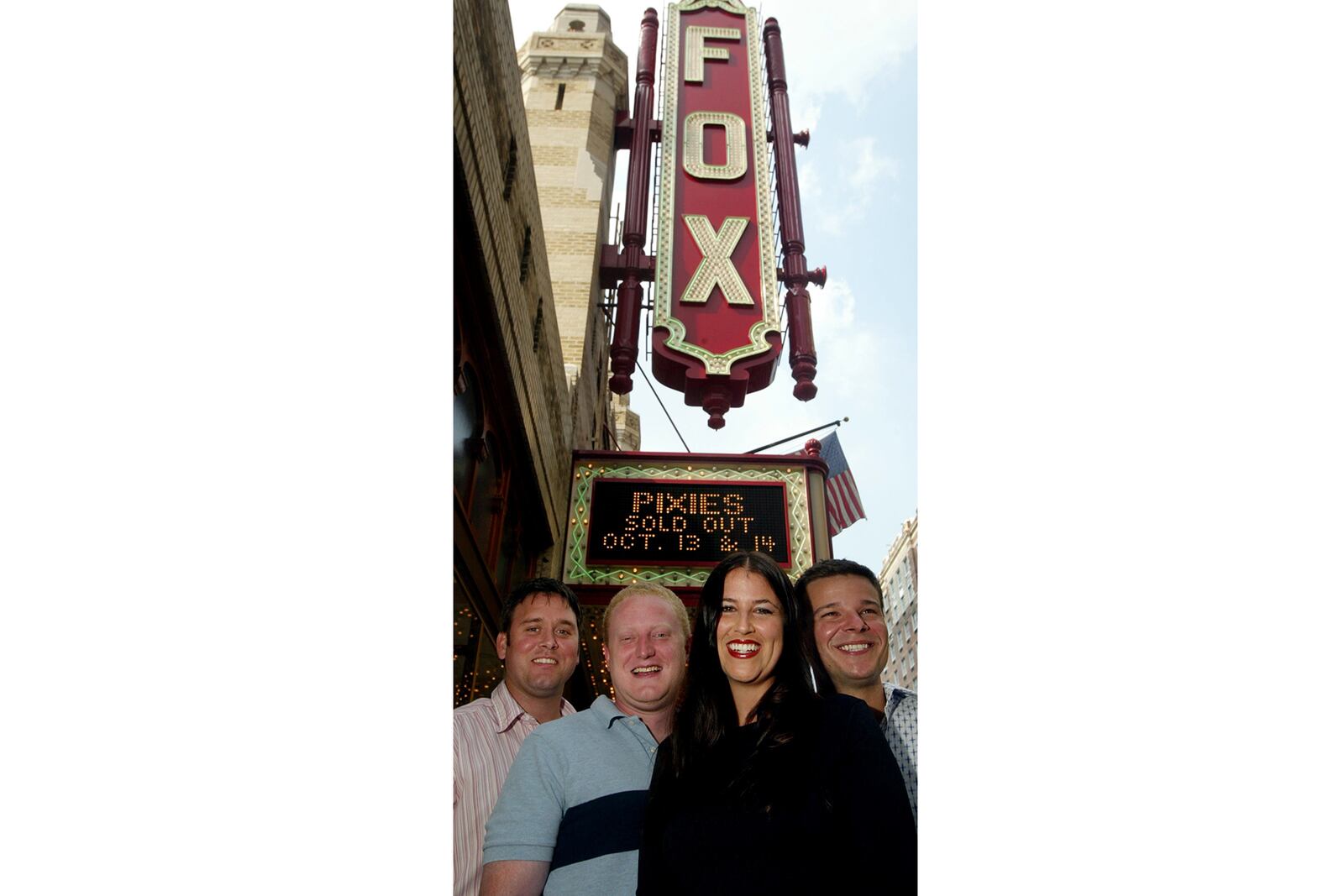
The Fox Theatre marquee had the Pixies on it. Underneath stood four people from a young Atlanta concert business, smiling for a photograph in 2004. Tom Cook was among them. Two decades later, his name appears beside software for checking supplier invoices. A useful reminder, perhaps, that an executive biography can leave rather a lot out when it begins with the current job.
Cook helped launch Rival Entertainment with Lucy Lawler, Josh Antenucci and Brandon Mize. His working life already included legal training and hospitality ventures. Today he is the co-founder and CEO of FlexTecs, the recovery audit and payment accuracy company he started with his father, John, in 2011. Between those chapters lies a question that has also occupied his nonprofit work: how do people get the opportunity to put their abilities to use?
The answer takes this Atlanta story a considerable distance from Atlanta. Nepal became part of the company’s operating model because his father wanted employment to follow educational support. The geography was personal before it became corporate.
Before the invoices, the encore
Cook’s involvement in music extended beyond the occasional good seat. In 2004, his ventures included the venues EarthLink Live and Vinyl. He liked soul music, and an idea he had been developing helped become SoulFest, a two-day event at Turner Field with a lineup spanning hip-hop, R&B and gospel.
The venues offered different scales: Vinyl held 300, EarthLink Live 1,100. In the concert business, a room has to be the right size for the audience an artist can bring. Enthusiasm is welcome; empty space remains stubbornly visible.
Rival’s launch brought together people with different experience in music and hospitality. That detail matters more than the temptation to make an invoice sound like a guitar solo. There is no need to pretend the businesses are identical. The earlier venture shows Cook working with partners, building something in public and taking on the practical obligations that follow a promising idea.
Entertainment is a useful corrective to the tidy career timeline. A concert happens at a particular hour, in a particular place, with actual people expecting the doors to open. The plan eventually meets the evening. Cook’s later work would involve another kind of execution: making sure a negotiated agreement survived its journey into a payment.
The distance between training and a job
Cook graduated from Emory Law in 1998. His career included practicing law, but it also took him into workforce development. He founded New Hope Enterprises, a nonprofit concerned with preparing people facing hardship for employment. At a graduation ceremony, he and co-founder Angele Hawkins were honored for their work on its job-readiness program.
A graduation is a revealing place to find a business founder. It measures progress in people who are ready for a next step. The ceremony belongs to the participants; the work behind it involves making preparation useful beyond the classroom.
His involvement extended into public service. He was appointed to Georgia’s State Workforce Development Board in 2015 and was among the members reappointed in December 2022. The state’s workforce planning documents also list him, connecting his name with New Hope Enterprises and, in a later plan, FlexTecs North America.
These are concrete points of contact between his nonprofit and commercial lives. They give the employment theme some weight. It appears in an organization he helped create, in a public board appointment and in the decision about where a family business would establish operations.
There is a difference between helping someone acquire skills and having somewhere for those skills to go. Cook’s career has touched both sides of that problem. The connection becomes particularly clear in Nepal.
“My father would be so proud.”
Tom Cook, reflecting on FlexTecs Nepal’s twelfth anniversary
Why Nepal was in the plan
John Cook had supported scholarships in Nepal for years before FlexTecs began. When father and son started the business, John wanted an operation there to create jobs. Tom recalled the decision while celebrating FlexTecs Nepal’s twelfth anniversary in Kathmandu, reporting that its team had grown beyond 350 employees.
His recollection is touching because it is specific. A parent had a view about what the company should make possible. Years later, the son was in Kathmandu, looking at the people who had become part of it.
The educational connection continued through the John M. Cook Opportunity Initiatives. FlexTecs supports that work in Nepal and Thailand, spanning school years and career development. Some people whose education John supported went on to leadership positions within FlexTecs Nepal.
That last detail changes the shape of the story. Education and employment can be discussed as separate programs, with separate photographs and separate annual reports. Here, there are people whose lives cross the boundary. The company’s Nepal operation became a place where an investment in a person could acquire another practical use.
It also adds an obligation to the usual account of international growth. An office is a business address. For the people working there, it is also a place where careers develop. Cook’s anniversary recollection keeps both meanings in view without needing to turn the celebration into a management lecture.
- AtlantaVenues, legal work
and new ventures - Job readinessNew Hope and
workforce service - NepalEducation connected
with employment
Moving the check closer to the mistake
At FlexTecs, the business problem is money paid incorrectly or value lost in the payables process. Recovery auditing searches for discrepancies after transactions. The company combines that work with software intended to bring checks earlier, while there is still a chance to prevent an error.
For a buyer, the attraction is easy to grasp. Finding an overpayment is useful. Keeping the money from leaving incorrectly avoids the subsequent exercise in getting it back. Anyone who has pursued a refund will appreciate the administrative difference.
In April 2025, FlexTecs expanded FlexTrap with supplier statement reconciliation, automating transaction validation with suppliers. A customer at Tidewater described benefits including duplicate-payment checks, configurable validation and timely alerts. These are fairly unglamorous activities until you are the person responsible for doing them.
Cook’s task is to build around that everyday usefulness. The leadership team includes operations, technology and client-service specialists, with Sudan Chapagain leading Nepal and John Kidd serving as chief technology officer. A distributed business depends on those responsibilities connecting.
and supplier records
discrepancies arise
incorrect payment
From audit findings to earlier checks in the payment workflow.
A contract has to survive the paperwork
On October 23, 2026, FlexTecs announced Invoice Compliance for FlexTrap. The module checks supplier invoices against negotiated pricing, discounts and terms before payment. Cook’s starting observation was plain: “Companies negotiate hard for their pricing”.
The gap is that an invoice can agree with a purchase order while the purchase order itself fails to reflect the contract. Matching documents does not automatically settle whether the negotiated bargain has been honored. The new module is intended to address that gap.
The product draws on the team’s contract audit experience, with optional human validation for complex contracts. Its place beside payment error prevention, statement reconciliation and inbox assistance shows the direction of travel: carry knowledge from reviewing past transactions into the work happening now.
There is something pleasingly literal about this ambition. A price agreed in a meeting ought to remain the price when the bill arrives. The intervening systems can make that simple expectation surprisingly difficult to enforce.
The next business to learn
Cook’s formal education includes Wake Forest University and an MBA from Georgia Tech, as well as his law degree. The sequence sits comfortably beside a career that has resisted staying within one professional lane. A qualification marks a period of study; the later work keeps presenting fresh material.
Growth has brought its own education. In Spring 2025, Cook participated in Build with Kanbrick, a three-month program for midsize business leaders. The cohort placed an experienced founder back among other operators working on their businesses. A CEO, too, can have homework.
The program brought together seven companies selected from more than 50 applicants across North America. The point of a cohort is that other people have businesses to run, too. They can recognize the difficulty in a problem without needing to work in the same industry. For a founder with several ventures behind him, that is a practical setting in which to keep asking questions.
In January 2026, FlexTecs announced a strategic investment from Cohere Capital. Existing leadership would continue running the company, with support for services, software and further expansion. Cook described a business that had doubled over the preceding three years.
“Our tech-enabled services business remains foundational to who we are,” he said. Software development, in that account, grows from experience doing the work. The service operation supplies knowledge of the problems; the product aims to apply that knowledge earlier and more widely.
The next chapter therefore asks Cook to hold several things together: a company’s established work, new products and teams in different countries. His earlier chapters make that responsibility easier to see in human terms. There were partners outside a theater. There were people preparing for employment. There was a father who wanted scholarships to lead somewhere.
In Kathmandu, Cook had a roomful of colleagues to celebrate. In the payment workflow, he has another practical task: help the agreement survive until the money moves. His career contains both kinds of follow-through.