One person. Hundreds of suppliers. Fifty reconciliations a month. In a case study published by FlexTrap, that was the arithmetic facing a global education organization. Its accounts payable analyst matched supplier statements against SAP records using VLOOKUPs. The work was happening. The queue was winning. Everyone beyond the top fifty suppliers waited outside the window.
- FlexTecs recovers overpayments and checks whether supplier bills match contracts.
- Its software, FlexTrap, brings payment checks, statement matching, and supplier email into one platform.
- The interesting shift: use yesterday’s mistakes to inspect tomorrow’s payments.
The organization tested FlexTrap against twelve months of SAP data and twenty particularly difficult supplier statements. Then it connected the software to SAP and OpenText. Six months later, the same one-person team covered 201 suppliers monthly. FlexTrap reports that 70% of reconciliations were automated. What changed was the amount of work one person could get through.
Move the inspection upstream
FlexTecs comes from an industry devoted to a peculiar corporate ritual: paying money, discovering some of it should never have been paid, and hiring someone to retrieve it. Recovery auditors sift transactions for duplicates, missed credits, and commercial allowances. A successful audit returns cash. A recurring error supplies next year’s audit with fresh material.
John Cook knew this business. He had founded PRGX Global before establishing FlexTecs with his son Tom in 2011. The company’s current history presents prevention as part of its founding ambition. The useful insight was about timing. A disputed transaction becomes harder to reconstruct as records age, employees move, and suppliers close their books.
In a 2021 article, FlexTecs described moving reviews from one or two fiscal years after a transaction to one or two quarters. An in-year audit could run a quarter behind purchases. Bring the review forward and the people who remember the deal may still be around. Bring it forward far enough and an incorrect payment can be stopped.

Three places to catch the leak
The services remain substantial. Retail recovery audits examine trading activity. Accounts payable audits pursue overpayments, unprocessed credits, and unapplied cash. Contract compliance specialists compare supplier billing with negotiated terms, including pricing, labor rates, and freight. A discount negotiated by procurement has little value if nobody notices it missing from the invoice.
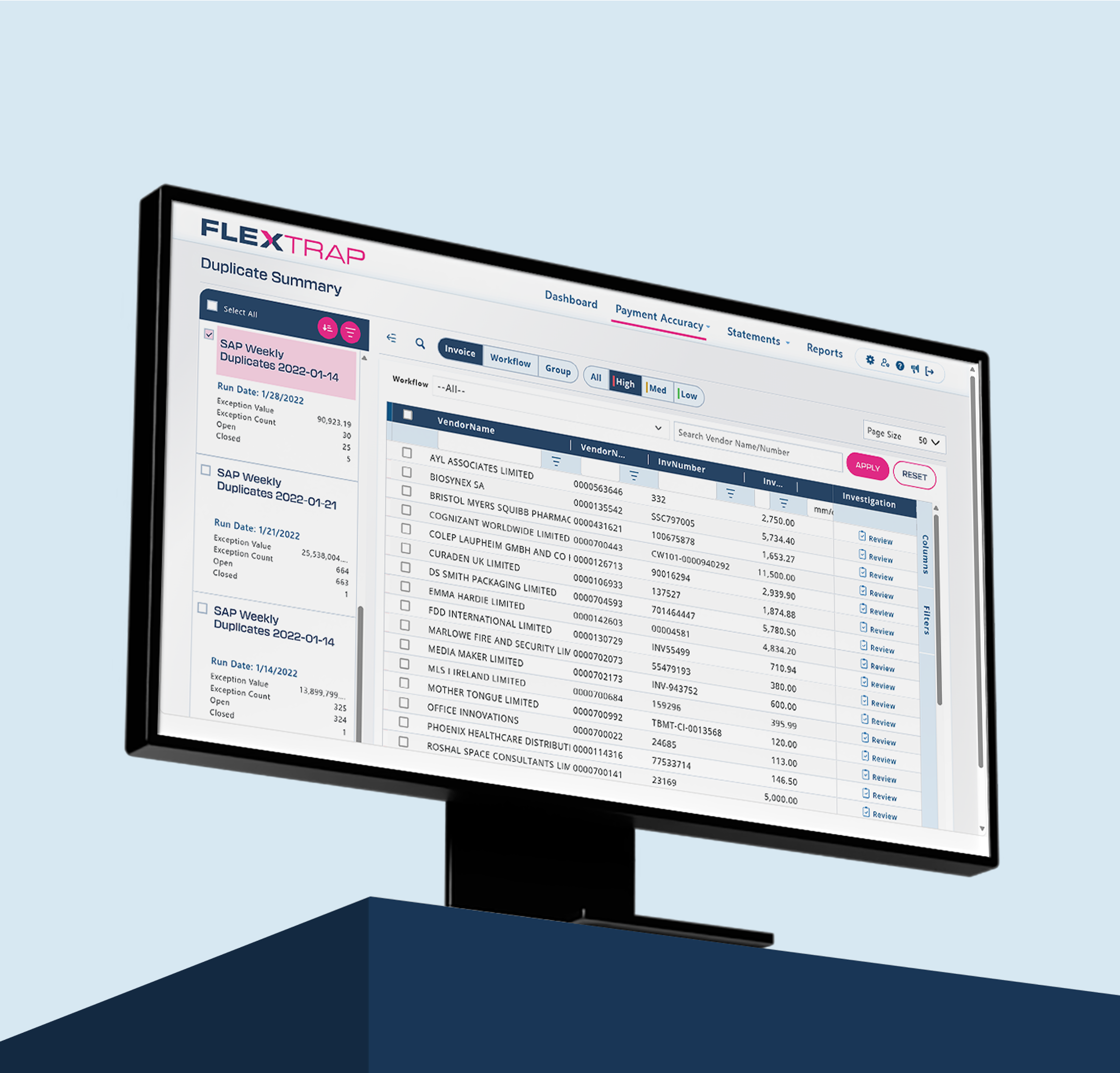
FlexTrap turns that experience into three connected software modules. Payment Error Prevention checks transactions for duplicates and anomalies. Statement Reconciliation collects supplier statements and matches their contents against accounts payable records. AP Inbox Assist classifies supplier messages and drafts responses using transaction context, with human oversight. The company markets the combined system as an AP intelligence platform.
- 01InspectInvoice and vendor checks
- 02ReconcileStatements, credits, balances
- 03ResolveSupplier questions and exceptions
The customers are enterprise finance and shared-services teams. Public testimonials include The Very Group, Aspen Dental, Tidewater, and Qiagen. Retail is central to the services business; the software also appears in healthcare and education. These are environments where invoices can cross subsidiaries, vendor records, and enterprise resource planning systems before anyone sees the whole journey.
“We were confident that our internal controls and ERP were catching ‘everything,’ boy I was wrong.”
Nicole Caley, Aspen Dental
Customer testimonial published by FlexTrap
Alternatives include recovery specialists such as PRGX and apexanalytix, internal auditors, and existing ERP controls. FlexTecs’s pitch combines people who investigate errors with software intended to prevent recurrence. That combination deserves evaluation on coverage, actionable findings, and implementation effort. A long list of checks alone tells a buyer very little.
The fee changes the question
There is a quieter benefit to reviewing current transactions: feedback arrives while the process can still be changed. The relevant measure becomes whether a particular mistake returns, which team owns the correction, and how much investigation the next invoice requires. Recoveries are visible cash. Cleaner workflows need their own scorecard.
The commercial model has two parts. FlexTecs advertises contingency fees for AP recovery audits. FlexTrap advertises a flat fee rather than a percentage of recoveries. That distinction matters: a buyer can purchase ongoing controls while separately deciding how much outside recovery work remains necessary. For procurement, the comparison is the full cost of software, review time, and residual audit work.
On January 22, 2026, FlexTecs announced investment from Cohere Capital. In that announcement, the company reported doubling the business over three years, more than 600 employees, and 25% revenue compound annual growth since 2020. The stated plan covers both services and software, geographic expansion, and possible acquisitions. Recovery expertise remains part of the expansion strategy.
Borrow the test, then count the work
The education customer offers a useful buying method. Start with statements that resisted your existing process. Test them against actual historical data. Measure the reconciliation coverage, the remaining exceptions, and the effort required to close them. Twenty awkward statements can expose more than a polished demonstration built around twenty easy ones.
The limits follow from the work. Read-only access still needs usable transaction data. A flagged invoice still needs someone responsible for resolving it. Supplier responses affect reconciliation. For a small organization with straightforward payments and reliable existing controls, the available saving may not justify another platform. Buyers should measure their own workload and error exposure before borrowing someone else’s return figure.
The other return on investment
There is another thread in the company’s history. John Cook supported education in Nepal and Thailand for decades. FlexTecs says that work helped shape its Nepal service center; some education beneficiaries later became leaders in the operation. Alongside Atlanta and Manchester, Lalitpur became part of the company’s delivery network.
That detail puts people back into a story dominated by matching engines and payment checks. Someone has to understand the commercial agreement, investigate the exception, and explain the error. FlexTecs’s proposition rests on bringing those people and the transaction closer together, while there is still time to do something useful.