Todd Holt had a satellite television bill of about $140 a month and a fondness for sports. In 2017, he replaced the satellite package with streaming. The change saved roughly $102 a month. Point Broadband’s marketing team found this interesting enough to turn the boss into a case study. A broadband company had acquired an unusually convenient test household: its own chief executive’s.
The joke was affectionate. His colleagues presented Holt as someone who could run a communications business without being the office’s first choice for technical troubleshooting. There is something reassuring about an internet executive who also has to work out how to watch a game. The remote control is a remarkably democratic instrument; an impressive job title offers it very little persuasion.
That small domestic episode opens a useful door into Holt’s career. He came through accounting, moved into the leadership of Knology, and later co-founded Point Broadband. Across those jobs, the recurring problem was practical: how to turn money, networks and local operations into a service somebody would pay for, month after month. The television experiment gave that problem a household scale.
An accountant enters the network
Before the fiber expansion announcements, Holt worked in public accounting as an audit manager at Ernst & Young. At Knology, he became corporate controller, then chief financial officer, then president. The company’s 2008 annual report dates his appointment as president to July 2008, after three years as CFO. His route into broadband leadership ran directly through its financial machinery.
Those positions put different demands on an executive. A controller must account for what has happened. A finance chief must arrange the resources for what happens next. A president has to make the operating business live with both. In a network company, that means the figures eventually meet physical things: construction, equipment, installation and the customers waiting for them.
Holt’s Knology years also placed him alongside people who would reappear in the wider business circle around Point. Chad Wachter signed Knology’s January 2005 filing announcing Holt’s appointment as principal accounting officer. Years later, Wachter appeared as Point’s general counsel. Telecommunications careers can have the continuity of a repertory company, even when the sign outside the theater changes.
- 1998Controller
- 2005CFO
- 2008President
After Knology, a wider operating education
In July 2012, WOW! completed its acquisition of Knology and named Holt chief financial officer of the combined company, reporting to president Steven Cochran. The announcement kept Colleen Abdoulah as CEO. For Holt, the transaction brought another version of a familiar task: carrying financial responsibility into a larger organization assembled from existing networks and teams.
His next roles widened the field. He served as president of Synapse in 2013 and 2014, and as CEO of AMK9 from 2014 to 2017. He also became CEO of ITC Capital Partners in 2014. Software, canine security and investment management made for a less obvious résumé than a straight climb through successive internet providers.
The common thread was operating responsibility. His work encompassed finance and strategy alongside sales, legal matters and acquisitions. Point would require that range. Building a broadband provider involves finding capital, but also deciding where to build, bringing acquired operations together and keeping a customer service organization functioning while the business changes around it.
A handshake in Magee
Point’s early public appearances were local affairs. In August 2017, Holt and colleague Jeff Couch attended a ribbon cutting in Magee, Mississippi, as Point joined the Chamber of Commerce. Mayor Dale Berry, chamber members and company personnel gathered for the occasion. Holt was also pictured with chamber president Ian Cowart. The setting was a long way from an investor presentation.
It was an appropriate introduction for a business aiming at rural and suburban customers with limited internet options. Early Point promoted wireless broadband investment. Its later expansion increasingly centered on fiber. Both approaches required entry into particular communities, where an unfamiliar company name had to become a plausible choice for the connection at home.
There is a useful corrective in the ribbon-cutting photograph’s cast of characters. A network expansion may be described as a market entry, but a mayor and a chamber president experience it as something happening in their town. Holt’s work involved both vocabularies. A business could make sense on a spreadsheet and still need an introduction on Main Street.
The mayor, the museum and the customer
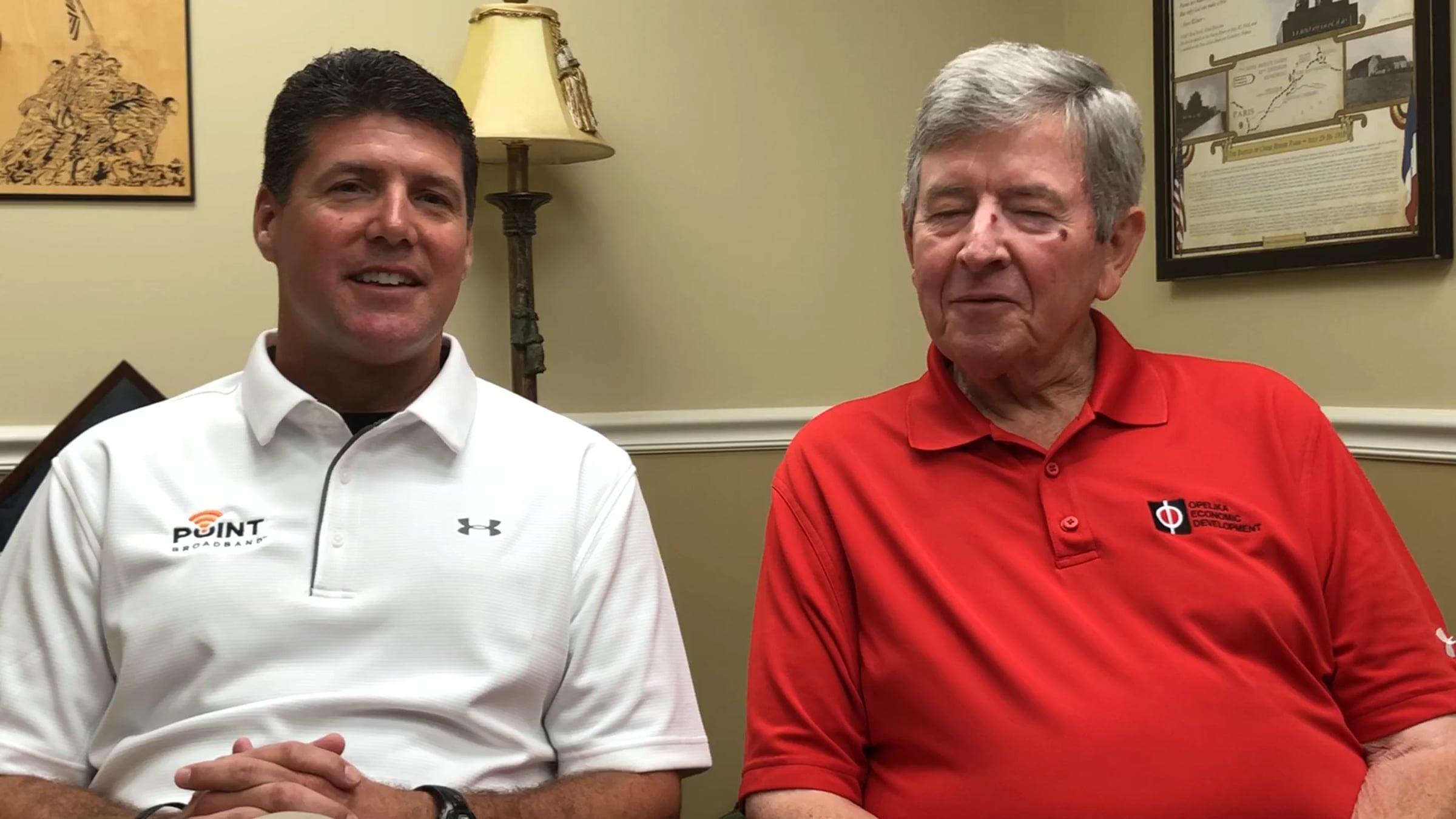
In 2018, Holt appeared alongside Opelika mayor Gary Fuller in a video about Point’s agreement to acquire the city’s OPS ONE fiber telecommunications assets and operations. Point described plans to offer gigabit internet, video and voice, with expansion beyond the city limits. Here was another kind of introduction: an incoming commercial operator explaining a change in local infrastructure.
The following May, Holt and chief operating officer Weldon Feightner took questions at the Birthplace of Country Music Museum in Bristol, Virginia. News anchor Rebecca Pepin moderated. The occasion marked the rebranding of Point’s Southwest Virginia and Northeast Tennessee operations. The museum supplied a particularly apt venue: it was itself a customer.
Holt’s phrase was plain: “We enjoy being a local partner.” His argument for fiber went all the way to the customer’s premises. More devices and greater data use made that final connection matter. The exchange put the company’s ambitions in a room with customers and public officials who could ask what those ambitions would mean for them.
“We enjoy being a local partner.”
Todd Holt · Bristol, May 2019
Buying the next stretch of road
GTCR acquired Point in October 2021 in partnership with Holt, its co-founder and CEO. The business combined existing networks with construction in nearby markets. That geography mattered. Adding a neighboring service area could extend an established regional operation rather than require a wholly separate business to be invented from scratch.
The acquisitions show the approach in motion. Point bought West Michigan Broadband in June 2022, then Monster Broadband and M33 Access that November. Monster brought operations in parts of rural Tennessee and Texas; M33 operated in northern Michigan. These were separate businesses with local histories, becoming pieces of a larger provider.
Further additions followed in 2023: NGN Fiber in Georgia and Community Internet Providers in Texas. The latter supplied fixed wireless service. Point’s expansion therefore involved a mixture of technologies as well as territories. For Holt, the challenge extended beyond choosing an acquisition. Each addition had to become part of an organization that could continue building and serving customers.
A construction calendar has opinions
Capital did not make construction predictable. In August 2022, an update from Ohio’s Miami Valley Communications Council described Point’s plans to expand fiber service into six member cities, with a separate arrangement in Springboro. Residents were being offered the prospect of another internet provider, with more choice over speed and price.
Holt was cautious about promising specific dates and locations. Supply chain problems and inflation left too many moving parts. That restraint belongs in the story alongside the expansion announcements. An executive can authorize a build and arrange funding; materials, schedules and conditions still have their say. A calendar is much easier to print than to persuade.
The Ohio project also illustrates how growth could connect to infrastructure already in place. The council’s GATEway network was a 44-mile fiber ring. Point’s role involved extending internet options to homes and businesses. In that arrangement, a regional network and the final household connection were different pieces of the same undertaking, with different work required to make them useful together.
More capital, then a different chair
By February 2023, Point served approximately 75,000 customers across nine states. It had added more than 100,000 fiber passings since GTCR’s investment. Berkshire Partners then announced a growth investment, joining GTCR in backing further expansion. The distinction between customers and passings matters: a network can reach a property before the occupant subscribes.
In January 2024, Patricia Martin arrived as Point’s president after 18 years at Cox Communications. Holt welcomed her experience in technology and operations, identifying growth, network stability and the customer experience as priorities. A business assembled through expansion needs people who can make its accumulated parts work together.
Martin became CEO in April 2024. Holt remained a significant investor, as GTCR reported the following spring. The change moved him out of the chief executive’s job while leaving him financially connected to the business he had helped establish. His Point story continued through ownership, with day-to-day leadership passing to someone else.
100,000+ additional fiber passings since the 2021 investment. A passing is a property reached by the network, not a paying subscriber.
The connection outlasts the job title
The company kept changing after that handover. On May 4, 2026, Point and Clearwave Fiber completed their merger. The combined operation reached more than 500,000 homes and businesses across 12 states, under CEO David Armistead. Its stated target was to exceed one million passings. Those are later company milestones, following Holt’s years as chief executive.
His own career is better understood through the work that preceded them: the accounting discipline, the transition into operating leadership, the acquisitions and the repeated appearance before local audiences. Even the variation in settings tells a story. There was a chamber ceremony in Mississippi, a conversation with an Alabama mayor and a question-and-answer session inside a Virginia museum.
The household television experiment remains the most compact illustration. A sports fan changed how he watched, and the monthly cost changed with it. Everything required to make that ordinary choice possible sits behind the screen: a functioning connection, an operating company and the money to build a network. Holt spent much of his career on those less visible arrangements. Then his colleagues asked him about the TV bill.
Follow the connection
Conversations, company history and further reading.
WATCH / 2018Holt and mayor Gary Fuller on Opelika’s fiber network ↗WATCHFiber Community Partners - Todd Holt ↗EXPLOREPoint Broadband’s official website ↗READ / 2025GTCR’s update on the leadership handover ↗FOLLOW THE COMPANYPoint Broadband on LinkedIn ↗