The money has left your account. The shoes have not arrived. Somewhere between those two facts sits an entire profession devoted to moving boxes, and a customer refreshing a tracking page. Tobias Buxhoidt grew up around the first of these worlds. He built parcelLab by taking the second one seriously.
It is an oddly modest place to begin a technology company. No new vehicle, no warehouse full of robots. Just the proposition that a retailer ought to keep talking to someone who has already paid. The receipt may close the transaction in the accounts department. In the customer’s house, the story is still running.
Buxhoidt’s career has followed that unfinished story from a family logistics business to engineering, consulting and a software company with international customers. The question underneath it has remained fairly stubborn: who takes responsibility for the person waiting?
A family business, then a different question
Logistics was part of Buxhoidt’s life before it became his startup subject. He grew up working in his family’s second-generation logistics company. Later, as a logistics consultant, he kept encountering poor experiences for the people at the receiving end, across businesses of different sizes.
His formal preparation was in industrial engineering. He studied at the University of Karlsruhe, now Karlsruhe Institute of Technology, and at the University of Newcastle. His professional route included work as a development engineer at BMW Group, followed by three years at Barkawi Management Consulting, working in strategy and logistics.
Those are useful places to learn how an operation works. Buxhoidt’s eventual business concerned how that operation feels from outside. A parcel can be moving efficiently through a network while its recipient remains entirely in the dark. A system may know a great deal without telling the customer anything useful.
By 2018, when he was talking to the furniture trade, his argument was already specific. Retailers should look after customers until the goods are actually in their hands. He discussed faster delivery, service and online shopping tools, but the recurring point was continuity: the shop should remain present throughout the purchase.
Three founders and a matchmaking event
The founding team did not arrive as a ready-made trio. Buxhoidt met Julian Krenge through a matchmaking event at the European funding programme SpeedUp Europe. Anton Eder joined through a job advertisement. Retailer conversations about poor transparency during shipping helped give the idea its shape.
The early dates explain why accounts sometimes begin in different years. The idea emerged in August 2014; the first customers tested the solution in July 2015. parcelLab identifies 2015 as its founding year. There was a period of finding the problem before there was a product in customers’ hands.
The division of labour was practical. Krenge brought the technical background and developed the product. Eder handled marketing and organisation. Buxhoidt brought experience of logistics and customers. Their backgrounds supplied different pieces of the same undertaking, which is rather more useful than three people enthusiastically agreeing about everything.
“Relentless focus on customer value, for each and every customer.”
Tobias Buxhoidt, 2019
There was also a small encounter with the limits of founder resourcefulness. Buxhoidt tried making the company logo himself, experimenting with WordArt and ClipArt. He subsequently hired a designer. His own account treats the sketches as something to laugh about, with a practical lesson attached: doing everything yourself has its limits.
The carrier already sends an email
In the early years, Buxhoidt recalled, people questioned whether parcelLab had any value. Carriers such as UPS already communicated with recipients. Another company proposing to send messages could seem like an elaborate answer to a question someone else had answered.
The objection exposes the business neatly. A carrier can report on a shipment. The retailer has a relationship with the buyer, a record of the order and a reason to earn the next purchase. Giving that retailer control of the conversation changes who is responsible for explaining what happens.
parcelLab’s software brings shipping information into communications carrying the retailer’s branding and into tracking pages on its website. Operational events become messages a customer can understand. The useful unit is a person’s order and what they need to know about it, rather than an isolated scan in a delivery network.
- 01BuyThe promise
- 02PrepareKeep me posted
- 03DeliverWhere is it?
- 04ReturnWhat happens next?
In his customer-experience interviews, Buxhoidt has pushed retailers to act before complaints arrive. If a delivery will miss its appointment, tell the customer early. If an item is damaged, explain the remedy. These examples are almost aggressively ordinary. That is their appeal. Nobody requires a brand philosophy while waiting at home for a delivery that will not turn up.
Seven million chances to say something useful
By October 2019, parcelLab had around 50 employees and offices in Munich, London and Paris. Its Series B brought Capnamic Ventures in as lead investor. Expansion meant taking a relatively narrow proposition into more markets while continuing to build the underlying technology.
The larger financing arrived in May 2021: a $112 million Series C led by Insight Partners, with Endeit Capital and existing investors Capnamic Ventures and coparion participating. At the time, parcelLab reported operations in 153 countries and around seven million proactive, personalised messages a day.
Capital supplied room to expand and develop products, including the returns experience. The numbers also put a scale on the founding idea. An update about a box is a small event. Repeat it across millions of deliveries and it becomes a substantial communication system.
Buxhoidt’s advice during peak shopping season remained plainspoken. “What brands have to do is to take away that uncertainty.” He wanted retailers to explain whether orders would arrive on time and what help they would offer when plans went wrong. The request is for an answer customers can use.
Less email can be better service
Growth gave Buxhoidt opportunities to discuss the proposition alongside the retailers using it. At the National Retail Federation’s 2024 conference, he appeared with YETI’s director of software engineering, Scott Streit. Their subject was keeping the experience consistent from shopping through delivery.
YETI described updating customers through the stages of personalised orders, as well as delivery. Streit reported average open rates above 80% for post-order confirmation emails. The account also covered communication after a return, including warning customers about refund delays. The relationship continued even when the product was coming back.
A 2025 appearance with John Lewis’s Victoria Evans supplied another useful detail: clearer communication could mean fewer messages. Their DELIVER Europe session described bringing order tracking together across a complex fulfilment network. John Lewis reported a 25% reduction in emails while making the information more relevant.
That is a welcome complication to any simplistic version of the business. A company selling communication software has reason to celebrate a smaller inbox. Someone who orders several things wants to understand the order; a collection of unrelated parcel updates can become another chore.
The John Lewis session also reported more than £1 million in incremental revenue from shoppable tracking communications. These were retailer results presented in a particular case, rather than a promise for every shop. Together, the examples show the two sides of Buxhoidt’s pitch: useful service can also create a commercial opening.
In a 2020 webinar with Forrester analyst Emily Pfeiffer, he made the customer’s circumstances part of the design problem. Different groups need different approaches. A message should respond to what a person expects and to what has actually happened to their order. A delay may require an apology and a useful offer. Sending the same thing to everyone would miss the point of having the information in the first place.
The parcel comes back
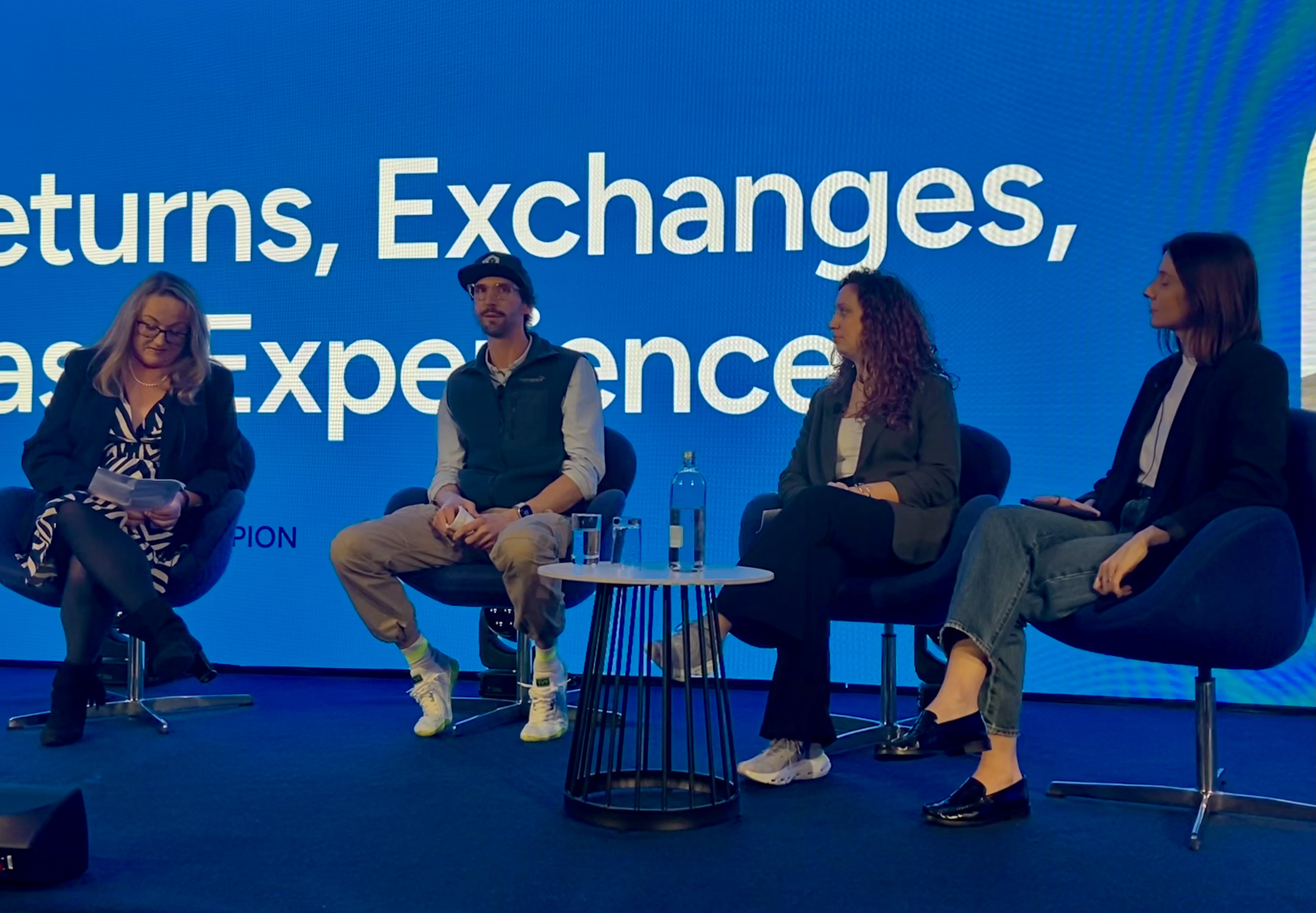
By February 2026, Buxhoidt was onstage in London with representatives of On and New Look, discussing returns. His argument had moved beyond getting the parcel to the door. A return should remain part of an ongoing relationship, with a chance to bring the shopper into another buying cycle.
“Brands still see returns too negatively,” he said. He discussed more individual approaches to the process and predicted that conversational AI would allow customers to navigate it according to their needs. Those were proposals and predictions, rather than a description of a finished future.
There is continuity with his earlier ambitions. In 2023, he had talked about using data to help shoppers choose the right product before a return became necessary, and about collecting older items for resale or donation. The ambition was to improve what happened around the sale, including the awkward business of reversing it.
A river wave, a refresh button
Away from the operational vocabulary, there is a more unexpected picture of Buxhoidt. A 2019 account of the founders placed him on a mountain bike or surfing at Munich’s Eisbach when he was away from customers. It is a pleasing footnote to a career concerned with keeping things moving.
He has kept returning to much the same customer problem through conferences, interviews and product discussions. His public LinkedIn profile now places him in Boston; parcelLab’s leadership page lists him as co-founder and chief executive. The geography has expanded considerably since the early Munich business.
And yet the practical test remains small enough to fit on a phone screen. Has someone explained the delay? Is the return progressing? When will the next update arrive? Buxhoidt’s business began by noticing how much happens after a sale. Its continuing challenge is to make that interval less of a guessing game for the person who paid.